
Battery classification guide · 2026 review
UN3480 vs UN3481 What shippers need to know
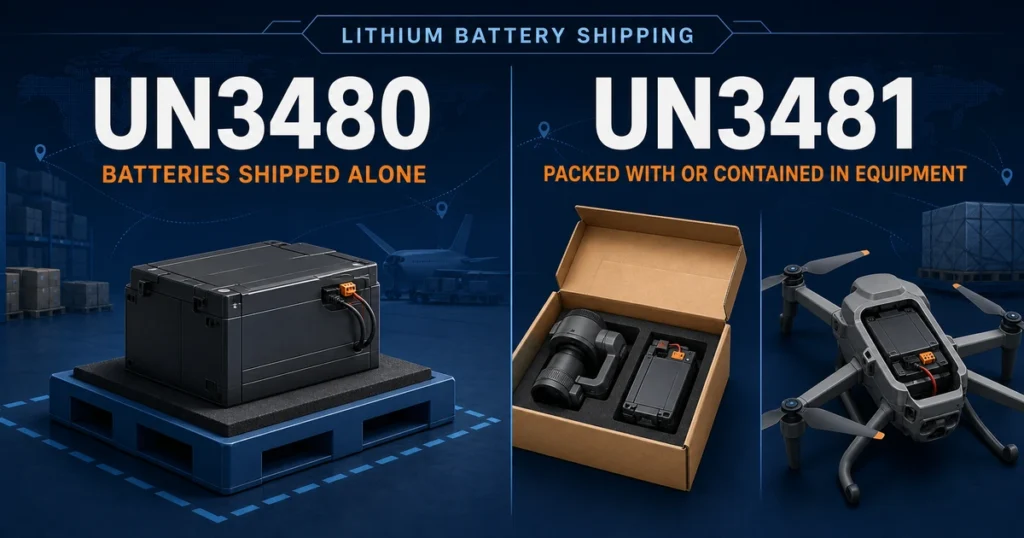
UN3480 applies to lithium-ion cells and batteries shipped on their own. UN3481 applies when lithium-ion cells or batteries are either packed in the same package as equipment or installed in that equipment. That difference determines the starting regulatory entry and, for air transport, whether Packing Instruction 965, 966 or 967 is likely to apply.
The UN number is only the beginning of a shipment review. Battery chemistry, Watt-hour rating, physical configuration, condition, state of charge, packing method, transport mode, origin, destination and carrier variations can all change what is permitted and what must be prepared. This guide helps business shippers identify the likely configuration and assemble the information needed for a shipment-specific review; it is not a legal classification for any individual shipment.
Find the likely starting point before requesting a route.
This visual is an orientation tool, not a legal classification. Confirm chemistry, configuration, condition, mode, packing and current carrier requirements.
Likely UN3480
No equipment accompanies the lithium-ion cells or batteries. For air, begin the review with PI 965.
Likely UN3481 · PI 966
The battery accompanies the equipment it powers but is not installed in that equipment.
Likely UN3481 · PI 967
The lithium-ion battery is contained in the equipment during transport.
UN3480 vs UN3481 at a Glance
| Shipment configuration | Likely UN entry | Air packing instruction | Simple example | Main question to verify |
|---|---|---|---|---|
| Lithium-ion cells or batteries shipped without equipment | UN3480 | PI 965 | Replacement battery cartons shipped as inventory | Are the batteries truly standalone, and are they eligible for the proposed air service? |
| Lithium-ion cells or batteries packed in the same outer package as the equipment they will power, but not installed | UN3481 | PI 966 | A device and its removable battery packed together, with the battery outside the device | Is the number and type of batteries consistent with operating the accompanying equipment? |
| Lithium-ion cells or batteries installed in equipment | UN3481 | PI 967 | A laptop, scanner or power tool shipped with its battery installed | Is the battery securely contained and protected against damage and accidental activation? |
These descriptions follow the configuration-based entries in the UN Model Regulations, 24th revised edition and the air-transport mapping in the IATA 2026 battery guidance. Both UN3480 and UN3481 are Class 9 dangerous-goods entries, but their packing, marking, documentation and carrier-acceptance pathways are not identical.
What Does UN3480 Mean?
UN3480 is the entry for lithium-ion cells and batteries, including lithium-ion polymer batteries, when they are transported without the equipment they are intended to power. In practical shipping language, these are standalone batteries.
Typical commercial examples may include:
- cartons of replacement lithium-ion battery packs;
- loose rechargeable cells supplied to an assembler;
- power-bank inventory, subject to the applicable classification and product details; and
- battery modules shipped separately from a machine or energy-storage system.
For air transport, UN3480 is associated with IATA Packing Instruction 965. Under the baseline air rules, UN3480 lithium-ion batteries are forbidden on passenger aircraft and move on cargo aircraft only when the applicable provisions and carrier acceptance are satisfied, as summarized in the IATA 2026 battery guidance. This does not mean that every UN3480 shipment is automatically accepted on a cargo aircraft. Watt-hour rating, quantity, package design, state of charge, test evidence, documentation, operator variations and route availability still require review under the current rules.
Do not classify a shipment as UN3480 merely because a commercial invoice calls the item a “battery.” The actual chemistry and configuration must be established. Lithium metal batteries use different UN entries, while vehicles, cargo transport units and certain hybrid or special products may fall under other provisions.
What Does UN3481 Mean?
UN3481 covers two related but distinct configurations: lithium-ion batteries packed with equipment and lithium-ion batteries contained in equipment. Both use the same UN number, but the air packing instruction and practical packing review differ.
UN3481 Packed with Equipment
“Packed with equipment” means that the battery and the equipment it is intended to power are in the same package, but the battery is not installed in the equipment. For air transport, this configuration is associated with Packing Instruction 966.
Imagine a handheld device and its removable battery placed in the same outer box, with the battery separately protected inside that box. The battery is accompanying the equipment, but it remains physically outside it. The packing review should confirm terminal protection, prevention of movement, protection against damage, and whether the battery quantity is appropriate for operating the accompanying equipment.
A box of spare batteries shipped beside a token piece of equipment should not automatically be treated as “packed with equipment.” The shipment facts and applicable quantity provisions need to support the configuration.
UN3481 Contained in Equipment
“Contained in equipment” means that the battery is installed in the equipment during transport. For air transport, this configuration is associated with Packing Instruction 967.
Common examples can include laptops, handheld terminals, rechargeable tools and other products shipped with their lithium-ion batteries installed. The equipment and battery still need protection from damage. The design and packing should prevent short circuits, unintended operation and movement that could compromise the battery during normal transport conditions.
Not every powered product belongs under UN3481. Electric vehicles, battery-powered cargo transport units and some other products have separate UN entries or special provisions. A product description such as “machine with battery” is not enough to make the decision.
A Five-Question Classification Workflow
Use the following sequence before requesting a freight plan.
1. What is the battery chemistry?
Confirm whether the product uses rechargeable lithium-ion or lithium-ion polymer cells. Do not transfer a UN3480 or UN3481 decision to lithium metal, sodium-ion, lead-acid or hybrid products without a separate review.
2. Where is the battery in relation to the equipment?
Ask one physical question: is the battery shipped alone, beside the equipment in the same package, or installed inside the equipment?
- Alone points toward UN3480.
- In the same package but not installed points toward UN3481 packed with equipment.
- Installed points toward UN3481 contained in equipment.
Photographs of the product and the proposed inner and outer packing are often more useful than an ambiguous product name.
3. What are the battery’s technical details?
Collect the manufacturer, model number, nominal voltage, ampere-hour capacity and Watt-hour rating. If Wh is not printed but voltage and Ah are known, the mathematical relationship is Wh = V × Ah; however, the shipper should use verified manufacturer data rather than an unsupported estimate for shipment documents.
Also identify the number of cells or batteries per item and per package. A mixed carton, multiple battery models or extra spares can change the applicable pathway.
4. Is the battery new, used, damaged, defective, a prototype or intended for recycling?
Condition matters. Damaged or defective batteries, batteries transported for disposal or recycling, and low-production or prototype designs may face different prohibitions, approvals or packing requirements. They should be disclosed at the start, not after booking.
5. Which mode, route and carrier are proposed?
Air, sea, road and rail rules are not interchangeable. National rules, transit points, State variations and carrier/operator policies may add restrictions. The current modal regulations and the selected carrier’s acceptance policy must be checked against the actual shipment.
Why the Difference Changes Air-Shipping Preparation
The ICAO Technical Instructions form the international regulatory basis for dangerous goods carried by air, while IATA’s rules and guidance support airline operations. Airlines may impose variations that are stricter than the baseline. Always review the edition in force on the date of shipment. For service-planning context, see shipping batteries by air.
UN3480 and Packing Instruction 965
PI 965 addresses standalone UN3480 lithium-ion cells and batteries. This category receives particularly restrictive air treatment. The baseline prohibition on passenger aircraft, the required state-of-charge control, and carrier-specific acceptance make early route verification essential.
A shipper should not assume that a previous booking proves the next shipment is acceptable. Battery model, Wh rating, package quantity, net battery weight, packing method, origin, destination, transit airport and airline can all affect the result.
UN3481 Packed with Equipment, PI 966 and the 2026 State-of-Charge Change
For shipments offered from 1 January 2026, the IATA 2026 battery guidance states that lithium-ion cells and batteries packed with equipment under PI 966 Section I must be at no more than 30% state of charge. Under PI 966 Section II, cells and batteries above 2.7 Wh are also subject to the 30% limit. Offering them above that level requires the approvals and conditions specified in the applicable instructions.
This change is operationally important for factories and exporters. The shipper may need a controlled charging process, a way to substantiate the state of charge, and time to resolve carrier questions before cargo arrives at the terminal. “Packed with equipment” should no longer be treated as a shortcut around standalone-battery planning.
The exact applicable section and every approval pathway must be confirmed from the current regulations and shipment facts. This article does not reproduce package limits because they depend on the precise configuration and rule set.
UN3481 Contained in Equipment and PI 967
PI 967 covers batteries installed in equipment. In its 2026 guidance, IATA strongly recommends offering such batteries at no more than 30% state of charge or no more than 25% indicated battery capacity. That recommendation should not be described as the same universal mandatory baseline that applies to the cited PI 966 cases. A State or operator variation can nevertheless impose stricter conditions.
For equipment with user-selectable charging limits, indicated battery capacity and state of charge are not necessarily the same measurement. Shippers should retain the terminology used by the applicable instruction and provide the carrier with clear, supportable information.
How Sea Shipping Treats the Same Distinction
The standalone-versus-equipment distinction remains relevant for ocean freight, but air packing instructions and aircraft restrictions do not govern sea transport. Sea shipments must be reviewed under the current International Maritime Dangerous Goods Code and applicable carrier, port and national requirements.
The IMO states that the IMDG Code 2024 Edition, incorporating Amendment 42-24, became mandatory on 1 January 2026. When the lithium battery mark is applicable, the same configuration logic identifies UN3480 for standalone lithium-ion cells or batteries and UN3481 for batteries packed with or contained in equipment. The rest of the sea-shipping preparation—including packaging, marks, labels, documentation, segregation and stowage—must be checked under the current IMDG Code framework.
Ocean freight may be commercially suitable for some larger or less time-sensitive shipments, but it is not automatically unrestricted. Vessel operator policies, container planning, port acceptance and the battery’s condition remain material. China-origin shippers can compare lithium battery air shipping from China with shipping lithium batteries by sea from China; smaller shipments may also need a separate lithium battery courier shipping review.
UN38.3, SDS and Shipment Documents Are Different Things
These records are often grouped together in a sales email, but they serve different purposes.
UN38.3 test summary
Subsection 38.3 of the UN Manual of Tests and Criteria concerns design-type tests for lithium cells and batteries. The test summary identifies the tested design and provides evidence related to that testing. It is not created by a freight forwarder, and it does not by itself determine whether the shipment is UN3480, UN3481 packed with equipment or UN3481 contained in equipment.
IATA’s guidance explains that a test summary does not normally have to accompany every air shipment unless a State or operator requires it, but manufacturers and subsequent distributors must make it available as required. In practice, providing it early can help the logistics parties verify that the battery model matches the supplied evidence.
SDS or MSDS
A safety data sheet describes product hazards and handling information. Carriers or logistics providers may request one as supporting information, and it can help confirm chemistry and product identity. It should not be presented as a universal substitute for UN38.3 evidence or as proof that the proposed packing and route comply with every transport rule.
Transport and commercial documents
Depending on the mode, configuration and applicable provisions, a shipment may require dangerous-goods transport documentation, marks, labels, declarations, packing evidence and ordinary commercial records. The exact set cannot be decided from the UN number alone. BAT Logistics reviews customer- or factory-supplied information and coordinates with eligible freight parties; it does not issue or obtain UN38.3 test summaries, SDS documents, test reports, packaging certificates, permits or licences.
Common UN3480 and UN3481 Mistakes
Mistake 1: Choosing the UN number from the product name
“Battery pack,” “power supply” or “electronic device” does not describe the transport configuration. Confirm chemistry and physically locate the battery.
Mistake 2: Treating both UN3481 configurations as identical
Packed with equipment and contained in equipment share a UN number but use different air packing instructions. They should be shown separately on the internal shipment worksheet.
Mistake 3: Adding equipment merely to avoid UN3480
The relationship between the battery quantity and the equipment matters. A contrived package can fail regulatory or carrier review.
Mistake 4: Assuming one document settles everything
A UN38.3 test summary, SDS, product specification or previous air waybill answers only part of the question. Model consistency, configuration, condition, packing, current regulations and carrier acceptance still need review.
Mistake 5: Applying air rules to sea freight—or vice versa
The UN entry may stay the same while modal requirements differ. Use the current rule set for the actual transport mode and every relevant leg.
Mistake 6: Hiding damaged, returned or prototype status
Returns, recalls, swelling, leakage, physical damage, suspected safety defects, prototypes and recycling movements require early disclosure. Some are prohibited from routine air transport or require a special pathway.
Mistake 7: Treating carrier acceptance as guaranteed
Even a well-prepared shipment can face operator variations, route limitations or a request for more evidence. Build review time into the schedule.
Information to Send Before Requesting a Freight Plan
For a faster and more useful assessment, prepare:
- product and battery manufacturer;
- exact battery model number;
- chemistry, nominal voltage, Ah and Wh rating;
- whether the battery is standalone, packed with equipment or installed;
- number of cells or batteries per item, package and shipment;
- state of charge for a proposed air shipment;
- whether the goods are new, used, returned, damaged, defective, prototypes, waste or for recycling;
- clear product and packing photographs;
- inner and outer packing description;
- package count, gross weight, net battery weight and dimensions;
- origin, destination and preferred mode;
- requested shipping date; and
- available customer- or factory-supplied UN38.3 test summary, SDS, specification sheet and other requested supporting records.
Do not alter a product description or hide spare batteries to fit a preferred category. Accurate shipment facts allow the freight parties to evaluate a workable route.
Frequently Asked Questions
What is the main difference between UN3480 and UN3481?
UN3480 covers lithium-ion cells and batteries shipped on their own. UN3481 covers lithium-ion cells and batteries packed with equipment or contained in equipment. For air shipments, those configurations generally lead to PI 965, PI 966 and PI 967 respectively.
Is a spare lithium-ion battery shipped with a device UN3481?
It may be UN3481 packed with equipment if the battery is in the same package as the equipment it is intended to power and the applicable provisions are met. Extra batteries, the relationship to the equipment and the proposed packing still require review.
Is a laptop with its battery installed UN3481?
A typical laptop with its lithium-ion battery installed is generally an example of UN3481 contained in equipment. The model, battery condition, quantity, packing and current modal/carrier rules must still be checked.
Does the 30% state-of-charge limit apply to every UN3481 shipment by air?
No. In the 2026 IATA guidance, the cited PI 966 packed-with-equipment cases are subject to a 30% state-of-charge limit, while PI 967 contained-in-equipment shipments carry a strong baseline recommendation of no more than 30% state of charge or 25% indicated battery capacity. State and operator variations may be stricter, so the actual shipment needs a current review.
Does a UN38.3 test summary have to travel with every shipment?
Not normally, according to IATA guidance, unless required by a State or operator. Manufacturers and subsequent distributors must nevertheless make it available as required, and logistics parties may request it during pre-booking review.
Can the same UN number be used for air and sea shipping?
The configuration may lead to the same UN3480 or UN3481 entry across modes, but the operational requirements are mode-specific. Air packing instructions cannot be used as a substitute for the current IMDG Code, and sea procedures cannot be assumed to satisfy air rules.
Are power banks UN3480 or UN3481?
Power banks are generally treated as batteries rather than as equipment containing a battery, so lithium-ion power banks commonly fall under UN3480. The specific design, chemistry, condition and current carrier rules must be verified before shipment.
Can BAT Logistics provide a UN38.3 test summary or certify the battery?
No. BAT Logistics can review customer- or factory-supplied information and coordinate suitable freight parties and routing for eligible shipments. It does not issue or obtain UN38.3 test summaries, SDS documents, test reports, certificates, permits or licences.
Request a Shipment-Specific Review
If you are shipping lithium-ion batteries or battery-powered products from China, BAT Logistics can review the information you provide and coordinate a suitable freight plan for eligible cargo.
Send the battery model, Wh rating, configuration, condition, packing photographs, quantity, package weights and dimensions, route, preferred mode, air-shipment state of charge, and available customer- or factory-supplied documents. This allows the team to identify missing information and discuss realistic air, sea or courier options with the relevant freight parties.
Request a shipment review or learn more about battery shipping from China.
Regulations, State variations and carrier policies change. This guide is general operational information and does not determine the legal classification, compliance or acceptance of a specific shipment. Final requirements must be verified against the current rules and the selected carrier before tender.
Start with the actual shipment
Request a shipment-specific review.
BAT Logistics can review customer- or factory-supplied information and coordinate eligible freight parties and routing. Final requirements and acceptance remain subject to the actual cargo, current rules and selected carrier.
- Battery model, chemistry, voltage, Ah and Wh
- Standalone, packed with or installed
- Condition, quantity and state of charge
- Packing photos, weights and dimensions
- Origin, destination, mode and ready date
- Available customer or factory documents