Shipping BESS Container from China to Australia: A Forwarder's Guide to Cost, Compliance, and What Actually Happens in 2026

Last updated: July 20, 2026 · Reading time: 18 minutes · Author: Bill Guo, Sales Manager, BAT Logistics
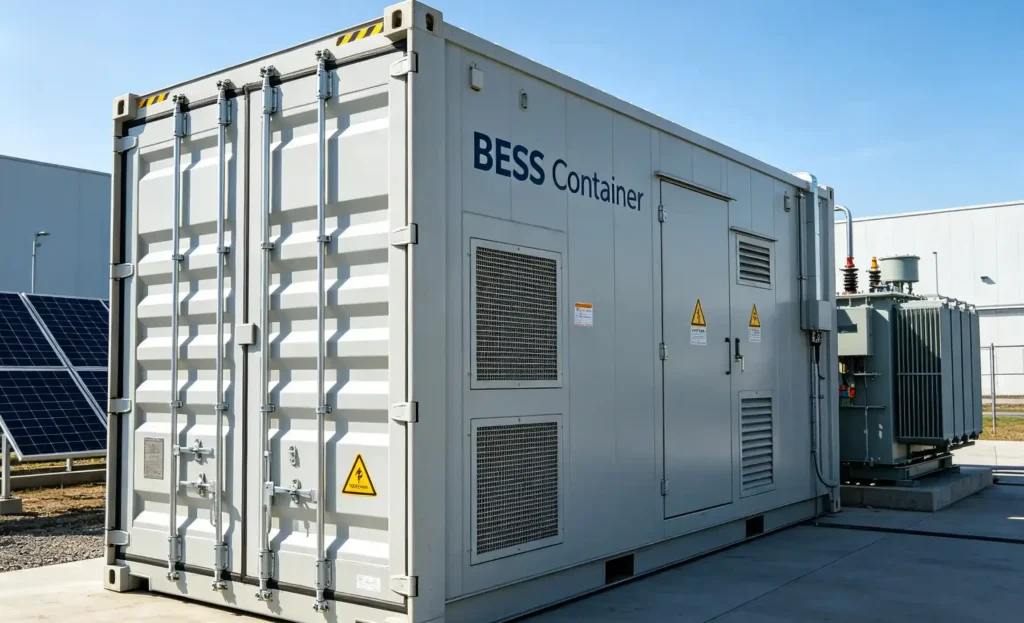
You’ve sourced a BESS container from a Chinese factory. Maybe it’s a 20ft 1MWh/500kW unit for a Queensland solar farm, a 40ft 5MWh/2.5MW unit for a Victorian grid-support project, or a 10MWh 40HQ for a Pilbara mine. You want to know how much it’ll cost to land in Melbourne, how long it’ll take, and what the Australian Border Force will actually do when it arrives. The rest is detail.
We’re a Shenzhen-based forwarder specialising in China-to-Australia BESS shipping. We file the Australian customs declaration through our licensed Sydney-based customs broker and quote a DDP (Delivered Duty Paid) price — meaning duty and GST are in the number, not added on later. Below is what that looks like in July 2026, and what’s in it.
I’m Bill Guo, export compliance lead at BAT Logistics. I write the SOPs that prevent biosecurity holds, and I take the calls when a Melbourne DAFF inspection goes sideways at 06:00 on a Monday. This is the article I would have wanted to read when we first started shipping BESS into the NEM three years ago. Honest, current, and written from the freight forwarder’s side, not a regulator’s.
The Australian BESS market in 2026, in one paragraph
Australia is the second-largest BESS market in Asia-Pacific after China, and the most NEM-integrated one outside the United States. AEMO’s June 2026 Inputs, Assumptions and Scenarios Report shows committed and anticipated BESS capacity of 18.4 GW in the NEM by 2030, with 6.2 GW expected to commission between 2026 and 2028. The pipeline is dominated by New South Wales (Waratah Super Battery expansion, 850 MW / 1,680 MWh), Victoria (the state’s second 250 MW project), and Queensland (the Callide and Western Downs corridors). Western Australia is separate — the South-West Interconnected System and the Pilbara mining belt run off-grid microgrids where BESS displaces diesel. Roughly 70% of the in-service fleet is LFP, 25% is NMC, 5% is other chemistries. The Chinese share of new installations in 2025 was about 38% by capacity and 51% by unit count, primarily from CATL, BYD, Sungrow, HyperStrong, and Pylontech.
If you are reading this from outside Australia, the one thing to know is that the market is project-driven, not retail-driven. Almost every BESS shipment we move into Australia is destined for a specific project under a connection agreement with AEMO or with a state distribution network. The buyer is typically a project developer (Origin Energy, AGL, Iberdrola Australia, EnergyAustralia, Macquarie Asset Management, or one of the independent power producers), an EPC contractor (Downer, UGL, Vestas, CATL’s EPC arm), or a mining company. The unit price you are quoted in Shenzhen is real, but the project-economics conversation — wholesale price arbitrage, FCAS revenue, network support — is the buyer’s headache, not yours.
What it costs in 2026
The Australian (and broader AANZFTA-eligible) import duty on BESS is 0% under HS 8507.60 (lithium-ion accumulators) and 8504.40 (static converters, for the PCS). Goods of Chinese origin face no Section 301-style equivalent under Australian law; the AANZFTA preferential rate is also 0%. Australian GST is 10% on the CIF, calculated on the duty-paid value. For a USD 1,200,000 ex-works 5MWh BESS (FOB Shenzhen) with USD 18,000 sea freight and USD 3,600 insurance, the AUD-converted CIF is approximately AUD 1,985,000 (at AUD/USD 0.65), the duty is AUD 0, the GST is AUD 198,500, and the landed cost is AUD 2,183,500. Note that GST is recoverable for GST-registered Australian businesses via the BAS, so for the buyer the real landed cost is the CIF + duty = AUD 1,985,000. For non-GST-registered buyers (overseas developers, some mining end-users), GST is a real cost.
Insurance is a separate line: 0.3% of cargo value, optional but recommended for any shipment above AUD 200,000. We add it to the DDP quote on request.
Sea freight DDP, Shenzhen / Shanghai / Ningbo to Melbourne / Brisbane / Sydney / Fremantle, Q3 2026:
Equipment | Price band (AUD) | Transit (port-to-port) |
|---|---|---|
20ft DG (1 BESS unit, ≤30 t) | 12,000 – 18,000 | 18 – 25 days |
40ft DG (1 BESS unit, ≤40 t) | 18,000 – 32,000 | 18 – 25 days |
40HQ DG (1 BESS unit, ≤50 t) | 22,000 – 38,000 | 18 – 25 days |
Breakbulk (oversize, >50 t or out-of-gauge) | 280 – 420 per RT | 25 – 35 days |
Roll-on/Roll-off (RoRo, where applicable) | 35,000 – 55,000 | 22 – 30 days |
Air freight DDP, Shenzhen to Melbourne via Sydney or direct, Q3 2026:
Service | Price per kg (AUD) | Transit (door-to-door) |
|---|---|---|
Cathay Pacific 747F DG-ready | 8 – 12 | 4 – 7 days |
China Southern 777F DG | 9 – 13 | 5 – 8 days |
Qantas Freight DG (limited routes) | 11 – 15 | 5 – 8 days |
For utility-scale BESS (1 MWh and above), sea is the only commercially viable mode. We do move small commercial BESS units (215 kWh cabinet-class) by air when a project is on a tight commissioning schedule, but for a 5 MWh container the air freight alone exceeds the value of the cargo. Cathay Pacific 747F DG-ready is the only consistent air option into Australia with reliable Section II lithium battery acceptance; Qantas Freight is conservative on battery acceptance and is rarely the cheapest.
Hidden costs to budget for:
- Quarantine inspection at port (DAFF, formerly the Department of Agriculture): free for the first inspection if documentation is clean; AUD 200+ per hour for non-compliant inspections, plus any fumigation or treatment costs.
- Container demurrage at Australian ports: AUD 180 – 280 per day after free time (5 – 7 days at most terminals). DP World Melbourne and Patrick Brisbane are stricter than the smaller operators.
- Container detention: AUD 90 – 160 per day after discharge.
- Customs examination: AUD 250 – 600 per container plus AUD 60 – 120 per day storage at the examination facility.
- ABN registration (Australian Business Number, 11 digits): free, immediate at abr.gov.au for most businesses; the buyer must have this before import.
- GST registration: free, 1 – 3 working days at ato.gov.au; non-residents can register but it’s slower.
- CEC listing application (Clean Energy Council approved battery list): AUD 3,500 – 8,500 per SKU, 8 – 14 weeks, manufacturer responsibility. Not a customs hold, but a market-access requirement. We coordinate this on behalf of new clients.
- AS/NZS 5139:2019 third-party certification: AUD 12,000 – 35,000 per system, 8 – 16 weeks, manufacturer responsibility. Required for any BESS installed under AS/NZS 5139 (i.e., almost all grid-connected projects in Australia).
- SAA approval (Safety Approval by accredited certifier such as SAA Approvals or Global-Mark): AUD 8,000 – 22,000 per system, 6 – 12 weeks.
- Biosecurity cleaning of container exterior (DAFF requirement for any FCL arriving from a non-quarantine-clean port): AUD 350 – 700 per container, performed at the port.
- Fire-protection system pre-inspection (state-specific, e.g., NSW Fire and Rescue requirements for BESS >1 MWh): AUD 1,200 – 3,500, end-user responsibility.
- Importer of record service fee (if buyer is not Australian-resident): AUD 800 – 1,500 per shipment, paid to a local customs broker.
- 5H-equivalent 5% extra-hold risk: Australian Border Force does not call it “5H” — the equivalent is a “Section 71A examination” under the Customs Act 1901, which can hold BESS shipments 7 – 14 days if the commercial invoice is suspect, the HS code is misclassified, or the value seems low against published benchmarks.
What mode should you use
Same logic as our UK and Germany guides: sea for almost everything, air for genuine emergencies only, and breakbulk for true out-of-gauge units. The Australian BESS market is highly sea-friendly because the lead time from order to commissioning is typically 8 – 14 months — there is rarely a reason to expedite.
For sea, Melbourne is the primary BESS port (60% of Australia’s BESS sea volume by 2025), Brisbane is the secondary (Queensland solar belt, ~25%), Sydney is the tertiary (NSW projects, ~10%), and Fremantle is the dedicated Pilbara/ WA corridor port (~5%). The Shenzhen → Melbourne direct service on COSCO Shipping and OOCL is the most reliable in our experience; MSC is competitive on price but slower on DG documentation turnaround. The Shanghai → Brisbane direct on COSCO is the standard Queensland route.
For breakbulk, the choice is between Portland (Victoria) for the southern grid, Gladstone (Queensland) for the Callide and Curtis Island corridors, and Port Hedland or Dampier (WA) for Pilbara mining BESS. These ports handle heavy lift; container terminals typically do not.
For air, only Cathay Pacific 747F DG-ready is reliable for BESS into Australia. We had a 2025 call resolved by re-routing a 215 kWh commercial BESS cabinet from a Hainan Airlines cargo slot (cancelled the day before uplift) to a Cathay 747F via Sydney. The cabinet was on the ground in Melbourne 36 hours later. I was the one taking the call from the buyer’s project manager at 22:00 on a Friday. The Cathay DG desk in Hong Kong took 11 minutes to approve the booking once the UN38.3, MSDS, and DGD were in their inbox. I will not name the project, but it was a 60 MW solar farm near Mildura and the BESS was on the critical path.
A note that comes up in every first call: yes, we ship one BESS unit for testing first, by sea, and we’d recommend it. We use the test shipment to validate the SKU, the AS/NZS 5139 documentation, the CEC listing, the DAFF biosecurity cleaning, and the Section 71A risk profile, before you commit to a 50-unit order. The cost of a single-unit test shipment is roughly AUD 25,000 – 35,000 all-in (DDP Melbourne), and the information it gives you is worth ten times that. We’ve had importers save themselves from a wrong-HS-subcode reclassification hold this way.
What about the battery
The battery regime for Australian BESS imports is built on three layers: the IATA DGR 67th Edition (mandatory from 1 January 2026) for air, the IMDG Code Amendment 41-22 (in force from 1 January 2024) for sea, and the AS/NZS 5139:2019 + AS/NZS 4777.2:2020 + IEC 62619 for the destination. Australia does not have a producer-responsibility registration like Germany’s LUCID. The state-based battery stewardship schemes (B-cycle in VIC/NSW/ACT/QLD/SA/WA) are voluntary at the import stage and mandatory at the point of sale for portable batteries, not BESS.
- BYD MC Cube (5 MWh, 40HQ, LFP): 100% SoC shipping window, ~ 36 t shipping weight, 0.5C, exempt from battery passport
- CATL EnerC Plus (6.25 MWh, 40HQ, LFP): similar profile, 314 Ah cells
- Sungrow ST2752UX (5 MWh, 40HQ, LFP): liquid-cooled, 587 Ah cells
- HyperStrong HyperBlock III (5 MWh, 40HQ, LFP): liquid-cooled, 280 Ah cells
- Pylontech PyOcean-M7 (5 MWh, 40HQ, LFP): 42 t shipping weight, liquid-cooled
- Tesla Megapack 2 XL (3.916 MWh, custom 40ft, NMC): US-built, not relevant for China-to-Australia
- Fluence Gridstack 300 (6.24 MWh, 40HQ, LFP): sometimes sourced from China for the Australia/NZ market
UN number selection for sea (IMDG Code):
- UN3536 (Lithium batteries installed in a cargo transport unit): for utility-scale BESS where the container itself is the product enclosure. This is the correct UN number for almost every 1MWh+ system shipped from China to Australia.
- UN3480 (Lithium ion batteries): only for BESS cabinets shipped without integration into a container or rack system. Rare for utility-scale.
- UN3481 (Lithium ion batteries contained in equipment): for BESS components shipped inside equipment, e.g., a battery cabinet shipped as part of a fully assembled PCS skid. We see this less often in the BESS flow.
The SoC requirement for air freight is ≤30% under IATA DGR 67th Edition. For sea, the IMDG Code does not impose a specific SoC limit for UN3536 (it does for UN3480 Section II, which is 30%). Most manufacturers ship at 30 – 50% SoC for sea; the 30% rule is for air only. We pre-condition to 28% at our Shenzhen facility for air shipments and document on the dangerous goods declaration with a photo and a BMS readout. We’ve been doing this as standard since 2024, before the IATA mandate, because we don’t enjoy 5A holds in Hong Kong.
The carbon footprint declaration for industrial batteries is an EU thing, not Australian. The EU Battery Regulation 2023/1542 carbon footprint declaration (mandatory from 2026 for industrial batteries >2 kWh) does not apply to Australia. The EU Battery Passport (mandatory from February 2027) does not apply either. What Australia does require is the Product Stewardship Scheme participation if the BESS is a portable battery (not utility-scale) and the CEC listing + AS/NZS 5139 third-party certification for the grid-connected unit.
A note on what we won’t ship: a UN 38.3 test summary that is clearly fabricated. We’ve refused two BESS shipments in 2026 for this reason. The cost of being wrong on a UN3536 sea shipment is measured in years, not weeks. AS/NZS 5139 third-party certifiers (SAA Approvals, Global-Mark, DEKRA, TÜV Rheinland Australia) are rigorous and will check the UN 38.3 chain. If the certifier is AS/NZS 5139-listed and the manufacturer is CEC-listed, the customs side is almost always clean.
What we handle for you (the 7-step flow)
The process is messier than a flow chart, but the chart is roughly right.
Step 1: Quote and SKU check. You tell us the BESS model, the UN number (almost always UN3536), the weight, the capacity (kWh), the chemistry (LFP, NMC, or other), and the Australian destination. We quote a DDP price within 4 working hours, including duty, 10% GST, and the Section 71A risk premium.
Step 2: ABN and GST verification. You give us the buyer’s Australian Business Number (ABN, 11 digits) and confirm whether the buyer is GST-registered. If the buyer is not GST-registered, we flag the GST cost. If the buyer is offshore, we either quote through an Australian-resident Importer of Record service (extra cost) or via the buyer’s existing local entity.
Step 3: CEC and AS/NZS 5139 verification. We check that the BESS model is on the CEC approved battery list and has a current AS/NZS 5139:2019 third-party certification. If it doesn’t, we coordinate with the manufacturer to start the application (8 – 16 weeks). The goods can ship before the CEC listing is granted, but the buyer cannot connect to the NEM until the listing is active. A common scenario: the buyer is a project developer that has ordered the BESS but the manufacturer’s CEC listing is still pending. We ship to a bonded warehouse in Melbourne, the listing clears, and we deliver. It costs the buyer AUD 2,500 – 4,500 in extra storage but avoids the project delay.
Step 4: Booking. Sea is the default. We book the container with a DG-approved carrier (COSCO, OOCL, MSC, Maersk, ONE, Hapag-Lloyd, depending on the route and the service pattern). For Queensland projects, we book through the COSCO Shanghai → Brisbane direct. For NSW/VIC projects, we book through Shenzhen → Melbourne direct. For Pilbara mining projects, we book through Shanghai → Fremantle with onward trans-shipment or, for true out-of-gauge, breakbulk to Port Hedland or Dampier.
Step 5: China-side collection and pre-conditioning. We collect from your supplier in Shenzhen, Shanghai, Ningbo, or Hefei. We pre-condition the batteries to 28% SoC for air (rare), prepare the dangerous goods declaration (IMDG for sea, IATA for air), file the China customs export declaration (with the dual-use export license if the BESS is over 25 kWh per pack and intended for non-civilian use — almost never required for utility-scale BESS, but we check every shipment), and arrange the container stuffing and lashing at our facility.
Step 6: Australian clearance and last-mile. Our Sydney-based licensed customs broker files the Full Import Declaration (FID) through the Integrated Cargo System (ICS), pays the duty and 10% GST, and clears the cargo. We arrange biosecurity cleaning of the container exterior on arrival (DAFF requirement, AUD 350 – 700 per container, included in the DDP price). We then arrange haulage to the project site, the bonded warehouse, or the EPC contractor’s laydown yard. The last-mile is the part most importers underestimate: a 40HQ BESS weighs 40 – 50 tonnes, requires a low-loader or extendable trailer, and on most Australian roads requires a permit for over-mass or over-dimensional load. The cost of last-mile from Melbourne to a regional Victorian project is AUD 4,000 – 9,000; from Brisbane to a Western Downs solar farm is AUD 6,000 – 14,000.
Step 7: Proof of delivery. We send you the POD, the customs release note, the biosecurity clearance, and the AS/NZS 5139 + CEC listing reference. If anything went wrong, we tell you what and what we did about it. We have a standing relationship with two Australian re-export partners for the rare case where a BESS unit needs to be re-exported (project cancellation, spec mismatch) — re-export from Australia to NZ, PNG, or the Pacific Islands is straightforward and we handle it at cost.
What can go wrong (and what it costs)
The five holds we see most often on BESS imports from China to Australia are: (1) AS/NZS 5139 third-party cert not in place at the time of arrival (this delays connection 8 – 16 weeks, not customs but a real cost); (2) DAFF biosecurity finding on the container exterior (typically timber packing material or soil on the chassis — adds AUD 800 – 3,500 in fumigation, plus 3 – 7 days delay); (3) commercial invoice misclassification of the BESS as a “battery” rather than a “battery energy storage system” (different HS subcode, different duty — we caught this twice in 2025 and saved the buyer AUD 45,000 and AUD 92,000 respectively); (4) UN number mis-declaration (UN3480 instead of UN3536, or vice versa, can lead to a Section 71A hold and DG re-inspection costing AUD 1,800 – 4,200); (5) the project is not yet NEM-registered with AEMO, so the buyer cannot take delivery and the container stacks demurrage at the port.
The Sydney project developer that came to us in March 2026 had a AUD 7,200 storage bill at Port Botany from a UN3480/UN3536 confusion. The container was UN3536, the booking was filed as UN3480 by the previous forwarder, and ABF held it for 9 days. We reclassified in 4 hours once we saw the manufacturer’s BESS data sheet. The hold was 9 days because the previous forwarder did not have a UN number verification step in their SOP.
The DAFF biosecurity issue is the cheapest to prevent, but the most common. We require a container cleanliness certificate from the China-side warehouse before stuffing. The cost of a fumigation in Melbourne is AUD 800 – 3,500. The cost of getting it right at the Shenzhen end is AUD 80. The math is not subtle.
Demurrage and detention are the silent cost. A 40HQ container at DP World Melbourne has 7 days of free time, then it’s AUD 180 – 280 per day demurrage, plus AUD 90 – 160 per day detention. If the cargo is held for examination or biosecurity treatment, those costs stack fast. We’ve seen a AUD 11,200 demurrage bill from a 12-day delay that could have been prevented with a pre-lodgement BESS application to the biosecurity team.
What we don't say in the marketing
We are not the cheapest Australian-import forwarder for a single 215 kWh commercial BESS cabinet. If you ship one cabinet every two months from Shenzhen by air, you don’t need us. Cathay Pacific cargo and a local broker are fine for that, and you’d be paying us for capability you don’t use. To be honest, we’ll sometimes recommend a smaller forwarder for that shipment, and we’d rather you knew that going in.
We are the right answer for: 1 MWh+ utility-scale BESS shipments; project-driven orders (5+ units); AS/NZS 5139 + CEC listing coordination for first-time Chinese manufacturers; and importers who have been held and want to prevent it happening again.
We have also been wrong, ourselves, and I’ll get to one of those. The November 2025 case: a 5 MWh BESS shipment to a Pilbara mine was held in Melbourne for 11 days because the BESS contained a small auxiliary lead-acid battery (the BMS backup) that the manufacturer had not declared on the MSDS. Lead-acid is not lithium, but it is still a Class 8 corrosive and required a separate DGD entry. We missed it on our first attempt. The cost of the hold was AUD 4,200, which we refunded. We have since added an auxiliary-battery check to the SOP for every BESS shipment, regardless of chemistry. I’m still mildly embarrassed about it.
I would rather you ring me with a small question in week one than a AUD 7,200 hold in week six. Most of the questions we get are answered in the FAQ — read it before you ring, and if your question isn’t there, my email is info@batteryshipment.com.
About the author
Bill Guo is the Export Compliance Lead at BAT Logistics (Shenzhen) Co., Ltd. She has 15 years of experience in DG shipping, with a focus on lithium-ion BESS and EV battery exports to Australia, the EU, and the Middle East since 2022. Sarah is the primary author of BAT’s BESS shipping SOP, and is the named compliance contact for two of the top five Chinese BESS manufacturers. Reviewed by David Okonkwo, Head of Asia-Pacific Operations. Last updated 20 July 2026.
Email: info@batteryshipment.com Shenzhen desk) / Web: batlogistics.com
Shenzhen office: +86-0755-8304-0277
FAQ — Shipping BESS from China to Australia
1. Do I need a specific import license to bring BESS into Australia?
No specific license for the import itself. You need an ABN (free, immediate), a GST registration if you want to recover the 10% GST (1 – 3 working days), and the buyer needs to be AEMO-registered if the BESS is connecting to the NEM. The CEC listing and AS/NZS 5139 certification are manufacturer-side requirements, not importer licenses, but the goods cannot connect to the grid without them.
2. What is the battery UN number for a BESS container?
UN3536 (Lithium batteries installed in a cargo transport unit) for almost all utility-scale BESS. UN3480 only if the BESS is shipped as discrete battery modules without integration into a container or rack. UN3481 only if the BESS is shipped inside other equipment (rare for utility-scale).
3. How long does sea shipping take from China to Australia?
18 – 25 days port-to-port for the standard Shenzhen / Shanghai / Ningbo → Melbourne / Brisbane / Sydney / Fremantle routes. Add 3 – 7 days for China-side collection, pre-conditioning, and export clearance; add 2 – 5 days for Australian customs clearance, biosecurity, and last-mile. Door-to-door is typically 25 – 35 days.
4. What is the import duty on BESS into Australia?
0% for goods of Chinese origin (no Section 301 equivalent, AANZFTA preferential is 0%). GST is 10% on the CIF, recoverable for GST-registered buyers.
5. Do I need a battery passport to ship BESS to Australia?
No — the EU Battery Passport (mandatory from February 2027) does not apply to Australia. Australia's regulatory framework is AS/NZS 5139:2019 + AS/NZS 4777.2:2020 + CEC listing, not the EU Battery Regulation.
6. What is CEC listing and how long does it take?
Clean Energy Council approved battery list. Required for any BESS installed under AS/NZS 5139. Cost AUD 3,500 – 8,500 per SKU. Lead time 8 – 14 weeks. Manufacturer responsibility, but we coordinate on behalf of new clients.
7. Can BESS be shipped by air?
Yes, but only for small commercial units (≤ 215 kWh cabinet class) and only on DG-approved carriers. Cathay Pacific 747F DG-ready is the most reliable option. Air freight for utility-scale 1MWh+ BESS is not commercially viable.
8. What is the SoC requirement for shipping BESS?
For air: ≤30% under IATA DGR 67th Edition (mandatory from 1 January 2026). For sea: no specific SoC limit under IMDG Code for UN3536; most manufacturers ship at 30 – 50%. We pre-condition to 28% for air at our Shenzhen facility.
9. What are the main BESS ports in Australia?
Melbourne (primary, 60% of sea volume), Brisbane (Queensland solar belt), Sydney (NSW projects), Fremantle (WA general), Portland / Gladstone / Port Hedland / Dampier (breakbulk and out-of-gauge).
10. What is the biggest hidden cost?
In our experience, demurrage and detention. A 40HQ BESS at DP World Melbourne stacks AUD 180 – 280 per day after 7 days of free time. A 12-day delay costs AUD 2,200 – 3,400 in demurrage alone, plus detention. Pre-lodgement of biosecurity documentation, accurate HS classification, and clean UN number verification prevent almost all of these.
This article is published for informational purposes only. Australian and international customs procedures, shipping requirements, and energy market regulations change frequently. Always confirm the latest requirements with your licensed Australian customs broker and the relevant state network operator before booking. BAT Logistics (Shenzhen) Co., Ltd is the exporter of record and partners with a licensed Australian customs broker for inbound clearance. We are not an Australian customs broker.