
Shipping from China to USA — Complete Guide 2026: Rates, Transit Times & Best Methods

Last updated: 26May 2026 · Reading time: 18 minutes · Author: Bill Guo, Sales Manager, BAT Logistics
Table of Contents
For more than a decade or two, billions of dollars’ worth of goods have been shipped from China to the United States every year—including consumer electronics, machinery and equipment, fast-moving consumer goods, industrial components, and new energy storage products, among others. While U.S.-China trade is among the most active in the world, the need for trans-Pacific shipping remains complex and challenging for importers.
From choosing the right freight forwarder China to USA to navigating US customs bonds, ISF filings, and import duties, the process is full of decision points that directly impact your cost and delivery speed. One wrong choice — wrong shipping method, incomplete documentation, an unreliable carrier — can mean delays, fines, or lost cargo.
This guide breaks down everything you need to know about shipping from China to USA in 2026: the best shipping methods, real cost benchmarks, required documents, customs requirements, and how to choose a freight partner you can trust.
Why Shipping from China to USA Demands a Freight Expert
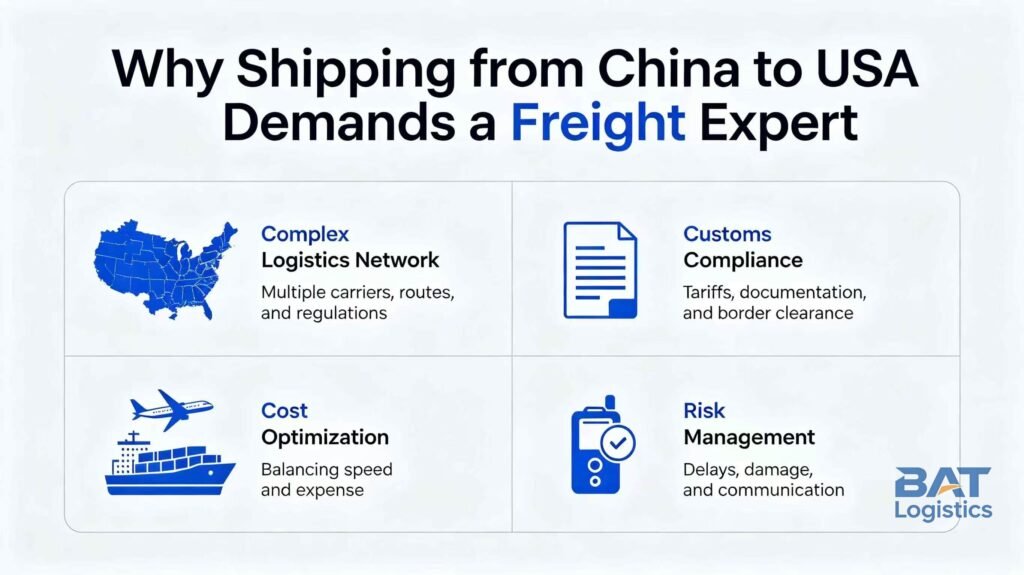
Shipping from China to USA is not a simple transaction. The first hurdle to overcome is the 6,000-plus-mile journey across the Pacific Ocean, followed by dealing with various regulatory agencies, different carriers, and customs brokers. Finally, the last-mile delivery involves multiple operators and numerous handovers in a multimodal transport process.
For businesses importing from China — whether you’re an Amazon FBA seller, an e-commerce brand, a manufacturer, or an individual — the stakes are real:
- Wrong shipping method = blown budgets on air freight you didn’t need, or 6-week delays on sea freight you couldn’t afford
- Missing documents = customs holds, storage fees, and frustrated customers
- Unreliable forwarder = no tracking visibility, cargo losses, and hidden charges
This is exactly why experienced importers treat choosing a shipping agent from China to USA as a strategic decision, not just a commodity purchase.
BAT Logistics brings 20 years of dangerous goods transport experience — and broad general freight expertise — to the China–USA trade lane. As a recognized industry leader in China’s logistics sector, we partner with major airlines and shipping lines to guarantee space, ensure documentation accuracy, and deliver cargo safely and on schedule.
Shipping Methods from China to USA — Which One Is Right for You?
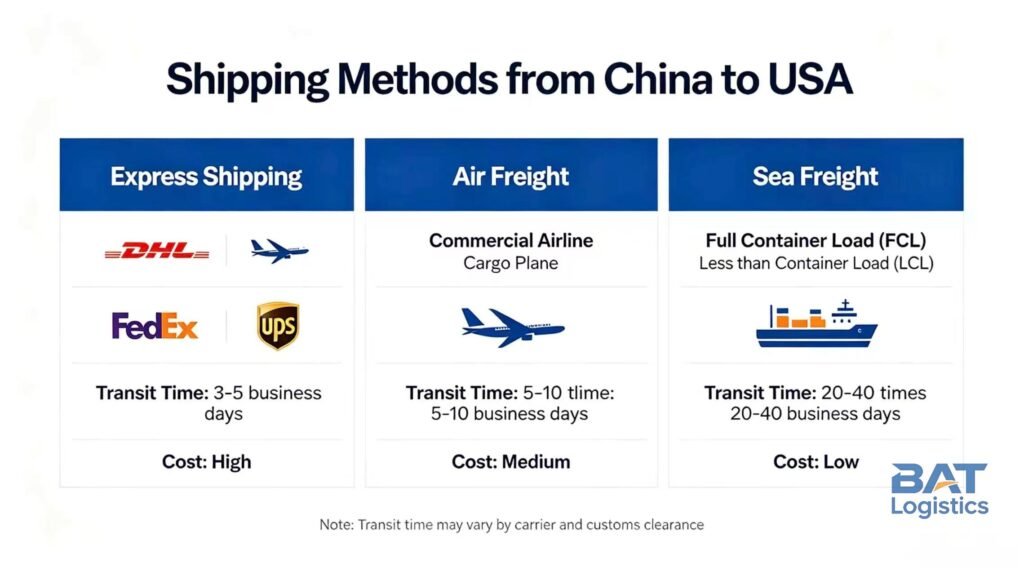
Sea Freight from China to USA
Sea freight is the main mode of transport for trade between China and the United States; currently, over 90% of goods shipped from China to the United States are transported by sea. For high-volume, low-value, and heavy cargo, sea freight is the most cost-effective option.
Two main options:
- FCL (Full Container Load) — You book an entire 20ft or 40ft container exclusively. Best for 20+ cubic meters of cargo. More control, faster loading/unloading, lower per-unit cost at scale.
- LCL (Less than Container Load) — Your cargo shares a container with other shippers. Charged by volume (per CBM). Ideal for smaller shipments of 1–20 CBM.
Key sea freight routes from China to USA:
Route | Transit Time |
|---|---|
Shanghai / Shenzhen → Los Angeles / Long Beach | 12–19 days (port to port) |
Shanghai → New York (via Panama Canal) | 23–33 days |
Guangzhou / Shenzhen → Seattle / Oakland | 18–25 days |
Qingdao → Houston (Gulf Coast) | 26–38 days |
Major China ports: Shanghai, Shenzhen, Ningbo, Guangzhou, Qingdao, Xiamen, Tianjin
Major US ports: Los Angeles, Long Beach, Oakland, Seattle, New York, Savannah, Houston
2026 FCL rate benchmark (Shanghai → LA/LB): $2,800–$4,300 per 20ft container; $4,100–$7,500 per 40ft container (rates vary by season and carrier)
Best for: Bulk goods, furniture, machinery, oversized cargo, Amazon FBA shipments, and non-urgent commercial imports.
Air Freight from China to USA
Air freight is 5–8x more expensive than sea freight, but 4–6x faster. It makes sense when speed matters more than cost.
Typical air freight rates (China to USA), 2026:
Route | Rate per kg | Transit Time |
|---|---|---|
Shanghai / Shenzhen → Los Angeles / New York | $5.00–$9.50 | 5–10 days airport to airport |
Express courier (DHL / FedEx / UPS) | $8.30–$12.80 | 4–12 days door-to-door |
Air freight involves more than speed. All shipments are subject to IATA regulations, and airline cargo space must be pre-booked — especially during peak seasons (October–December). This is where a freight forwarder’s airline partnerships become critical.
Best for: High-value goods, time-sensitive shipments, samples, urgent replacement parts, electronics with short product cycles.
Express Shipping from China to USA (DHL / FedEx / UPS)
Express courier services offer the fastest door-to-door solution for small parcels and urgent shipments.
- Transit time: 4–10 business days
- Maximum weight per shipment: Typically 0.5–70 kg per parcel
- Customs: Simplified clearance for low-value shipments, but de minimis thresholds have tightened in 2026
Important 2025 update: The US Section 321 de minimis exemption — which previously allowed duty-free entry for shipments under $800 — has faced regulatory changes affecting China-origin goods. Formal entry requirements now apply to more categories. Always verify current thresholds with your forwarder.
Best for: Small packages, samples, documents, urgent small-volume shipments.
Door-to-Door Shipping from China to USA
Door-to-door shipping covers the entire journey: pickup at the Chinese supplier, transport to port, ocean or air crossing, US customs clearance, and final delivery to your doorstep, warehouse, or Amazon FBA facility.
This is the most convenient option — one invoice, one contact — but requires a forwarder with end-to-end capabilities and a reliable US agent network.
BAT Logistics offers DDP (Delivered Duty Paid) door-to-door service for China–USA shipments, covering all documentation, duties, taxes, and last-mile delivery in a single package.
Shipping Cost from China to USA — 2026 Rate Guide
Understanding shipping cost from China to USA requires breaking down several cost components:
What Determines Your Freight Rate?
- Shipping mode — Sea freight is cheapest per unit; air and express scale upward significantly
- Cargo volume and weight — Sea freight priced per container or CBM; air freight priced per kg
- Origin and destination ports — West Coast routes are shorter and cheaper; East Coast adds Panama Canal fees
- Fuel surcharges and carrier GRI (General Rate Increase) — Applied quarterly by major shipping lines
- Seasonality — Peak season surcharges of $500–$2,000 per container are common in October–December
- Accessorial charges — THC, DDC, ISPS, AMS/ACI filing fees, customs brokerage
2026 Shipping Rate Summary
Shipping Method | Cost Range | Transit Time | Best For |
|---|---|---|---|
Sea Freight FCL (20ft) | $2,800–$4,800 / container | 15–35 days | Bulk, heavy, large-volume |
Sea Freight FCL (40ft) | $4,100–$7,100 / container | 15–35 days | Very large shipments |
Sea Freight LCL | $100–$250 / CBM | 25–45 days | 1–20 CBM shipments |
Air Freight | $5.10–$9.50 / kg | 5–10 days | Time-sensitive cargo |
$8.50–$12.00 / kg | 4–10 days | Small parcels, samples |
BAT Logistics provides transparent, all-inclusive pricing with no hidden charges. We quote the full cost upfront — including origin handling, freight, destination fees, customs clearance, and last-mile delivery — so you can budget with confidence.
Shipping Time from China to USA — How Long Does It Take?
“How long does shipping from China to USA take?” is one of the most common questions importers ask. The honest answer: it depends.
Transit times by method (2026 averages, door-to-door including customs):
Method | Transit Time |
|---|---|
Express Courier (DHL / FedEx / UPS) | 4–10 business days |
Air Freight | 5–10 business days |
Sea Freight FCL (West Coast) | 15–25 days |
Sea Freight FCL (East Coast) | 28–38 days |
Sea Freight LCL | 35–45 days |
Rail + Sea (China–Europe–US) | 35–50 days |
Key variables that affect transit time:
- Port congestion at origin or destination (Los Angeles/Long Beach can have 3–7 day queue times)
- Weather and typhoon season (July–October)
- Customs clearance speed (depends on documentation completeness)
- Peak season demand (October–December adds 5–10 days)
- Red Sea security disruptions (forcing some Asia–Europe routes to reroute via Cape of Good Hope, affecting some multimodal shipments)
BAT Logistics tracks all shipments in real time and proactively communicates any delays — so you’re never left guessing.
Documents Required for Shipping from China to USA
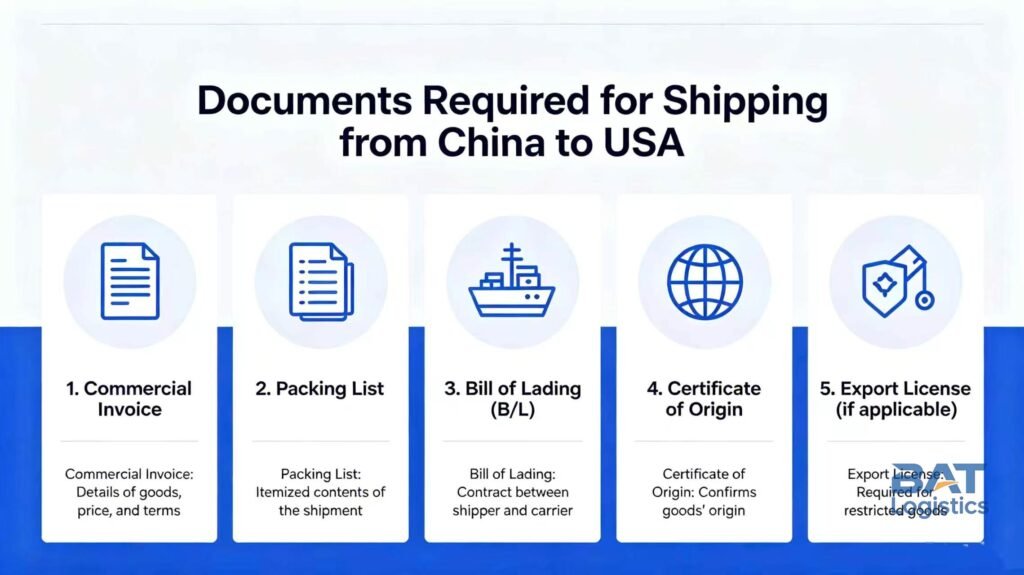
Proper documentation is the difference between a smooth clearance and a customs hold. Missing or incorrect paperwork is the #1 cause of US import delays.
Essential Documents Checklist
Document | Purpose |
|---|---|
Commercial Invoice | Customs valuation, duty calculation, HS code classification |
Packing List | Contents, weight, dimensions, packaging marks per carton |
Bill of Lading (B/L) / Air Waybill (AWB) | Contract of carriage; proof of shipment |
ISF (Importer Security Filing) | Required for all sea freight shipments to US — must be filed 24 hours before vessel departure |
Certificate of Origin | Required for FTA duty benefits; China–US tariffs make this less relevant now, but still used for MFN treatment |
Customs Bond / Importer of Record (IOR) | Mandatory for all commercial US imports over $800 |
Product-specific certifications | FDA (food/drugs), FCC (electronics), DOT (vehicles), etc. |
US Customs Requirements for China Imports
The United States has specific requirements for imports from China:
- Section 301 Tariffs — Large categories of Chinese goods face 7.5%–25% additional tariffs on top of regular import duties
- TSCA (Toxic Substances Control Act) — Required for chemicals and certain materials
- FDA Prior Notice — Required for food, cosmetics, and medical device imports
- ACE (Automated Commercial Environment) — All entries filed electronically through US Customs
- De minimis updates (2026) — Formal entry required for more categories; consult your forwarder for current thresholds
BAT Logistics has extensive experience with US customs requirements. Our US broker network pre-files all documentation to minimize clearance delays and ensure tariff classifications are accurate.
How to Ship from China to USA — Step by Step
Step 1 — Classify Your Cargo (HS Code)
Every product imported to the US requires a 10-digit HTS code (Harmonized Tariff Schedule). This determines your duty rate and which regulations apply. Incorrect HS codes can result in overpayment, delays, or penalties.
Step 2 — Choose Your Shipping Method
Match your cargo profile to the right method:
- Heavy/bulk/volume → Sea freight FCL
- Moderate volume, flexible timeline → Sea freight LCL
- Time-sensitive, high-value → Air freight
- Small parcels, samples → Express courier
Step 3 — Select a Freight Forwarder
This is the most consequential decision. A good freight forwarder China to USA handles:
- ✅ Booking space with carriers (critical during peak season)
- ✅ Export customs clearance in China
- ✅ Cargo consolidation and packaging
- ✅ Documentation preparation (B/L, commercial invoice, packing list)
- ✅ Freight tracking throughout transit
- ✅ US customs brokerage and clearance
- ✅ Last-mile delivery coordination
BAT Logistics offers all of the above — plus 20 years of dangerous goods expertise for battery, chemical, and DG-classified cargo. Our partnerships with major airlines and shipping lines mean guaranteed space, even during peak demand.
Step 4 — Prepare and Submit ISF
For all sea freight shipments to the USA, the ISF (Importer Security Filing) must be submitted electronically at least 24 hours before the vessel departs China. This is a US CBP requirement — late or incorrect ISF filings result in fines of $5,000 per violation.
Information required for ISF:
- Manufacturer/supplier name and address
- Seller/buyer name and address
- Importer of Record number
- Consignee number
- Country of origin
- HTS code (6-digit minimum)
Step 5 — Track and Receive
Once your shipment is in transit:
- Monitor tracking through your forwarder’s system
- Prepare for customs examination if selected (random or targeted)
- Arrange final-mile delivery upon customs release
- Retain all import records for a minimum of 5 years (US CBP requirement)
Shipping from China to Amazon FBA USA — Key Considerations
Amazon FBA sellers face unique logistics requirements when shipping from China to Amazon FBA warehouses:
- FNSKU labels must be pre-printed and applied before or upon arrival
- Box dimensions and weight must comply with Amazon’s packaging standards
- Hazmat items (lithium batteries, liquids, aerosols) require Amazon-approved hazmat designation
- Appointment scheduling — most FBA warehouses require scheduled delivery appointments
BAT Logistics has extensive experience with Amazon FBA shipping from China. We handle label preparation, hazmat classification, carrier booking, and coordinate Amazon appointment scheduling to ensure your cargo is received without rejection or re-labelling fees.
BAT Logistics — Your Trusted Shipping Partner China to USA
Who We Are
BAT Logistics is a China-based freight forwarding company with 20 years of specialized dangerous goods transport experience and broad general freight capabilities across all major trade lanes. Recognized as a market leader in China’s logistics industry, we serve importers across the e-mobility, electronics, consumer goods, and industrial sectors.
Our Core Credentials:
- ✅ 20 years of dangerous goods transport — Deep expertise in lithium battery, chemical, and DG-classified cargo handling
- ✅ Strategic airline and shipping line partnerships — Guaranteed cargo space even during peak seasons
- ✅ End-to-end service capability — From factory pickup in China to final-mile delivery in the USA
- ✅ Licensed and bonded — Licensed Chinese freight forwarder, US customs bonded broker
- ✅ Zero incident record on DG shipments — 20 years, thousands of dangerous goods shipments, no safety incidents
Why Importers Choose BAT Logistics:
Our Strength | Your Benefit |
|---|---|
20 years DG expertise | Correct handling of complex, regulated cargo |
Airline & shipping line partnerships | Space guaranteed — no last-minute cancellations |
US customs broker network | Faster clearance, fewer holds |
Transparent pricing | No hidden fees; know your total cost upfront |
Real-time tracking | Full visibility from factory to door |
Shipping from China to USA — Case Study
Client: A consumer electronics importer based in Los Angeles, sourcing smart home devices from suppliers in Shenzhen and Guangzhou. Monthly import volume: 4 × 40ft containers of mixed electronics.
Challenges:
- Tariff complexity — Multiple product categories subject to Section 301 tariffs; incorrect HTS classification risked $50,000+ in overpayment annually
- Peak season space shortage — October bookings routinely delayed by 2–3 weeks due to carrier space crunch
- US customs holds — Two consecutive shipments held for document review; caused 10-day delivery delays and storage fees
- Amazon FBA requirements — Growing portion of inventory going to Amazon warehouses; label compliance critical
The BAT Logistics Solution:
- HTS code audit and reclassification — BAT’s tariff specialists reviewed all SKUs and corrected misclassified items, recovering an estimated $48,000 in annual duty overpayment
- Forward booking strategy — BAT secured annual space allocations with two major carriers, eliminating peak-season delays entirely
- Pre-filed ISF and customs brokerage — BAT’s US broker partner pre-filed all entries before vessel departure, reducing customs hold rate from 2-in-6 to 0-in-18 months
- Amazon FBA label management — BAT handled all FNSKU label printing, carton marking, and appointment coordination for FBA-bound containers
Results:
Metric | Before BAT | After BAT |
|---|---|---|
Average transit time (door-to-door) | 38 days | 33 days |
Customs hold rate | 33% | 0% |
Annual duty savings (HTS correction) | — | $48,000 |
Peak season delays | 2–3 weeks | None |
FBA rejection rate | 12% | 0% |
“We’d been struggling with inconsistent transit times and customs issues for over a year before partnering with BAT Logistics. Their tariff expertise alone paid for their fees in the first quarter. Now we plan shipments with confidence.” — Import Manager, LA Consumer Electronics Importer
Frequently Asked Questions — Shipping from China to USA
1. What is the cheapest way to ship from China to USA?
Sea freight — specifically, FCL (Full Container Load) — is the most cost-effective method for large shipments. LCL is the best option for smaller volumes under 10 CBM. If your shipment is under 250 kg and time-sensitive, air freight or express courier becomes the more practical choice despite higher per-unit cost.
2. How much does shipping from China to USA cost in 2026?
Sea freight FCL ranges from $2,100–$7,100 per container depending on size and season. LCL runs $150–$250 per CBM. Air freight is $5.1–$8.50 per kg. Express courier runs $8.5–$12 per kg. Get a transparent all-in quote from BAT Logistics before booking.
3. How long does shipping from China to USA take?
Sea freight to the US West Coast takes 15–25 days port-to-port (25–40 days door-to-door). East Coast routes add 10–15 days due to the Panama Canal. Air freight is 5–10 days door-to-door. Express courier is 4–10 business days.
4. Can I ship from China to USA by DHL, FedEx, or UPS?
Yes. Express courier services (DHL, FedEx, UPS) handle small parcels and urgent shipments from China to USA in 2–5 days. However, these services are expensive for large or heavy shipments and may not accept goods classified as dangerous goods without special arrangements.
5. What documents do I need to ship goods from China to the USA?
Essential documents include: Commercial Invoice, Packing List, Bill of Lading (B/L) or Air Waybill (AWB), ISF filing (for sea freight), Certificate of Origin, Customs Bond, and product-specific certifications (FDA, FCC, DOT as applicable). BAT Logistics prepares all documentation as part of our standard forwarding service.
6. Is DDP (Delivered Duty Paid) shipping from China to USA legal?
Yes. DDP shipping is a legitimate Incoterms 2020 option where the seller (or their forwarder) bears all costs including duties and taxes up to the named destination. However, a compliant US Importer of Record (IOR) with a valid customs bond must be designated for the entry. BAT Logistics offers DDP service with our licensed IOR arrangement.
7. What is ISF filing and when must it be submitted?
The Importer Security Filing (ISF) is a US Customs and Border Protection requirement for all ocean freight shipments entering the USA. ISF must be filed electronically at least 24 hours before the vessel departs China. Late or inaccurate ISF filings result in penalties of up to $5,000 per violation.
8. How do tariffs and Section 301 duties affect shipping from China to USA?
The US-China trade war imposed Section 301 tariffs of 7.5%–25% on a wide range of Chinese goods. This significantly affects landed cost calculations. BAT Logistics helps importers understand applicable tariff rates during the quoting stage, so there are no surprises after shipment.
9. What is a customs bond and do I need one to import from China?
A US customs bond is a surety guarantee (typically 10% of annual import value, minimum $50,000) required by CBP for all commercial imports over $800. It ensures import duties and taxes will be paid. BAT Logistics can arrange a customs bond through our US broker network.
10. Can BAT Logistics handle dangerous goods shipping from China to USA?
Absolutely. 20 years of dangerous goods transport experience is our core specialization. BAT Logistics handles DG cargo across all transport modes — sea, air, and express — with full IATA DGR and IMDG Code compliance, DG-certified packaging, and documentation prepared to destination-country standards.
Ready to Ship? Get a Quote from BAT Logistics
Shipping from China to USA is complex, but it doesn’t have to be a headache. With the right freight partner, you get competitive rates, reliable transit times, accurate documentation, and stress-free customs clearance.
BAT Logistics combines 20 years of dangerous goods transport leadership with broad general freight expertise on the China–USA trade lane. Our airline and shipping line partnerships guarantee you space. Our transparent pricing means no hidden charges. Our US customs broker network keeps your cargo moving.
Contact BAT Logistics today for a free shipping consultation and all-inclusive quote.
This article was written by the BAT Logistics editorial team, combining hands-on logistics experience with comprehensive knowledge of international dangerous goods transport regulations. Last updated 26 May 2026.