
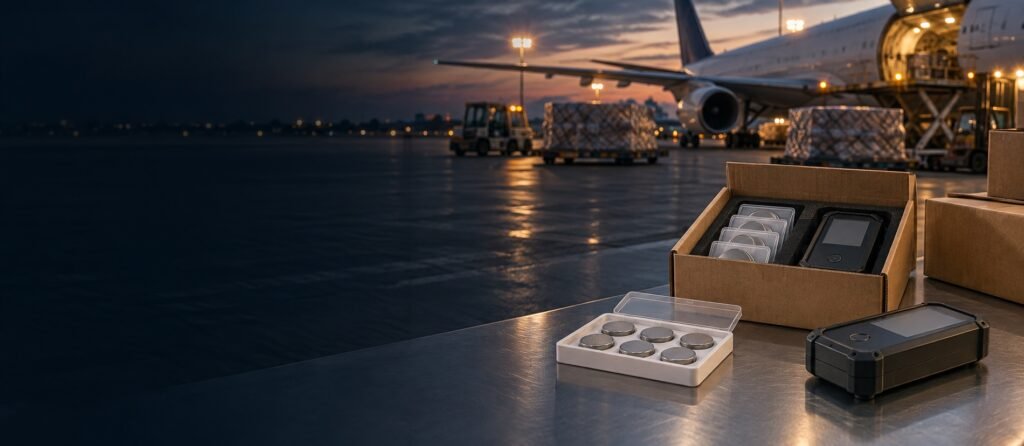
Lithium-metal air-shipping decision guide
Lithium Metal Battery Packing Instructions 968, 969 and 970 Explained
Start with the battery’s physical relationship to the equipment it powers. Then verify the section, package, aircraft pathway and operator requirements for the actual shipment.
For lithium-metal cells or batteries offered for air transport, the first packing-instruction question is where the batteries are in relation to the equipment they are intended to power:
- PI 968 is the starting instruction for UN 3090 lithium-metal cells or batteries shipped by themselves.
- PI 969 is the starting instruction for UN 3091 lithium-metal cells or batteries packed with equipment, but not installed in it.
- PI 970 is the starting instruction for UN 3091 lithium-metal cells or batteries contained in equipment—installed in the device they power.
This three-way map comes from the IATA 2026 lithium-battery guidance flowchart. It identifies an initial instruction family, not a final declaration or a promise that a carrier will accept the cargo. The shipper still has to establish the exact battery identity and condition, UN 38.3 status, lithium content, applicable section, package design and quantity, marks and documents, aircraft pathway, and any State or operator variations.
This article was reviewed against public material on 21 September 2026. The ICAO 2025–2026 Technical Instructions remain the applicable edition through 31 December 2026, but addenda and route-specific requirements must also be checked. IATA expressly says its public battery document is guidance, not a source of regulatory compliance. A trained dangerous-goods specialist should verify the complete instruction and the accepting operator's conditions for the actual shipment.
First Verify That the Battery Is Lithium Metal
Do not choose PI 968, 969 or 970 from a product name alone. “Battery pack,” “sensor,” “tracking device” and “replacement battery” describe products or commercial uses, not necessarily their transport chemistry. Obtain the manufacturer and model identification and confirm whether the cell or battery is lithium metal, including lithium alloy, rather than lithium ion or sodium ion. The IATA guidance definitions separate these chemistries and their UN entries.
The chemistry changes the instruction family. Lithium-ion cells and batteries generally follow PI 965, 966 or 967, depending on configuration. This page concerns lithium-metal cells and batteries. It should not be used to relabel a rechargeable lithium-ion power bank as a lithium-metal article merely because the sales description says “lithium battery.”
Identify the exact cell or battery model and ask whether the applicable UN 38.3 testing has been completed. The IATA 2026 guidance explains the test-summary availability requirement and the exception for button cells installed in equipment. A seller's generic certificate for a different model is not an adequate substitute for matching the proposed goods to the relevant test-summary identity. Also establish whether the goods are ordinary, undamaged commercial batteries. Damaged, defective, recalled, waste, prototype or other non-routine goods need a separate review before anyone assumes the routine PI pathways below apply.
Once chemistry, model and condition are known, look at the completed transport package, not just the product photograph. Ask whether each battery is alone, beside the equipment it powers, or installed in that equipment. A kit with different battery positions can require more careful package-level analysis than its invoice title suggests.
PI 968 vs PI 969 vs PI 970 at a Glance
The following is an orientation table, not a package-preparation or carrier-acceptance matrix. It summarizes the IATA 2026 lithium-metal flowchart.
| Starting PI | UN entry | Physical relationship at shipment | Illustrative example | Section family | Immediate next question |
|---|---|---|---|---|---|
| PI 968 | UN 3090 | Cells or batteries shipped without the equipment they power | Replacement lithium-metal cells sent as a battery-only package | IA or IB | What are the lithium content, aircraft pathway, package capability and permitted quantity? |
| PI 969 | UN 3091 | Cells or batteries packed in the same transport package as compatible equipment, but not installed | Spare lithium-metal cell packed with the meter it powers | I or II | Does the equipment relationship and battery count meet the current instruction? |
| PI 970 | UN 3091 | Cells or batteries installed in the equipment they power | Meter shipped with its lithium-metal cell fitted | I or II | Is the equipment protected against damage and unintended activation, and what section applies? |
The same UN number does not mean the same packing instruction: both PI 969 and PI 970 use UN 3091, but “packed with” and “contained in” are different physical situations. Conversely, a change from UN 3090 to UN 3091 cannot be achieved by putting an unrelated cable or charger in a battery carton. For the upstream UN-number distinction, see UN 3090 vs UN 3091.
PI 968: Lithium-Metal Batteries Shipped Alone
PI 968 begins with lithium-metal cells or batteries offered without the equipment they are intended to power. A box of replacement cells for future installation is a straightforward example. A device elsewhere in the same commercial order does not, by itself, turn a battery-only transport package into “packed with equipment.” The package configuration presented to the operator matters.
The 2026 public flowchart shows Section IA and Section IB under PI 968. It uses lithium content—rather than the Watt-hour measure commonly used for lithium-ion batteries—as an important branch input. The chart shows 1 g per cell and 2 g per battery as the boundary values in its initial section map. Those values are not a stand-alone Section IB permission. Quantity, packaging and all other current Section IB conditions must also be met. If a condition is not met, a trained reviewer must determine whether another lawful pathway is available or the goods cannot travel by air; a small cell is not automatically excepted.
PI 968 needs particular attention to the aircraft path. The IATA 2026 definitions and flowchart show UN 3090 lithium-metal batteries shipped alone as forbidden as cargo on passenger aircraft under the ordinary route. IATA also describes narrowly defined approval or exemption provisions. Those are not a general booking option and cannot be assumed available because a shipment is urgent or small. The proposed airline, station and route need a specific acceptance review. The dedicated Cargo Aircraft Only guide explains why “CAO” is a pathway designation, not a carrier commitment.
The correct package must protect the cells or batteries against damage and short circuit. The required packaging performance, net battery quantity, marks, labels and declaration depend on the final section and complete current instruction. The public flowchart notes package-capability requirements for Section IB, but it is not a substitute for confirming the finished package and its evidence. See the air-shipping quantity guide and the dedicated 1.2 m drop and 3 m stack explanations for those separate questions.
PI 969: Lithium-Metal Batteries Packed With Equipment
PI 969 applies when the lithium-metal cells or batteries are in the same completed transport package as the equipment they are designed to power, but are not installed in it. A compatible replacement cell packed beside a measuring instrument can raise a PI 969 question. A carton of batteries accompanied only by an AC adaptor, charger, cable or unrelated device does not establish the necessary equipment relationship.
The distinction is functional as well as physical. Ask which battery powers which included device, how many cells or batteries the device needs to operate, and how many spares are proposed. The IATA 2026 packing FAQ discusses the limit tied to the minimum number needed to power the equipment plus spare sets for PI 969. The actual count, lithium content, section and aircraft quantity limit have to be checked together. A “kit” label does not authorize an unlimited stock of spares.
The public flowchart shows Section I and Section II under PI 969. It places higher-lithium-content cells and batteries in the Section I branch and lower-content ones in the Section II branch, provided the other conditions are met. If the seller cannot identify the lithium content of the exact model, do not infer it from cell size, nominal voltage, retail price or the number of devices in the box. Obtain the manufacturer data and review the lithium-content calculation guide.
Packaging must protect the battery from short circuit and movement, while protecting the equipment and the completed package from damage. The 2026 IATA FAQ discusses more than one permitted packaging arrangement for Section I PI 969, so a simple rule such as “the outer carton must always carry the UN specification code” would be misleading. The correct arrangement must be checked against the full instruction for the proposed package. For Section II PI 969, the public IATA guidance identifies completed-package drop capability, and its 3 m stack-test interpretation identifies a further stack-capability provision for the relevant non-UN-specification packaging. Those are package-design questions, not conclusions that can be reached from a carton photograph.
PI 970: Lithium-Metal Batteries Contained in Equipment
PI 970 begins when the lithium-metal cell or battery is installed in the equipment it powers. A sensor shipped with its cell fitted in the intended battery compartment is an ordinary example. The equipment must still be identified: simply taping a loose cell to the outside of a device is not the same as installing it in an appropriate operating position.
The IATA 2026 flowchart shows Section I and Section II under PI 970, again with lithium content relevant to the downstream branch. Installed configuration does not erase the need to confirm the battery model, test status, condition, quantity, packaging and operator conditions. It also does not mean that every mark or document is automatically waived. Some narrow exceptions may apply to particular Section II packages—for example, certain button cells installed in equipment or limited small consignments—but the facts and current instruction must match the exception before it is used. See the IATA marking FAQ.
The equipment and packaging must be prepared to prevent battery damage and unintended activation. A switch, trigger or exposed control can create a genuine transport risk even though the battery is installed. The IATA guidance on inadvertent activation describes ways that packaging or an independent device control can address it. It also recognizes intentionally active devices under defined conditions; do not assume every active tracker is prohibited or that every active sensor is exempt. The IATA 3 m stack-test interpretation lists PI 970 Sections I and II among the affected non-UN-specification packaging provisions. A qualified packager must check which requirement applies to the actual finished package.
Section Selection Comes After the PI Family
A useful decision sequence is chemistry → physical configuration → likely packing instruction → lithium content and remaining section conditions. It prevents two common errors: using lithium-ion Watt-hours to classify a lithium-metal cell, and deciding “Section II” before verifying whether the battery is shipped alone, packed with equipment or contained in equipment.
In the 2026 IATA flowchart, PI 968 has Section IA and IB branches; PI 969 and PI 970 have Section I and II branches. The chart's lithium-content figures are starting points for the review, not the complete section tests. A cell or battery within the lower-content boundary can still fail another Section IB or II condition. Never describe a package as “excepted,” “fully regulated” or “approved” on lithium content alone.
For the data required to determine cell and aggregate battery lithium content, use the lithium-metal content guide. For the differences between Sections IA, IB, I and II, use the section guide. The final section should be recorded against the exact battery model and package, not copied from an older shipment of a superficially similar product.
Packaging, Quantity and Aircraft Pathway Are Separate Decisions
Knowing the PI family should trigger a second review rather than end the process. The following questions are useful before a booking request:
- What exactly is the completed package? Record the outer packaging, inner protection, equipment placement, battery position and any overpack. A supplier's retail box and the transport package may not be the same thing.
- How are electrical and mechanical risks controlled? Confirm protection against short circuit, movement, damage and unintended equipment operation. The specific method depends on the instruction and package design.
- What package capability must be demonstrated? Check whether the applicable branch calls for UN specification packaging or another permitted design with completed-package drop or stack capability. Do not treat “tested box” as a sufficient description without knowing the test scope and assembled configuration.
- How much lithium-metal battery material is in each package? Distinguish grams of lithium content per cell or battery from the net weight of batteries in the package. They are different measurements used for different decisions. The IATA 2026 FAQ addresses net battery weight for relevant declarations.
- Which aircraft and operator are proposed? The passenger-aircraft and Cargo Aircraft Only columns differ, and the initial PI does not prove that an operator will accept the shipment. Check the actual route, including origin, transit and destination constraints.
The answers are linked. For example, increasing the number of spare batteries may change both a quantity assessment and the package design. Moving a cell from an installed position to a separate inner package may change the starting instruction. A revised packing photo or bill of materials should therefore trigger a fresh PI and documentation review, not just a new carton label.
Keep Marks, Labels, Declarations and Booking Data Consistent
The UN entry, proper shipping name, packing instruction, section, package quantity and aircraft pathway used in the shipping records should all describe the same completed package. A draft air waybill saying UN 3091 cannot repair a package actually prepared as battery-only UN 3090 cargo. Similarly, a correct battery mark cannot compensate for a wrong section, missing hazard label, unsuitable packaging or a route that the carrier has not accepted.
Requirements vary by branch. Some Section II arrangements have different declaration treatment from Section I; certain PI 970 Section II packages may meet a battery-mark exception, while other packages do not. Do not reuse a mark or a statement from a previous shipment without checking the current package and consignment facts. The 2026 IATA marking and documentation FAQs illustrate why these distinctions matter. For the detailed subjects, use the separate marks and labels guide, Shipper's Declaration guide and shipping-documents checklist.
Mixed Kits and Non-Routine Batteries Need a Stop-and-Review Point
A single sales SKU may contain an installed lithium-metal cell, one loose compatible spare, accessories and other battery chemistries. That description is not enough to assign one PI to every component. Map each cell or battery to its position and the equipment it powers; then have a qualified reviewer assess the completed package and any mixed-battery provisions. A box with both installed and loose batteries should not automatically be called PI 970 because one battery is installed.
Button cells deserve the same care. Their size does not decide PI 968, 969 or 970. Installed button cells can qualify for specific test-summary or marking exceptions under the IATA 2026 guidance, but a loose button cell is not “contained in equipment,” and the conditions of any exception must be verified. Do not convert a conditional exception into a blanket “button batteries are exempt” statement.
Stop the routine workflow if the battery is damaged, defective, recalled, waste, intended for recycling, a prototype, a low-production-run design, or otherwise outside the ordinary tested-commercial-product case. The IATA 2026 classification FAQ says batteries identified as safety-defective or damaged with a potential for dangerous heat, fire or short circuit are forbidden from air transport, including when installed in equipment. Other non-routine cases may require a different approval route; they are not automatically allowed. A PI 968/969/970 chart alone cannot resolve that status. Seek a trained dangerous-goods determination and operator pre-acceptance before proposing packaging or a flight.
A Pre-Booking PI Decision Record
A practical review packet makes discrepancies visible before the cargo reaches an airline counter. It should include:
| Record | Why it matters |
|---|---|
| Manufacturer, exact cell/battery model and chemistry | Confirms that the lithium-metal PI family is relevant. |
| Cell lithium content and aggregate battery lithium content, with manufacturer basis | Supports section and other rule checks without guessing from appearance. |
| Applicable UN 38.3 test-summary reference and product-to-model match | Helps verify the design type and the information made available for that model. |
| Condition and purpose of shipment | Flags returns, defects, recalls, waste or prototypes that may not follow the ordinary path. |
| Packing diagram or clear photographs of every battery's position | Distinguishes alone, packed with equipment and contained in equipment. |
| Equipment model, function and proposed spare count | Tests whether a “packed with equipment” claim is real and whether the count is supportable. |
| Battery count, net battery weight, package count, dimensions and any overpack | Allows quantity, packaging and handling review. |
| Origin, transit, destination and intended operator or service | Enables State/operator-variation and carrier-willingness checks. |
| Draft package marks, labels, declaration and booking description | Reveals disagreements between the proposed PI and the transport record. |
This is a decision record, not a compliance certificate. Its value is that the same facts can be reviewed by the shipper, trained preparer, forwarder and intended operator before someone prints final marks or commits a flight. Where a model number, lithium-content figure or package photograph disagrees with the document set, resolve the inconsistency at source rather than selecting the easiest branch.
Common PI 968/969/970 Mistakes
Choosing from the product name. “Medical sensor kit” could mean installed cells, separately packed spares, or batteries alone. Inspect the actual package.
Treating any accessory as equipment. A charger or cable next to batteries does not necessarily make PI 969 applicable. Identify the device the cells are designed to power.
Starting with the section instead of the configuration. Lithium content helps select a section only after the likely PI family is established. Lower lithium content does not automatically remove the remaining conditions.
Importing lithium-ion terminology. PI 965/966/967 and Wh-based discussion belong to lithium-ion shipments. PI 968/969/970 and lithium-content inputs concern lithium-metal shipments. Verify the model's actual chemistry before borrowing a supplier template.
Equating a PI with airline acceptance. The applicable packing instruction, complete packaging and documents are necessary review inputs; State and operator variations and the carrier's own willingness remain separate. The ICAO Technical Instructions portal links to current updates and State variations, while the IATA DGR download page provides an update entry point.
Frequently Asked Questions
Can PI 969 include spare lithium-metal batteries?
It can cover batteries packed with the equipment they power, including permitted spares, but not an unlimited number. The IATA 2026 FAQ ties the count to the equipment's operating requirement and spare-set allowance. Confirm the complete PI, section, lithium content, net quantity and aircraft column for the exact package.
What if equipment has an installed cell and a loose spare in the same box?
Record both positions and the relationship of each cell to the equipment. Do not assume that the whole box qualifies under PI 970 because one cell is installed, or under PI 969 because another is loose. The qualified preparer must evaluate the mixed configuration under the current instructions and describe it consistently to the operator.
Does a button cell automatically change the packing instruction?
No. Configuration still matters. A button cell installed in equipment may qualify for particular exceptions, while a loose cell does not become “contained in equipment” because it is small. Verify the full conditions rather than using button-cell size as the PI decision.
Is PI 970 automatically exempt from marks and documents?
No. The final section, battery count, package count and other conditions determine what is required. The IATA 2026 marking FAQ describes limited PI 970 Section II battery-mark exceptions, not a general exemption for all equipment containing lithium-metal batteries.
Can PI 968 batteries travel on a passenger aircraft?
Under the ordinary UN 3090 pathway in the IATA 2026 guidance, lithium-metal batteries shipped alone are forbidden as cargo on passenger aircraft. The guidance discusses narrow approval or exemption routes, which require case-specific authority and operator review. Do not plan a passenger-aircraft shipment from this article alone.
Who checks State and operator variations?
The shipper and trained parties preparing the offer must identify the applicable route and rule set; the intended carrier must also decide whether it accepts the cargo under its own conditions. A forwarder can coordinate a route and document review, but cannot turn a general PI explanation into an airline approval. Recheck the ICAO State-variation resource, current IATA updates and the operator's requirements for the actual booking.
Resolve the actual package before booking
Request a Shipment-Specific Review
If you are preparing a lithium-metal air shipment, send the exact battery model, chemistry, lithium-content information, UN 38.3 reference, packing photos, equipment relationship, counts and proposed route. BAT Logistics can review the shipment information and coordinate questions about documents and routing with the relevant parties. The final classification, packaging, declaration and airline acceptance must be confirmed under the complete rules and by the responsible trained parties and operator. Do not tender the cargo on the basis of a three-row PI comparison alone.
- Exact battery model, chemistry and condition
- Lithium content and UN 38.3 reference
- Packing photos, equipment relationship and count
- Proposed origin, transit, destination and operator