
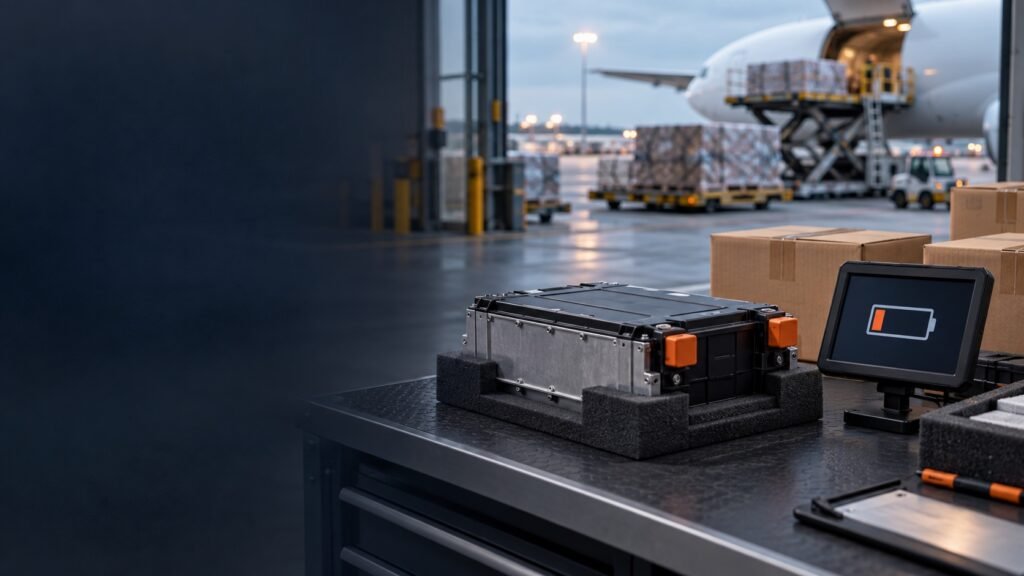
2026 lithium-ion air-shipping decision guide
Lithium Battery State of Charge for Air Shipping: When the 30% Rule Applies
For air transport in 2026, 30% state of charge is not a universal rule for every lithium battery. The correct requirement depends first on the battery chemistry and the way the battery is presented for transport.
- UN3480 lithium-ion cells or batteries shipped on their own under Packing Instruction 965 must be offered at no more than 30% of their rated capacity.
- Under Packing Instruction 966, UN3481 lithium-ion cells or batteries packed with equipment are subject to new reduced-charge requirements from 1 January 2026. Section I cells and batteries must be at no more than 30%; in Section II, the mandatory threshold applies when the cell or battery is over 2.7 Wh.
- Under Packing Instruction 967, no more than 30% state of charge or no more than 25% indicated battery capacity is recommended for lithium-ion batteries contained in equipment, but reduced charge is not mandatory under the baseline provision.
- Under Packing Instruction 952, a qualifying vehicle powered by a battery over 100 Wh must be offered with the battery at no more than 30% state of charge or no more than 25% indicated battery capacity, unless the applicable State approval pathway is used.
These distinctions are set out in the IATA 2026 Guidance Document for Lithium Batteries and Sodium Ion Batteries. The public guidance is not the complete IATA Dangerous Goods Regulations or ICAO Technical Instructions. The current edition, addenda, State variations, operator variations and actual route must still be checked.
Determine the Air-Shipment Configuration Before Applying 30%
Do not begin with a percentage copied from a previous booking. Begin with four questions:
- Is the battery lithium-ion, lithium metal, sodium-ion or another chemistry?
- Is it shipped on its own, packed with equipment, contained in equipment or installed in a vehicle?
- What is its verified Watt-hour rating?
- Which packing instruction, section, route and operator apply on the shipment date?
For lithium-ion cargo, the physical configuration usually points toward one of these air pathways:
- Shipped on its own: likely UN3480 under PI 965.
- Packed with equipment: likely UN3481 under PI 966.
- Contained in equipment: likely UN3481 under PI 967.
- Installed in a qualifying vehicle: a vehicle entry such as UN3556 may apply under PI 952.
This is an orientation framework, not a legal classification. Power banks, vehicles, hybrid-powered products, battery-powered cargo transport units, prototypes and damaged or defective batteries require particular care. The responsible shipper and qualified dangerous-goods parties must confirm the actual entry and preparation.
The 30% Rule Is Not Universal
“Lithium battery” is a broad description. It does not identify the chemistry, UN number, physical configuration, battery size or transport pathway.
The IATA air framework treats lithium-ion batteries shipped alone differently from batteries packed with equipment, batteries installed in equipment and batteries installed in vehicles. Even where 30% appears in more than one instruction, the legal status may differ:
- mandatory baseline limit;
- recommended safety measure;
- strong recommendation for a smaller vehicle battery; or
- threshold that may be exceeded only through a specified approval pathway.
The distinction matters. Calling a recommendation mandatory can create unnecessary operational problems. Calling a mandatory condition optional can make a shipment unacceptable. Stating only “battery below 30%” is also incomplete because reduced charge does not replace UN38.3 design-type evidence, correct classification, packaging, marks, labels, documents, training or operator acceptance.
Lithium metal batteries provide another important boundary. They generally use UN3090 or UN3091 starting entries and verified lithium content rather than the lithium-ion Watt-hour and SoC decision described here. See the separate UN3090 vs UN3091 guide when the battery is primary/non-rechargeable lithium metal.
2026 State-of-Charge Rules at a Glance
| Battery or article | Configuration | Air starting point | 2026 reduced-charge status | What still needs to be checked |
|---|---|---|---|---|
| Lithium-ion cell or battery | Shipped on its own | UN3480 / PI 965 | No more than 30% SoC is mandatory under the baseline rule | Section, Wh, package, quantity, cargo-aircraft status, approval route and operator variations |
| Lithium-ion cell or battery | Packed with equipment, Section I | UN3481 / PI 966 Section I | No more than 30% SoC is mandatory from 1 January 2026 | Genuine equipment relationship, package, quantity, declaration, State approval above 30% and operator acceptance |
| Lithium-ion cell or battery over 2.7 Wh | Packed with equipment, Section II | UN3481 / PI 966 Section II | No more than 30% SoC is mandatory from 1 January 2026 | Above 30% cannot remain under Section II; Section I and the applicable State approvals must be reviewed |
| Lithium-ion cell or battery | Contained in equipment | UN3481 / PI 967 | No more than 30% SoC or 25% indicated battery capacity is recommended, not mandatory under the baseline provision | Battery size, equipment protection, unintended operation, package, quantity and operator variations |
| Lithium-ion-battery-powered vehicle over 100 Wh | Battery installed in the vehicle | Relevant vehicle entry / PI 952 | No more than 30% SoC or 25% indicated battery capacity is mandatory unless the stated approval route applies | Correct vehicle entry, approvals, written conditions, protection and operator acceptance |
| Lithium-ion-battery-powered vehicle at or below 100 Wh | Battery installed in the vehicle | Relevant vehicle entry / PI 952 | The same thresholds are strongly recommended | Product identity, route and operator conditions |
This table summarizes the public IATA 2026 battery guidance. It does not reproduce the full packing instructions and should not be used as a packing checklist.
UN3480 Shipped Alone: PI 965 and the 30% Baseline
UN3480 is the ordinary starting entry for lithium-ion cells or batteries shipped without the equipment they are intended to power. Common examples include replacement battery inventory, power banks shipped as products and battery modules moving separately from their final equipment.
For air transport, UN3480 points to PI 965. The IATA 2026 guidance states that all UN3480 lithium-ion cells and batteries shipped by themselves must be at a state of charge not exceeding 30% of their rated capacity. A cell or battery above 30% may move only through the applicable approval route involving the State of Origin and the State of the Operator under the written conditions established by those authorities.
UN3480 is also forbidden as cargo on passenger aircraft under the baseline IATA framework. Eligible packages prepared under PI 965 Sections IA or IB therefore use a cargo-aircraft pathway and must bear the applicable Cargo Aircraft Only label in addition to other required marks or labels.
That restriction does not mean every UN3480 battery is automatically accepted on a cargo aircraft. The shipper still needs to confirm:
- exact manufacturer and battery model;
- lithium-ion chemistry and UN38.3 design-type status;
- nominal voltage, rated capacity and verified Watt-hour rating;
- applicable PI 965 section;
- cell, battery, package and consignment quantities;
- net battery weight and package performance;
- required marks, labels and documents;
- dangerous-goods training or instruction responsibilities;
- State and operator variations; and
- acceptance throughout the proposed route.
The 30% condition is one control inside a larger transport decision. It is not a substitute for that decision.
UN3481 Packed With Equipment: What Changed Under PI 966
“Packed with equipment” means the lithium-ion cells or batteries and the equipment they are intended to power are in the same package, but the batteries are not installed in that equipment.
The relationship must be genuine. A charger, cable or AC adapter is not automatically the equipment the battery powers. IATA's 2026 guidance explains that when a package contains only an adapter, charger or ancillary cable with lithium-ion batteries, it does not qualify as “packed with equipment” for PI 966 merely because those accessories are present.
PI 966 Section I
From 1 January 2026, lithium-ion cells and batteries offered under PI 966 Section I must be at no more than 30% of their rated capacity. A shipment above 30% may move only with approval from the State of Origin and the State of the Operator under written conditions established by those authorities, according to the IATA 2026 battery guidance.
This approval route is an exception process, not a routine commercial option. The approval does not remove the other requirements of Section I, and it does not compel an airline or other operating party to accept the cargo.
PI 966 Section II
Under PI 966 Section II, a lithium-ion cell or battery with a Watt-hour rating over 2.7 Wh must be offered at no more than 30% of its rated capacity from 1 January 2026.
If such a cell or battery is above 30%, it cannot remain represented as a Section II shipment. The IATA 2026 guidance says it must instead be offered under PI 966 Section I with the approval of the State of Origin and State of the Operator under their written conditions.
The 2.7 Wh wording must remain tied to the Section II rule. It should not be turned into a statement that every battery at or below 2.7 Wh is exempt from all SoC, packaging, quantity, documentation or operator conditions. The complete current instruction still controls.
The 2026 change is one reason an old PI 966 work instruction should not be reused without review. Manufacturers and shippers should update their internal decision trees, staff instructions and booking records to show the section, Wh value and charge status actually used.
For the broader UN-number distinction, see UN3480 vs UN3481. For service and routing questions, see shipping lithium batteries by air from China.
UN3481 Contained in Equipment: PI 967 Is a Different Branch
“Contained in equipment” means the lithium-ion cell or battery is installed in the device or apparatus during transport. This configuration ordinarily points to UN3481 under PI 967 rather than PI 966.
The IATA 2026 guidance recommends offering lithium-ion cells and batteries contained in equipment at either:
- no more than 30% of rated capacity; or
- no more than 25% indicated battery capacity.
It also says that reduced charge is not mandatory for these items under the baseline provision, while strongly recommending the reduced level as a transport-safety measure.
That difference must remain visible. The mandatory 2026 PI 966 wording for packed-with-equipment batteries must not be copied automatically to PI 967. At the same time, “not mandatory under the baseline provision” does not mean “no controls.” The shipper must still check:
- whether the battery is genuinely installed in the equipment;
- whether the product is equipment rather than a vehicle or another defined article;
- battery model, chemistry and Wh rating;
- protection against short circuit, damage and movement;
- prevention of unintended operation where required;
- package and quantity conditions;
- marks, documents and instructions; and
- State and operator variations.
An airline may impose a stricter condition than the baseline recommendation. Obtain current route acceptance rather than assuming every operator will carry a device at a higher charge level.
Battery-Powered Vehicles Under PI 952
A battery-powered vehicle is not automatically “equipment contained with a battery” under PI 967. Product function and the current modal definitions must be checked first.
The IATA 2026 guidance lists vehicle entries under PI 952 that include UN3171, UN3556, UN3557 and UN3558. UN3556 is the lithium-ion-battery-powered vehicle entry where applicable. The correct entry depends on the actual power system and product—not just the invoice description.
Vehicles With Batteries Over 100 Wh
From 1 January 2026, the IATA 2026 guidance says that a vehicle powered by a battery over 100 Wh must be offered for air transport with either:
- the battery at no more than 30% of its rated capacity; or
- an indicated battery capacity of no more than 25%.
A vehicle above the stated threshold may be shipped only with approval from the State of Origin and the State of the Operator under their written conditions. The approval does not replace protection against accidental activation, short circuit or damage, nor does it guarantee airline acceptance.
Vehicles With Batteries at or Below 100 Wh
For a vehicle powered by a battery at or below 100 Wh, the same two reduced-charge alternatives are strongly recommended rather than mandatory under the baseline IATA guidance.
This distinction should appear in the shipping record. A sentence such as “all vehicles must be at 30%” is too broad, while “small vehicles have no charge considerations” ignores the stated recommendation and any stricter operator condition.
30% SoC Is Not the Same as 25% Indicated Battery Capacity
State of charge and indicated battery capacity are not interchangeable measurements.
- State of charge refers to the battery's stored charge relative to its rated capacity using an appropriate technical determination.
- Indicated battery capacity is the level shown by a vehicle display, battery-management interface or comparable indicator.
IATA explains that 25% indicated battery capacity is easier for shippers to identify and is a practical method that delivers an equivalent safety mitigation in the PI 952 context. It also states explicitly that 25% indicated capacity is not directly equivalent to 30% SoC.
Do not recalculate one value into the other without an approved technical basis. Record which measure was used, how it was obtained, the date of the reading and the person or organization that supplied it.
Detailed vehicle handling and route planning remain with the EV battery logistics guide and product-specific pages such as shipping electric bikes from China.
Approval Does Not Equal Airline Acceptance
An approval pathway and an operator's commercial acceptance answer different questions.
Where the applicable instruction or special provision permits an above-threshold shipment only with State approvals, the written approval must come from the authorities named by that provision. The shipment must comply with the written conditions attached to the approval.
Even then, the route may involve separate decisions by:
- the airline or aircraft operator;
- the booking agent or freight forwarder;
- the origin airport and ground handler;
- transit airports and transfer handlers;
- customs or other national authorities; and
- the destination agent and final-delivery parties.
An operator variation can be stricter than the baseline rule. An operator may also decline a shipment for network, aircraft, handling or commercial reasons. A prior shipment, an approval issued for another party or a route accepted last month should not be treated as current acceptance for new cargo.
BAT Logistics can coordinate a shipment-specific route enquiry using information supplied by the manufacturer or shipper. BAT does not issue State approvals, compel carrier acceptance or guarantee that an above-threshold shipment will be carried.
How Shippers Should Record State of Charge
IATA's public guidance does not require a separate universal “30% certificate” for every PI 965 Section IA or IB shipment. It explains that the Shipper's Declaration includes the shipper's certification that the applicable air-transport requirements have been met, including the SoC requirement.
That does not remove the shipper's need for defensible internal evidence. A State, operator or freight party may request supporting information, and the shipper remains responsible for the declaration it signs.
Use a controlled record that identifies the exact battery or product. Recommended fields include:
Battery and product identity
- battery manufacturer and exact model;
- product or vehicle manufacturer and model, where applicable;
- battery chemistry;
- nominal voltage and rated capacity;
- verified Watt-hour rating;
- serial, batch or production reference when available; and
- a photograph of the rating plate tied to the same model.
Transport configuration
- proposed UN entry;
- shipped-alone, packed-with-equipment, contained-in-equipment or vehicle configuration;
- applicable packing-instruction starting point and section;
- number of cells or batteries per product, package and shipment; and
- new, used, returned, prototype, damaged, defective, recalled, waste or recycling status.
Charge record
- SoC percentage or indicated-capacity percentage;
- which of the two measures is being reported;
- measurement or display method;
- device, software or battery-management interface used;
- date and time of the reading;
- person or organization providing the value;
- supporting screenshot or photograph tied to the product; and
- charging, discharge, isolation or storage steps already performed.
Do not attach a generic screenshot that cannot be matched to the battery model. Do not copy a nominal factory setting into a shipment declaration without verifying the actual cargo and the method used.
BAT Logistics may review manufacturer- or customer-supplied records for obvious logistics gaps. It does not measure, calibrate, test, certify or approve the battery's state of charge.
Why the Air Rule Must Not Be Copied to Sea Freight
PI 965, PI 966, PI 967 and PI 952 are air-transport pathways. They do not govern an international ocean shipment.
International sea transport uses the International Maritime Dangerous Goods Code. The IMO IMDG Code publication page identifies the current maritime-code framework, while IMO Resolution MSC.556(108) contains Amendment 42-24.
Battery chemistry, UN entry, physical configuration, condition, package and actual charge level can still be relevant to a sea-shipment review. However, a shipper should not conclude that a marine shipment is compliant merely because the battery is below 30%, or that it is non-compliant merely because it is above 30%.
For the actual sailing, check the current IMDG provisions, corrections, national implementation, carrier rules, port and terminal requirements, container plan, inland legs and destination arrangements. See shipping batteries by sea for the maritime planning pathway.
Common State-of-Charge Mistakes
Applying 30% to every lithium battery
The number alone is not a classification method. Confirm chemistry, configuration, Wh rating, instruction and mode.
Choosing the percentage before the configuration
The same lithium-ion battery can enter a different transport branch depending on whether it is alone, beside equipment, installed in equipment or installed in a vehicle.
Treating PI 966 and PI 967 as identical
PI 966 covers batteries packed with equipment. PI 967 covers batteries contained in equipment. Their 2026 SoC status is not the same.
Missing the 2026 PI 966 change
An old work instruction may describe reduced SoC as only recommended. From 1 January 2026, PI 966 contains mandatory requirements, with the Section II rule applying to cells and batteries over 2.7 Wh.
Keeping an above-30% PI 966 shipment in Section II
The public IATA guidance directs an eligible above-30% movement to Section I with the specified State approvals. It must not remain presented as Section II.
Treating a recommendation as a mandate—or a mandate as a suggestion
Use the exact status applicable to PI 965, PI 966, PI 967 or PI 952. Also check operator variations, which can be stricter.
Converting 25% indicated capacity directly into 30% SoC
IATA describes the two values as practical alternative safety measures in the relevant provisions, not as mathematically equal readings.
Assuming approval guarantees carriage
State approval and operator acceptance are separate. Every route party may impose additional conditions or decline the cargo.
Using evidence that does not identify the battery
A gauge photograph, software screen or factory statement is weak if it cannot be tied to the exact battery, product, date and responsible source.
Hiding abnormal battery condition
Damaged, defective, safety-recalled, prototype, waste or recycling batteries can leave the ordinary workflow. Disclose the condition before booking and use the damaged, defective and recalled battery guide for triage.
Assuming a previous shipment proves current compliance
Rules, addenda, operator variations, routes and cargo condition can change. Recheck the actual shipment rather than copying an old airway bill.
Information to Send Before Requesting an Air Route Review
Provide one controlled shipment record containing the following information.
Battery and product details
- manufacturer, product and exact battery model;
- chemistry, nominal voltage, rated capacity and verified Watt-hour rating;
- UN38.3 test-summary reference and available manufacturer specifications;
- whether the battery is shipped alone, packed with equipment, contained in equipment or installed in a vehicle;
- product function and photographs when equipment/vehicle identity is uncertain;
- number of cells or batteries per item, package and shipment; and
- current condition and shipment purpose.
Charge evidence
- actual SoC or indicated battery capacity;
- method, device or interface used;
- reading date and responsible source;
- model-linked screenshot or photograph; and
- any applicable approval already held, including its holder, scope and conditions.
Package and route details
- inner and outer packaging description;
- package count, dimensions and gross weight;
- net battery weight where relevant;
- China pickup address and responsible shipper;
- origin airport, destination airport/country and delivery point;
- cargo-ready date;
- proposed operator or routing, if already nominated; and
- available SDS, transport documents and booking instructions.
Do not send a document bundle without connecting each record to the exact battery and physical shipment. The wider lithium battery shipping documents checklist can help organize the file.
Lithium Battery State-of-Charge Questions
Does every lithium battery have to be shipped at 30% SoC or below?
No. The requirement depends on chemistry, physical configuration, battery size, packing instruction, section and mode. Some air pathways make reduced SoC mandatory, some recommend it, and lithium metal batteries use different transport measures.
Does UN3480 under PI 965 have a 30% SoC limit?
Yes. Under the baseline IATA 2026 air framework, UN3480 lithium-ion cells and batteries shipped alone must be offered at no more than 30% of rated capacity. Above-threshold movement requires the applicable State approvals and written conditions.
What changed for UN3481 packed with equipment under PI 966 in 2026?
From 1 January 2026, PI 966 Section I cells and batteries must be offered at no more than 30% SoC. In Section II, the mandatory limit applies to cells and batteries over 2.7 Wh. The complete current instruction and variations must still be checked.
Can a PI 966 Section II shipment move above 30% SoC?
It cannot remain under Section II. The IATA 2026 guidance directs an eligible above-30% shipment to PI 966 Section I with approval from the State of Origin and State of the Operator under their written conditions.
Is 30% SoC mandatory for batteries contained in equipment under PI 967?
Not under the baseline IATA 2026 provision. IATA recommends no more than 30% SoC or no more than 25% indicated battery capacity and describes reduced charge as a strongly recommended safety measure. Operator variations may be stricter.
What does the 2.7 Wh threshold change?
For PI 966 Section II, it identifies the cells and batteries to which the mandatory no-more-than-30% rule applies from 1 January 2026. It is not a general exemption from other lithium-battery requirements.
Is 25% indicated battery capacity equal to 30% SoC?
No. IATA says it is not directly equivalent. Indicated capacity is a practical alternative that provides an equivalent safety mitigation in the relevant contained-in-equipment and vehicle guidance.
Can a vehicle with a battery over 100 Wh move above the stated thresholds?
Only through the applicable approval route. The IATA 2026 guidance requires approval from the State of Origin and State of the Operator under written conditions for an above-threshold vehicle. Operator acceptance remains separate.
Does a battery below 30% automatically qualify for air transport?
No. Reduced SoC is only one condition. Classification, UN38.3 status, package, quantity, marks, labels, documents, training, route, State variations and operator acceptance must also be checked.
Does the air 30% rule apply to sea freight?
Not as a universal maritime rule. Sea shipments must be reviewed under the current IMDG framework and the requirements of the actual carrier, ports, route and inland legs.
Does the 30% rule apply to lithium metal batteries?
This lithium-ion SoC decision should not be transferred to lithium metal batteries. Lithium metal shipments use UN3090/UN3091 starting entries and verified lithium content under their applicable instructions.
What evidence should a shipper keep for an SoC statement?
Keep a record tied to the exact battery or product: manufacturer, model, Wh rating, reported value, measurement or display method, device/software, date, responsible source and supporting model-linked image or record. Also retain the documents required by the applicable shipment pathway.
Can BAT Logistics measure or certify battery SoC?
BAT Logistics can review manufacturer- or customer-supplied information for obvious logistics gaps and coordinate a shipment-specific route enquiry. It does not measure, calibrate, test, certify or approve battery state of charge.
Start with the actual battery and physical configuration
Request a Shipment-Specific Air SoC and Route Review
Share the battery model, chemistry, Watt-hour rating, physical configuration, quantity, condition, packing details, SoC record, China pickup point and destination.
BAT Logistics can review the supplied information for obvious logistics gaps and coordinate a shipment-specific air-route enquiry. The responsible shipper and qualified dangerous-goods parties must confirm classification and preparation. Acceptance remains subject to the regulations in force, applicable approvals, State and operator variations and every operating party on the route.
- Battery manufacturer, exact model, chemistry and Wh
- Shipped alone, packed with, contained in or vehicle configuration
- SoC or indicated-capacity record and method
- Condition, quantity, package, dimensions and weights
- China pickup point, destination and ready date