China-Europe Rail freight-2026 Guide
Table of Contents
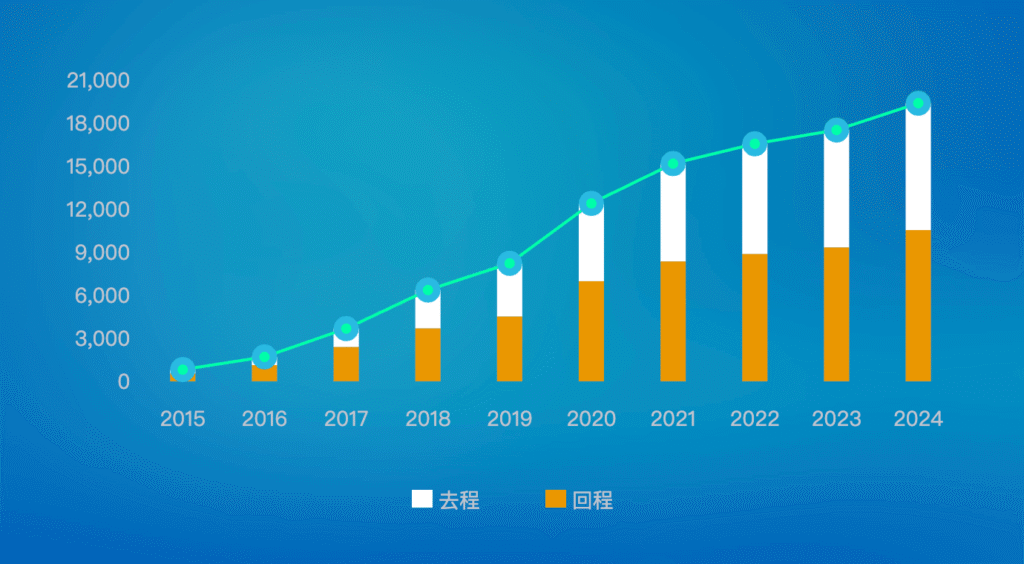
China-Europe Railway freight refers to international container block trains organized by China State Railway Group, operating on fixed schedules, routes, and train services between China and European countries along the Belt and Road Initiative.
By 2025, the cumulative number of China-Europe Railway freight trains exceeded 120,000 services, transporting more than 11.7 million TEUs of cargo with a total cargo value of approximately USD 490 billion. These railway services now reach 26 European countries and 232 cities, as well as 11 Asian countries and over 100 cities.
With its extensive geographic coverage and growing capacity, China-Europe Railway freight has become an important logistics solution for cross-border trade. To learn more details about railway freight transportation, please continue reading the article below.
In international air freight, goods cross national borders and must go through a series of cross-border procedures, including export customs declaration and inspection in the country of origin. Air freight offers advantages such as fast transit times and low cargo damage rates, making it particularly suitable for high-value and urgent shipments.
Our company(BAT) has over 20 years of experience in the international freight forwarding industry, with extensive expertise in China export transportation. We can provide professional, customized logistics services, especially in air freight.
If you’d like to learn more about rail routes from China to Europe, please see below
1.Shipping from China to Spain

What is rail freight?
Rail freight, also known as railway freight transport, is a core international logistics solution that moves goods across regions and countries through interconnected railway networks. It plays a vital role in cross-border supply chains by offering a balanced alternative between air freight and sea freight /road freight in terms of cost, speed, and reliability.
Rail freight mainly transports cargo in standard containers, supporting both FCL (Full Container Load) and LCL (Less than Container Load) shipments. It is well suited for bulk cargo, industrial equipment, machinery, electronics, automotive parts, semi-finished goods, and non-urgent commercial shipments. For businesses seeking predictable transit times without the high cost of air transport, rail freight is an efficient choice.
One of the biggest advantages of rail freight is its balanced transit time and cost. For example, the China–Europe Railway Express typically delivers cargo in 15–25 days, which is around 50% faster than sea freight and costs approximately 30–50% less than air freight. Rail freight is also less affected by weather disruptions and port congestion, offering greater schedule stability for regular shipments.
Rail freight services cover major trade corridors such as the Eurasian Land Bridge and China–Southeast Asia rail routes, with options for station-to-station or door-to-door rail freight services, often integrated with customs clearance. In addition, rail freight is considered a low-carbon logistics option, producing significantly lower emissions than air transport.
Overall, rail freight is an ideal solution for companies prioritizing cost control, stable transit times, and sustainable logistics in international trade.
Rail cargo shipping process
If you plan to use the China–Europe Railway for rail cargo shipping, it is essential to clearly understand the shipping process. A well-structured workflow helps ensure smooth booking and cargo dispatch.
Compared with sea freight, which typically takes 35–45 days, rail cargo shipping via the China–Europe Railway generally requires only 12–18 days in total transit time. At the same time, it offers a more cost-effective solution than air freight, making it an ideal balance between speed and cost efficiency.
I. Advance Cargo Preparation & Booking Arrangement
1. Confirm Shipping Requirements and Develop a Transport Plan
Clearly define cargo details, including product name, quantity, gross weight, volume, HS code, and destination.
Select the shipping mode: FCL (Full Container Load) or LCL (Less than Container Load).
Choose the appropriate rail corridor based on transit time and destination:
Central Corridor (Alashankou / Khorgos): Fastest option, approximately 12–15 days
Eastern Corridor (Manzhouli): More stable route, approximately 14–18 days
Western Corridor (Erenhot): Suitable for Mongolia and Russia-bound cargo, approximately 16–20 days
2. Booking Operation
Container space should generally be booked one week in advance, while during peak seasons, booking is recommended at least one month ahead.
3. Document Preparation
Required documents include:
Booking Authorization / Shipping Instruction
Commercial Invoice
Packing List
II. Cargo Preparation and Container Stuffing
1. Container Pickup and Drop-off
The railway platform issues a loaded container drop-off instruction (designated depot or rail terminal).
Arrange trucking to pick up the empty container and deliver it to the factory or warehouse for loading.
After loading, apply customs seals and commercial seals, and take photos for record-keeping.
2. Container Loading Requirements
Weight balance requirements:
Front-to-rear weight difference: less than 1,200 kg
Left-to-right weight difference: less than 600 kg
(If exceeded, the container must be unpacked and reloaded.)
Securing standards:
Use wooden blocks, lashing straps, air bags, and other reinforcement materials.
Carton-packed cargo must be secured with cargo nets.
Photo records (7 mandatory photos):
Empty container
1/4 loaded
1/2 loaded
3/4 loaded
Fully loaded
Half-closed doors
Fully closed doors with seal number
3. Warehouse Delivery
Deliver the cargo to the designated warehouse using the warehouse entry number and entry diagram.
Each package must be labeled in Chinese, consistent with the customs declaration.
The warehouse conducts weighing, measurement, and quantity verification, generating final inbound data.
III. Customs Declaration and Inspection & Quarantine
Customs procedures must be completed 2–3 days before train departure, allowing at least one additional day for possible inspections.
For FCL shipments, customs declaration is completed after the container enters the rail terminal.
For LCL shipments, customs declaration is completed collectively after container consolidation.
Rail Freight VS Sea Freight
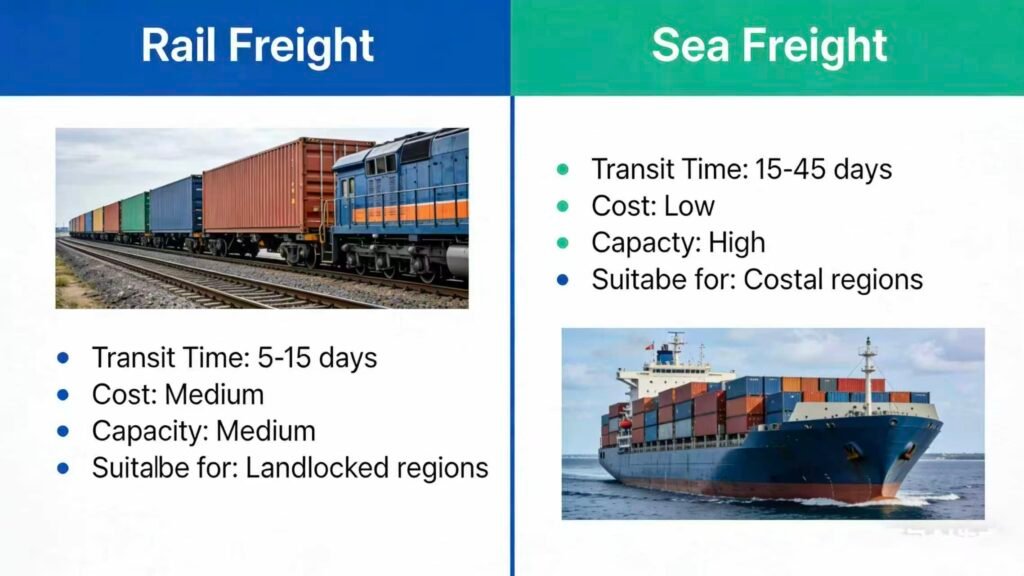
Rail freight and sea freight are two of the most cost-effective international shipping methods. Both play a critical role in global supply chains, but they differ significantly in transit time, cost, cargo suitability, reliability, and geographic coverage. Choosing the right option depends on your cargo type and delivery requirements.
1. Transit Time: Rail Freight Is Significantly Faster
One of the biggest advantages of rail freight transport is speed. On major corridors such as the China–Europe Railway Express, rail freight typically takes 15–25 days, compared with 30–45 days for sea freight. This makes rail freight around 50% faster than sea freight.
For regional routes like China–Southeast Asia rail freight, transit times can be as short as 7–15 days, making rail freight ideal for time-sensitive but non-urgent shipments. Sea freight remains slower due to long sailing schedules, port congestion, and transshipment delays.
2. Cost Comparison: Sea Freight Is Cheaper, Rail Freight Offers Balance
Sea freight is the lowest-cost option for international shipping, especially for large volumes and heavy cargo. Its cost per unit is unmatched for bulk shipments.
Rail freight costs are typically 1.5–2.5 times higher than sea freight, but still 30–50% cheaper than air freight. This positions rail freight as a strong middle-ground solution for shippers who need faster delivery without paying premium air freight rates.
3. Cargo Types and Flexibility
Rail freight is best suited for:
Containerized cargo (FCL & LCL rail freight)
Electronics and consumer goods
Automotive parts and industrial components
Cross-border e-commerce bulk shipments
Medium-volume cargo (10–500 CBM)
Sea freight excels in:
Ultra-bulk cargo (500 CBM+)
Heavy machinery and oversized goods
Low-value commodities
Dangerous goods with fewer route restrictions
Sea freight offers greater flexibility for oversized and overweight cargo, while rail freight has stricter size and route limitations.
4. Reliability and Schedule Stability
Rail freight is generally more stable and predictable. Fixed train schedules mean fewer disruptions from weather, port congestion, or labor strikes. This reliability makes rail freight attractive for regular and planned shipments.
Sea freight, while economical, is more vulnerable to port congestion, typhoons, canal delays, and peak-season disruptions, which can significantly extend transit times.
5. Geographic Coverage and Sustainability
Sea freight provides global coverage, reaching almost all coastal countries and islands. Rail freight focuses on land corridors such as the Eurasian rail network and inland destinations, making it ideal for landlocked regions.
From a sustainability perspective, rail freight is a low-carbon logistics option, producing fewer emissions than sea freight on inland routes and significantly less than air freight.
6.How to choose?
Choose rail freight when you need faster transit than sea freight, stable schedules, and reasonable costs—especially for China–Europe trade. Choose sea freight when cost control is the priority and transit time is flexible. Both modes remain essential tools in modern international logistics.
Rail Freight VS Road Freight
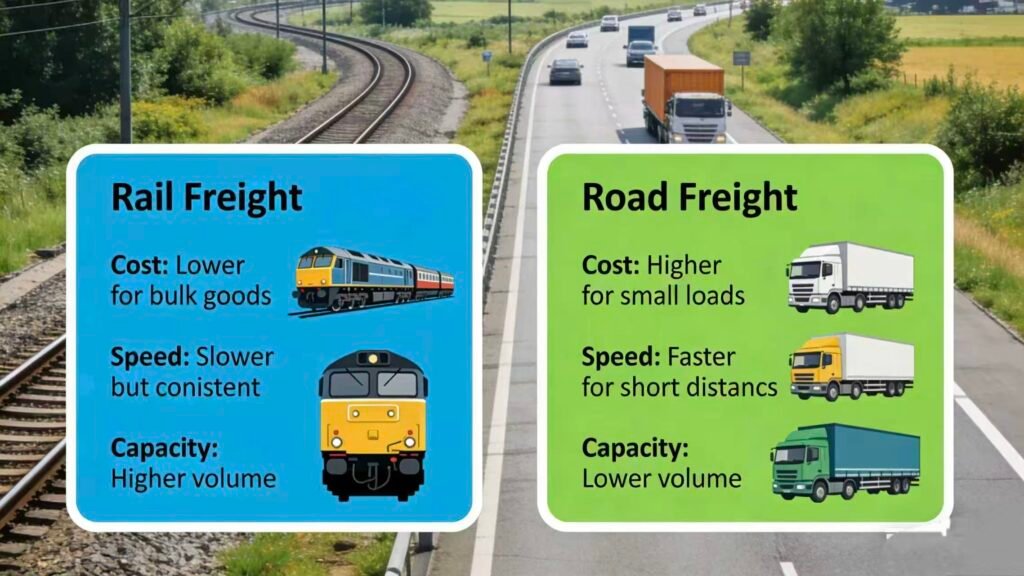
A comparison between China–Europe Railway transport and China–Europe road (truck) transport shows that the choice between these two options mainly depends on customer requirements and the type of cargo. If you would like to learn more about inspection procedures and customs checks for each transport mode, please continue reading.
1. Transit Time Comparison
China–Europe Railway (Rail Freight):
On core routes (such as Xi’an–Duisburg and Chongqing–Duisburg), transit time can be as fast as 10 days, with a typical range of 12–18 days.
Highly stable schedules, operating on fixed departures with an on-time rate exceeding 95%.
China–Europe Truck Transport (Road Freight):
Typical transit time is 18–25 days (e.g., Suzhou–Hamburg). Although there is no transloading, transit is heavily affected by road conditions, weather, and border congestion.
On-time performance is only 80%–85%; during winter, factors such as heavy snow in Russia or poor road conditions in Central Asia may cause 3–7 days of delays.
2. Transportation Cost
China–Europe Railway:
FCL cost: approximately USD 1,500–2,500 per container.
LCL cost: approximately USD 80–120 per CBM.
Volume discounts are available for bulk shipments (≥5 containers), further reducing costs, making rail freight one of the most cost-effective options for China–Europe cross-border logistics.
China–Europe Truck Transport:
FCL cost: approximately USD 2,500–3,500 per container.
LCL cost: approximately USD 120–180 per CBM.
While there are no additional deconsolidation/reloading fees, the per-container cost is 40%–60% higher than rail, making it suitable mainly for small-volume shipments.
3. Transport Capacity
China–Europe Railway:
A single train can carry up to 55 containers, with a maximum traction weight of 3,000 tons.
Each container can load up to 76 CBM or 26 tons.
Ideal for large-volume and bulk cargo, serving as the backbone transport mode for China–Europe trade.
China–Europe Truck Transport:
A single truck can carry approximately 65–70 CBM or up to 30 tons.
Overall transport capacity is only about 1/50 of a full train, making it suitable only for small, scattered shipments.
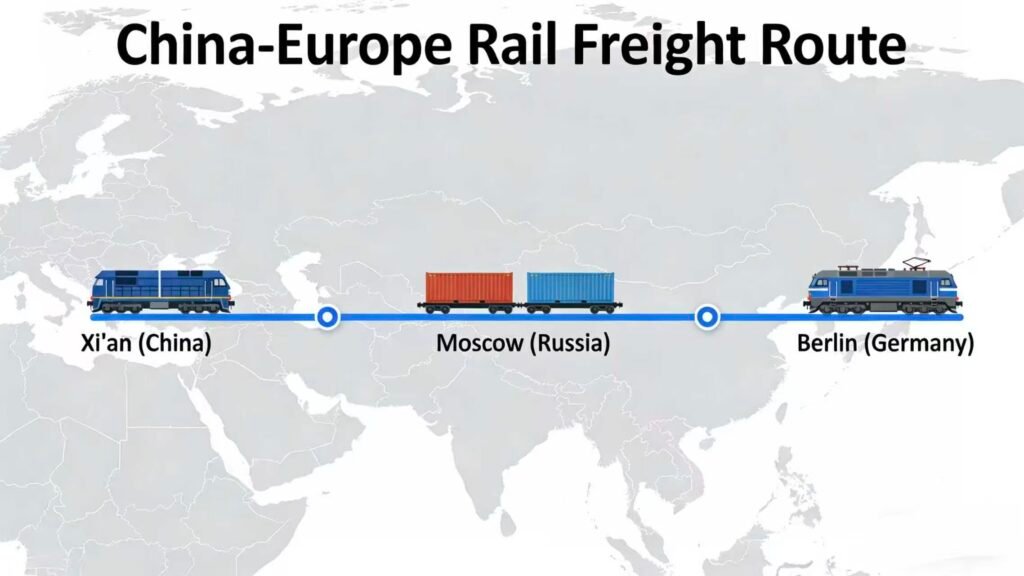
Rail freight from China to Europe
Rail Freight China to Europe has become a core logistics solution for companies seeking a stable balance between cost, transit time, and reliability on the Asia–Europe trade lane. Compared with sea freight, China–Europe rail freight cuts transit time by nearly 50%, while remaining significantly cheaper than air freight. Operated mainly through the China–Europe Railway Express, rail services connect major Chinese production hubs such as Xi’an, Chongqing, Chengdu, Zhengzhou, and Wuhan with Europe’s key inland logistics centers, making rail freight ideal for industrial cargo, electronics, automotive parts, and cross-border e-commerce shipments.
Rail Freight China to Germany
Rail freight from China to Germany is one of the most mature and stable rail corridors in Europe. Trains typically arrive at major hubs including Duisburg, Hamburg, and Leipzig, which serve as primary distribution centers for Western and Northern Europe. Average transit time ranges from 15–22 days, offering a much faster alternative to sea freight routes that often exceed 40 days.
This route is widely used for automotive components, machinery, electronics, and mid- to high-value goods that require predictable delivery schedules. Both FCL and LCL rail freight services are well developed, with frequent weekly departures and streamlined customs clearance. Germany’s advanced rail infrastructure and intermodal connectivity allow cargo to move efficiently onward to France, the Netherlands, Belgium, and other EU markets, making rail freight China to Germany a preferred option for manufacturers and e-commerce sellers alike.
Rail Freight China to Poland
Rail freight China to Poland plays a strategic role within the China–Europe rail network, as Poland functions as a key entry and consolidation point for Central and Eastern Europe. Main terminals such as Małaszewicze, Warsaw, and Łódź handle large volumes of rail cargo and connect seamlessly to regional road and rail systems.
Transit time from China to Poland typically falls between 14–20 days, often slightly faster and more cost-effective than routes extending deeper into Western Europe. This corridor is especially popular for cross-border e-commerce cargo, consumer goods, electronics, and industrial products, with easy redistribution to Germany, Czech Republic, Hungary, Slovakia, and the Baltic states. Competitive rail freight costs and frequent departures make Poland an attractive destination for businesses focused on both speed and budget control.
Throughout these corridors, professional forwarders such as BatteryShipment support rail freight China to Europe by managing customs documentation, route planning, and compliant handling for general and specialized cargo, helping shippers maintain stable and efficient rail supply chains across Europe.
Rail Freight forwarding in China
1.BAT Logistics
BAT Logistics is a China-based international freight forwarding agent with an operations team of 30–50 professionals and dedicated sales specialists. The company has over 10 years of experience in China–Europe Railway transportation and holds the relevant industry qualification certificates.
2.Sinotrans (China National Foreign Trade Transportation)
A state-owned enterprise and listed company, with the China–Europe Railway as one of its core businesses. Sinotrans operates a multimodal transport network integrating China–Europe Railway + ocean freight + air freight, covering major stations nationwide.
Strengths: strong official resources, stable train schedules, and suitability for large-volume cargo transportation.
3.Yuxinou (Chongqing) Supply Chain
The only company in China with dual certifications (a 5A-rated logistics enterprise and an official China–Europe Railway operator). It holds exclusive operating rights for direct rail services from Chongqing to Europe, with 100% self-operated routes.
4.Huamao International Logistics
A leading China–Europe Railway service provider in the Yangtze River Delta region, with strong LCL consolidation capabilities at stations such as Yiwu and Ningbo, making it ideal for small-batch e-commerce shipments.
5.Guangzhou Pan-Asia Railway Logistics
Known for its strong Southern Europe routes (including Italy and Spain).
Strengths: Central Asia corridors and logistics services covering Russian-speaking regions.
Rail Freight Quote/Cost/Rates
Rail freight from China to Europe has become a cost-efficient and stable solution for cross-border logistics, especially for shippers looking to balance transit time and budget. Positioned between air and sea freight, rail freight rates from China to Europe are typically 30–50% lower than air freight while cutting sea freight transit time by nearly half. Pricing is mainly structured around FCL (Full Container Load) and LCL (Less than Container Load), depending on shipment volume and cargo requirements.
Rail Freight Cost Structure (FCL & LCL)
Rail freight quotes are based on chargeable volume or weight, route distance, and service scope (terminal-to-terminal or door-to-door).
| Service Type | Typical Rate Range | Reference Transit |
|---|---|---|
| 20GP FCL | USD 1,000–1,500 / container | China → Europe |
| 40HQ FCL | USD 1,800–2,500 / container | |
| LCL Rail Freight | USD 50–110 / CBM | |
| Minimum LCL Charge | USD 50–150 / shipment |
In practice, key routes such as China to Germany (Duisburg/Hamburg) or China to Poland (Małaszewicze) remain the most competitive. Inland origins like Xi’an or Chengdu often offer 10–15% lower rail freight costs compared to coastal cities, due to direct train departures.
What Affects Rail Freight Rates
Rail freight pricing is not fixed and usually includes several variable components:
Cargo volume & weight (billing follows the higher of actual or volumetric weight, CBM × 500)
Route selection (Western corridors via Kazakhstan are often cheaper than Eastern routes)
Container utilization (FCL becomes more economical once cargo exceeds ~20 CBM)
Surcharges, including fuel (5–10%), peak season fees, and destination handling
Special handling, such as oversized cargo or regulated goods
Additional destination charges like unloading or devanning may apply, especially for LCL shipments.
How to Optimize Rail Freight Costs
To secure a competitive rail freight quote from China, shippers are advised to consolidate cargo, book space 2–4 weeks in advance, and work with experienced forwarders that offer transparent pricing. Professional providers such as BAT Logistcis help clients reduce hidden costs by optimizing routing, container usage, and documentation—particularly for complex cargo like batteries or industrial goods.
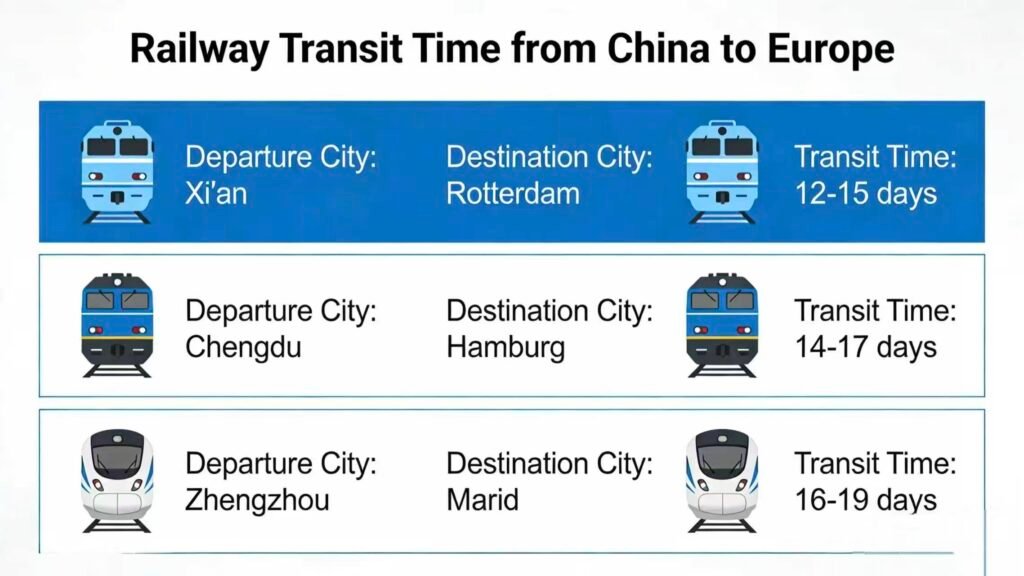
Railway transit time from China to Europe
The transit time of the China–Europe Railway is mainly affected by factors such as gauge change operations, border customs clearance, and transport distance.
1. Core Transit Process: Gauge Change Operations
The most critical transit stage of the China–Europe Railway is rail gauge change, caused by the difference between China’s standard gauge (1,435 mm) and the broad gauge (1,520 mm) used in Central Asia and Russia:
Outbound trains: Gauge change at Dostyk / Druzhba (Kazakhstan)
(standard gauge → broad gauge)
Inbound trains: Gauge change at Alashankou / Khorgos
(broad gauge → standard gauge)
Time required for gauge change operations:
Per container: approximately 2 minutes
Full train (55 containers): about 1 hour with three gantry cranes operating simultaneously
With current technical optimization, one full train can typically be completed within an average of 2 hours
2. Border Customs Clearance Time
Alashankou / Khorgos ports:
Transit time reduced from 12 hours to 6–8 hours
Import customs clearance shortened from 2–3 days to within 16 hours
Xi’an – Kazakhstan terminals:
Transshipment time reduced from 3–4 days to about 3 hours
Actual operational time:
Normal conditions: 2–3 days (including queuing and documentation processing)
Peak season (September–December): may extend to 7–15 days due to border congestion
Comparison by port:
Alashankou / Khorgos: 2–3 days (after optimization)
Erenhot: approximately 6 days
Manzhouli: about 5–7 days
3. End-to-End Transit Time of the China–Europe Railway
Point-to-point express services:
Xi’an – Prague: 11 days 4 hours
Zhengzhou – Hamburg: 11 days 19 hours
Xi’an – Budapest: 10 days 23 hours
Chongqing – Budapest: 11 days 16 hours
Shijiazhuang – Warsaw: 14 days 3 hours
Typical transit time ranges by corridor:
Western Corridor (Alashankou / Khorgos):
Chongqing – Duisburg: 13–15 days
Chengdu / Xi’an – Małaszewicze: 15–18 days
Central Corridor (Erenhot):
Jinan – Budapest: 12–14 days
Eastern Corridor (Manzhouli):
Harbin – Hamburg: 15–17 days
Special routes:
Yiwu – Madrid: longest route, approximately 21 days
Trans-Caspian International Transport Route (Middle Corridor): about 15 days, saving around 25 days compared with traditional routes
Why choose BAT?
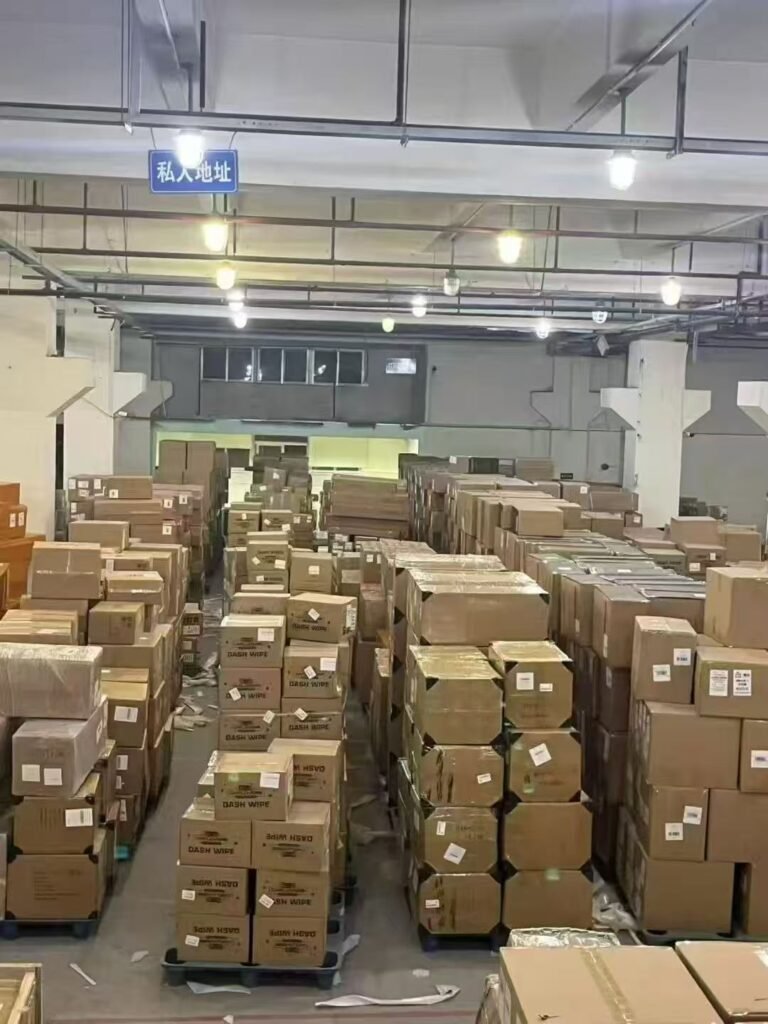
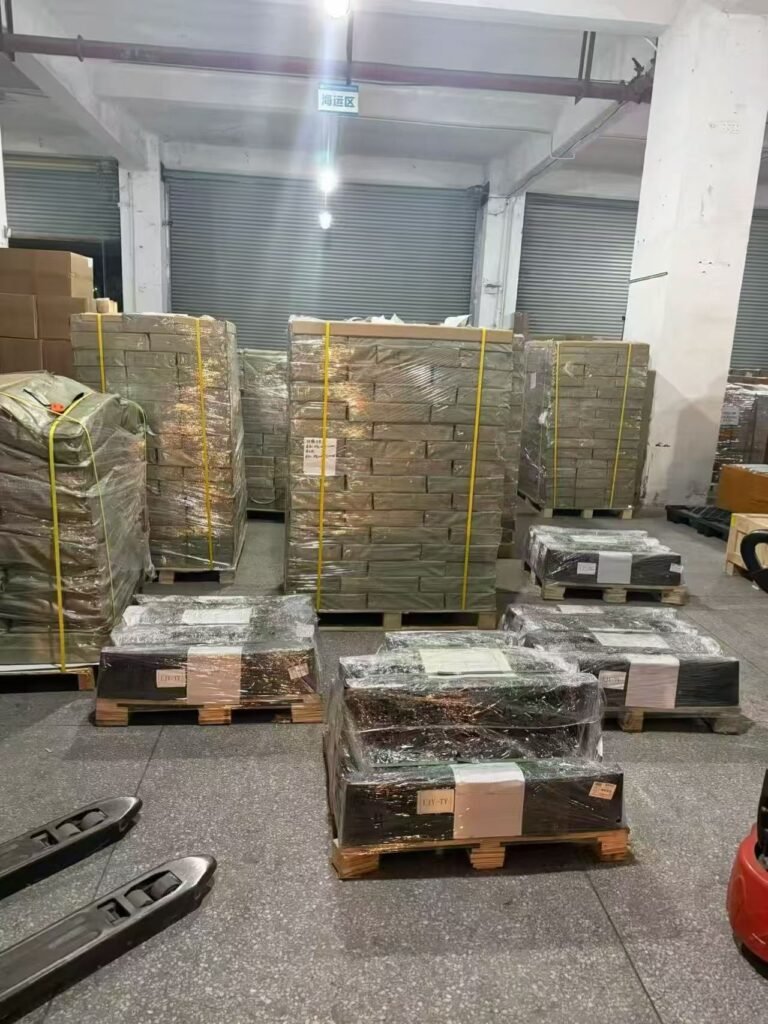
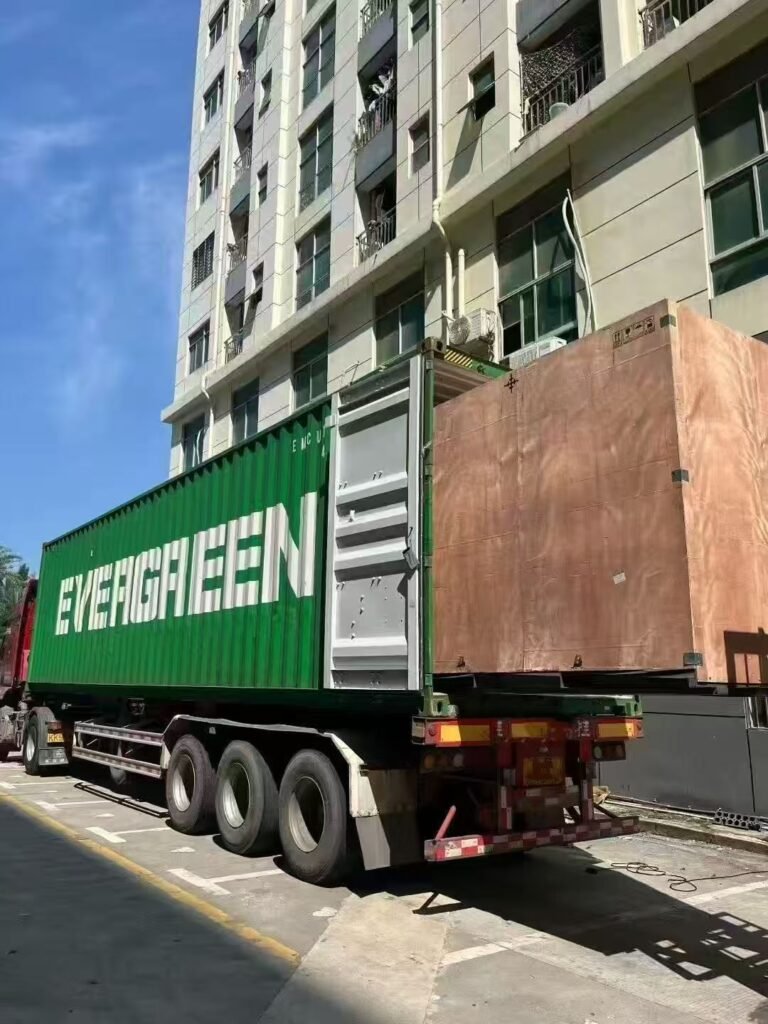
For businesses shipping between China and Europe, selecting a reliable rail freight forwarder is crucial. BAT Logistcis provides professional, cost-effective, and efficient China to Europe rail freight services, helping companies move goods safely, on time, and at competitive rates.
Extensive Rail Network & Route Expertise
BatteryShipment operates across major rail corridors, connecting key Chinese hubs like Chongqing, Xi’an, and Chengdu with European destinations including Germany, Poland, and France. Our team ensures smooth rail freight operations, managing customs clearance, terminal handling, and door-to-door delivery.
Battery Transport & Compliance
We specialize in transporting lithium batteries and other regulated goods by rail, fully complying with IATA DGR rules. BatteryShipment ensures proper packaging, labeling, and documentation, minimizing the risk of shipment rejection and delays.
Competitive Rates & Reliable Service
We offer tailored pricing for FCL (Full Container Load) and LCL (Less than Container Load) shipments, helping businesses save 30–50% compared with air freight while achieving faster transit than sea freight. Real-time tracking, proactive updates, and dedicated customer support guarantee dependable delivery for all China-Europe rail freight shipments.
If you’re still unsure which rail freight forwarder to choose, don’t hesitate to contact us. We provide 24-hour quotes to meet your shipping needs.
Frequently Asked Questions
Yes ,rail freight is cheaper.
No,There is DG cabinet for batteries.
This is generally more suitable for bulk goods.
Yes ,we can booking it .