
Shipping from China to Portugal — Complete Guide 2026: Rates, Transit Times & Best Methods
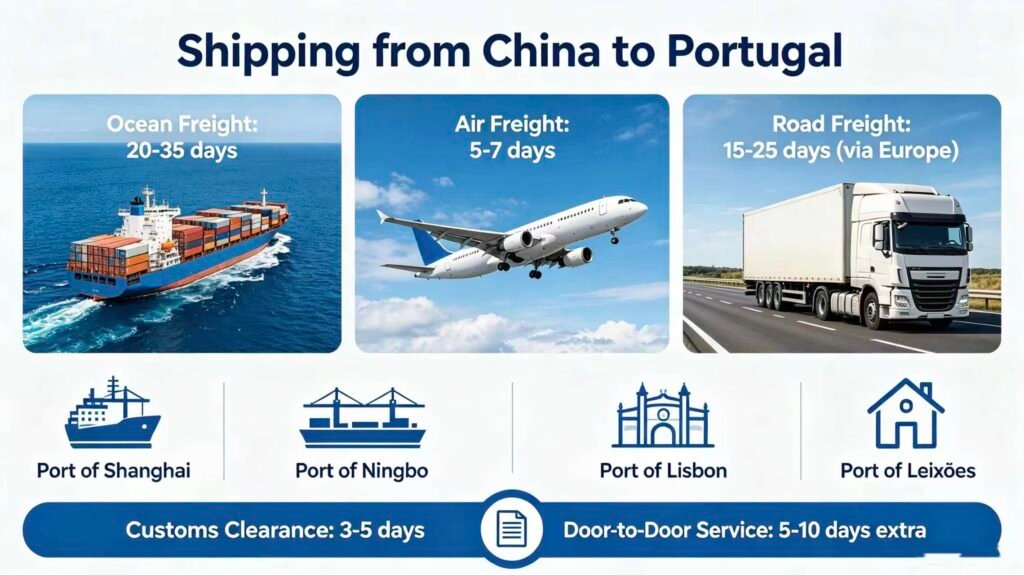
Why Shipping from China to Portugal Requires a Specialist Freight Partner
- 23% Portuguese VAT — the highest standard VAT rate in the EU. Portugal applies a 23% standard VAT rate (IVA), tied with Sweden for the highest standard rate in the EU. This is 4 points higher than Germany (19%), 2 points higher than Spain (21%), and 1 point higher than France and Italy (22%). For a €20,000 shipment with 4% customs duty, this represents €832 more VAT per shipment versus Germany.
- Portugal’s unique regional VAT structure. Portugal is the only EU country with legally distinct regional VAT rates: Madeira at 22% and the Azores islands at just 16%. This creates unique planning opportunities for businesses with distribution in these territories.
- Portugal–Spain overland transit. Many shipments arrive via Spanish ports (Algeciras, Valencia) and transit overland into Portugal — requiring both Spanish transit documentation and Portuguese customs clearance at the border.
Shipping Methods from China to Portugal — Which Option Is Right for You?
Shipping Methods from China to Portugal
Select the optimal logistics solution tailored to your cargo volume, budget, and timeline.
Express Shipping
- Transit Time: 3 – 5 Business Days
- Service Type: Door-to-Door (DDP/DDU)
- Best For: Small parcels, samples & urgent documents
- Cost Benchmark: High (Charged per KG)
Air Freight
- Transit Time: 5 – 8 Business Days
- Service Type: Airport-to-Airport / Door-to-Door
- Best For: High-value electronics, time-sensitive goods
- Cost Benchmark: Moderate to High
Sea Freight (FCL / LCL)
- Transit Time: 29 – 45 Days (Direct/Via Spain)
- Service Type: Port-to-Port / DDP Door-to-Door
- Best For: Bulk cargo, heavy machinery, furniture
- Cost Benchmark: Most Economical
Sea Freight from China to Portugal
Route | Transit Time (Port to Port) |
|---|---|
Shanghai → Lisbon | 32–40 days |
Shenzhen / Guangzhou → Leixões (Porto) | 31–38 days |
Ningbo → Lisbon | 32–39 days |
Shanghai → Sines (Atlantic gateway) | 29–35 days |
Shenzhen → Leixões (Porto) | 30–37 days |
- Lisbon — Portugal’s capital port and primary Atlantic gateway
- Leixões (Porto) — Northern Portugal’s main port, serving Porto and the Minho/Alto Minho industrial regions
- Sines — Portugal’s deep-water Atlantic port, increasingly important for large vessel calls
- 20ft container: $2,500–$2,900
- 40ft / 40HQ container: $4,250–$4,550
- LCL: $15–$80 per CBM
Rail Freight from China to Portugal
- Route: China → Kazakhstan → Russia → Belarus → Poland → Germany → France → Spain → Portugal
- Typical transit time: 22–30 days
- Container types: 20ft and 40ft containers, including 40HQ
- Best for: Mid-sized shipments where sea is too slow but air is too expensive; bypasses Suez and Red Sea routing
Air Freight from China to Portugal
- General cargo: $5.00–$9.50 per kg
- Express courier (DHL / FedEx / UPS): $10.00–$13.00 per kg
Express Shipping from China to Portugal (DHL / FedEx / UPS)
Door-to-Door Shipping from China to Portugal
Shipping Cost from China to Portugal — 2026 Rate Guide
Portugal Import Landed Cost Calculator
Estimate your total import duties, regional VAT, and total landed cost instantly.
Cost Breakdown Summary
What Determines Your Total Landed Cost?
- Shipping method
- EU CET duty rate — 0% to 17%+ depending on CN code
- 23% Portuguese VAT (mainland) — Applied to customs value + duties
- 22% VAT in Madeira — Madeira autonomous region
- 16% VAT in the Azores — Azores autonomous region
- Postponed VAT Accounting — Whether VAT is paid at the border or deferred
- Spain overland transit costs — If routing via Algeciras or Valencia
- AT customs clearance fees
- Last-mile delivery
Portugal / EU Import Duty Rates by Category (Representative CET rates)
Category | Typical CET Duty Rate |
|---|---|
Electronics | 0–6% |
Machinery | 0–3.7% |
Textiles and clothing | 8–12% |
Footwear | 8–17% |
Automotive parts | 0–4.5% |
Furniture | 0–2.7% |
Toys | 0–4.5% |
Tiles and ceramics | 3–8% |
How to Calculate Portuguese Import Costs — Including 23% VAT
Shipment Value | CET Duty (4%) | Portugal VAT (23%) | Germany VAT (19%) | Extra VAT Cost vs. Germany |
|---|---|---|---|---|
€10,000 | €400 | €2,392 | €1,976 | €416 |
€20,000 | €800 | €4,784 | €3,952 | €832 |
€50,000 | €2,000 | €11,960 | €9,880 | €2,080 |
Region | Standard VAT Rate |
|---|---|
Mainland Portugal | 23% (highest in EU) |
Madeira (autonomous region) | 22% |
Azores (autonomous region) | 16% |
2026 Shipping Cost Summary
Shipping Method | Cost Range | Transit Time | Best For |
|---|---|---|---|
Sea Freight FCL (20ft) | $2,500–$2,900 / container | 29–40 days | Bulk, heavy |
Sea Freight FCL (40ft) | $4,200–$4,550 / container | 29–40 days | Very large shipments |
Sea Freight LCL | $15–$80 / CBM | 30–40 days | 1–15 CBM |
Rail Freight | $4.50–$7.50 / kg | 22–30 days | Mid-value cargo |
Air Freight | $5.00–$9.50 / kg | 5–8 days | Time-sensitive |
Express Courier | $10.00–$13.00 / kg | 3–7 days | Small parcels, samples |
Shipping Time from China to Portugal — How Long Does It Take?
Method | Transit Time |
|---|---|
Express Courier | 3–5 business days |
Air Freight (via LIS / OPO) | 5–8 business days |
Rail Freight | 22–30 days |
Sea Freight (direct to Lisbon / Leixões) | 32–42 days |
Sea Freight (via Spain overland transit) | 34–46 days |
Sea Freight (via Cape of Good Hope detour) | 42–57 days Note: Current routings via the Cape of Good Hope may add 10–15 days to the standard transit times listed. |
Portuguese Customs and EU Regulations — Importing from China to Portugal
Portuguese Customs — Autoridade Tributária e Aduaneira (AT)
Portugal EORI Number — Essential for All EU Importers
EU CET — Common External Tariff on China Imports
Portuguese VAT on Imports — 23% (EU’s Highest Standard Rate)
- 23% standard rate — mainland Portugal (highest in the EU)
- 22% rate — Madeira autonomous region
- 16% rate — Azores autonomous region
Portugal–Spain Overland Transit
CE Marking and Portuguese / EU Regulations
Documents Required for Shipping from China to Portugal
Document | Purpose |
|---|---|
Commercial Invoice | Customs valuation, HS/CN code, transaction value in EUR |
Packing List | Contents, weight, dimensions |
Bill of Lading (B/L) / Air Waybill (AWB) | Contract of carriage |
Portuguese / EU EORI Number (PT) | Mandatory for all EU customs declarations |
AT Customs Declaration | Lodged by your customs broker |
CE Marking Documentation | Required for regulated product categories |
T1 Transit Document | Required for Spain-overland transit shipments |
Import Licenses | Required for restricted goods |

How to Ship from China to Portugal — Step by Step
A seamless, compliance-first workflow engineered to navigate EU border regulations and optimize your landed costs.
Classify Your Goods (HS Code / CN Code)
Determine your exact 8-digit Combined Nomenclature (CN) code via the EU TARIC database. This framework identifies the baseline duty rates and flags whether your cargo (such as electronics or battery systems) requires specific CE marking, REACH compliance, or faces anti-dumping duties before departing China.
Calculate Full Landed Cost
Budget beyond the standard ocean or air freight rates. Accurate cost modeling stacks the layers in sequence:
Import Duty = CIF × CET Duty Rate (0% – 17%+)
Portuguese VAT (IVA) = Applicable Rate × (CIF + Duty)
Keep Portugal’s distinctive regional VAT structure in mind: 23% for Mainland Portugal, 22% for Madeira, and 16% for the Azores.
Choose Your Shipping Method
Align your cargo volume, deadlines, and budget with the ideal transit mode. Opt for high-capacity Sea Freight (FCL/LCL) directly to Lisbon, Leixões, or Sines for cost efficiency; select the China-Europe Railway Express for balanced mid-value routing; or deploy Air Freight / Express Courier for urgent, time-critical inventory top-ups.
Apply for Portuguese EORI & PVA
Ensure your entity possesses a valid Portuguese EORI number (starting with PT), which is mandatory for lodging any customs declaration with the Autoridade Tributária e Aduaneira (AT). For VAT-registered businesses, setting up Postponed VAT Accounting (PVA) is highly recommended to defer the 23% VAT onto your quarterly return.
Select a Specialist Freight Forwarder
Partner with an experienced freight forwarder specialized in the China–Portugal trade lane. A specialized partner manages factory logistics, oversees complex transit documentation (like T1 documents for Spain-overland trucking corridors), and mitigates customs risks from the start.
Track, Clear, and Receive
Monitor your cargo through active milestone tracking. Upon arrival at the Portuguese gateway, your customs broker submits the Commercial Invoice and compliance forms to AT. Following swift customs clearance (typically 1–3 business days), your cargo is released for final door delivery to your warehouse.
- Large volume / non-urgent → Sea freight FCL (direct to Lisbon or Leixões)
- Southern Portugal / cost-sensitive → Sea freight via Algeciras with Spain overland transit
- Mid-sized / time-sensitive → Rail freight or Sea freight LCL
- Time-sensitive / high-value → Air freight (via Lisbon Airport LIS)
- Small parcels / samples → Express courier
Shipping from China to Amazon FBA Portugal — Key Points
BAT Logistics — Your Trusted China to Portugal Freight Partner
- ✅ 20 years of dangerous goods transport expertise — Certified handling for lithium battery, chemical, pharmaceutical, and DG-classified cargo on sea, rail, and air
- ✅ Strategic carrier partnerships — Guaranteed space with major shipping lines, airlines, and rail operators on China–Portugal routes
- ✅ Lisbon / Leixões / Sines port expertise — Deep experience with Portugal’s Atlantic port gateways
- ✅ Spain–Portugal transit expertise — Established relationships with Spanish transit operators and Portuguese AT border clearance brokers
- ✅ AT / Autoridade Tributária e Aduaneira expertise — Licensed brokers handling all Portuguese customs declarations
- ✅ 23% Portuguese VAT and Postponed VAT Accounting — Essential expertise for Portuguese import cost optimization
- ✅ Portugal regional VAT planning — Advising on Madeira (22%) and Azores (16%) distribution for VAT optimization
- ✅ End-to-end DDP service — Factory pickup in China through to door delivery across mainland Portugal, Madeira, and the Azores
- ✅ Full landed cost transparency — Quoting CET duties, Portuguese VAT at applicable rate, and all charges upfront
Our Strength | Your Benefit |
|---|---|
20 years DG expertise | Correct handling of complex, regulated cargo |
23% VAT expertise | Accurate landed cost planning and Postponed VAT Accounting |
AT / Lisbon expertise | Smooth AT customs clearance |
Spain–Portugal transit | Seamless coordination for Algeciras-overland routes |
Madeira / Azores planning | Strategic advantage from Portugal’s regional VAT structure |
Transparent pricing | Know your full landed cost before your cargo ships |
Shipping from China to Portugal — Case Study
- 23% Portuguese VAT cash flow burden — Paying 23% VAT upfront tied up approximately €48,000 in working capital per shipment
- Portugal vs. Spain VAT comparison confusion — Had been comparing Portugal landed costs against Spanish operations without accounting for the 2-point VAT differential; pricing was inconsistent
- Amazon.pt launch — Planning to launch on Amazon Portugal with FBA; needed Portuguese EORI, IOSS, and CE marking documentation
- Azores distribution opportunity — Exploring distribution to the Azores autonomous region; needed to understand the 16% VAT differential
- Spain overland transit — Some southern Portugal shipments were arriving via Algeciras and transiting overland; required coordination between Spanish transit operators and Portuguese AT clearance
- Postponed VAT Accounting setup — Introduced a Portuguese tax advisor partner; assisted client with Postponed VAT Accounting application to AT; reduced cash flow burden from €48,000 per shipment to €0 upfront — releasing approximately €192,000 in annual working capital
- Accurate Portugal vs. Spain cost comparison — Built a landed cost model showing the true 23% vs. 21% VAT differential; helped client re-price Portuguese SKU lines to maintain consistent margins
- Amazon Portugal FBA launch — Coordinated Portuguese EORI (PT EORI) registration, IOSS setup with AT, CE marking documentation review for fitness equipment, and AT customs clearance at Leixões for Amazon.pt FC deliveries
- Azores distribution feasibility study — Conducted an analysis of the 16% Azores VAT rate vs. mainland 23%; identified that high-margin cycling accessories were viable candidates for Azores distribution given the 7-point VAT differential
- Spain–Portugal transit management — Established a dedicated Spain-overland transit corridor with pre-coordinated AT border clearance; reduced southern Portugal transit time from 5 days to 2 days and eliminated customs delays at the Portuguese border
Metric | Before BAT | After BAT |
|---|---|---|
Working capital tied up in import VAT | ~€48,000 per shipment | €0 (Postponed VAT Accounting) |
Portugal vs. Spain pricing accuracy | Inconsistent / unmodelled | Full landed cost model in place |
Amazon.pt FBA rejection rate | — | 0% |
Azores distribution viability | Not assessed | 7% VAT advantage quantified and implemented |
Southern Portugal AT border clearance | 3–5 day delays | <1 day clearance |
Monthly import volume | 2–4 containers | 4–6 containers |