
Shipping from China to Switzerland — Complete Guide 2026: Rates, Transit Times & Best Methods
Switzerland is one of Europe’s most prosperous markets and a strategic destination for Chinese exporters. Though not a member of the European Union, Switzerland’s close regulatory alignment with EU standards, combined with the pioneering China–Switzerland Free Trade Agreement (FTA) signed in 2014, makes it a uniquely attractive import destination. China exports electronics, machinery, textiles, energy storage batteries, and furniture to Switzerland, while Switzerland exports high-end pharmaceuticals, medical devices, watches, and precision instruments to China.
For businesses importing from China, understanding how shipping from China to Switzerland works is essential. Switzerland is one of the few countries in the world where customs duties are calculated based on weight and product type rather than solely on value — a distinctive feature that impacts landed cost calculations significantly. Add to this a 7.7% standard VAT rate (substantially lower than EU nations), the mandatory Passar digital customs platform, and the fact that Switzerland has no seaport — all goods must arrive via transit through Rotterdam, Hamburg, or Antwerp before crossing into Switzerland via Basel.
This guide covers everything you need to know about shipping from China to Switzerland in 2025: shipping methods, cost benchmarks, the China–Switzerland FTA benefits, Swiss customs requirements, VAT calculations, Passar digital clearance, transit times, and how BAT Logistics — with 20 years of dangerous goods transport expertise — delivers reliable freight solutions on the China–Switzerland trade lane.
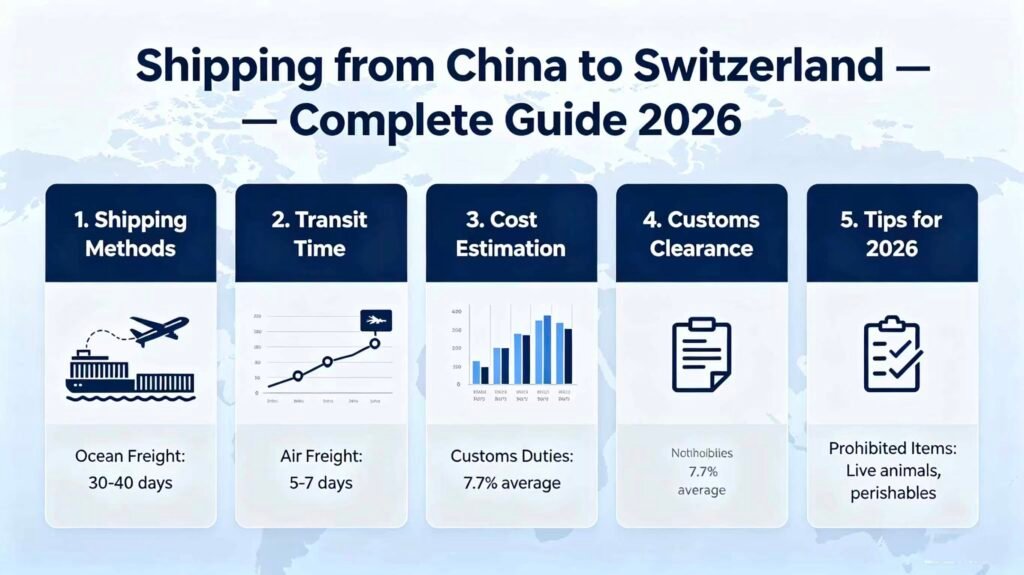
Why Shipping from China to Switzerland Requires a Specialist Freight Partner
Shipping from China to Switzerland involves a layered logistics chain: freight from Chinese ports to North Sea gateway ports (Rotterdam, Hamburg, Antwerp), then inland transit via barge or rail to Basel — Switzerland’s primary goods gateway. The absence of a Swiss seaport adds complexity and transit time compared to direct port-of-destination markets.
Three factors make Switzerland distinctive for China importers:
- China–Switzerland FTA (2014) — preferential tariff rates. Switzerland was one of the first European countries to sign a bilateral FTA with China. Qualifying goods enjoy reduced or zero tariffs under the agreement, provided a valid Form E certificate of origin is submitted. This is a significant cost advantage unavailable to importers shipping to EU destinations.
- Swiss customs valuation — weight-based system. Unlike most countries that calculate customs duties primarily on transaction value, Switzerland also factors in weight and product type. Understanding this system is critical for accurate landed cost calculations.
- 8.1% VAT — substantially lower than EU rates. Switzerland’s standard VAT rate of 7.7% is nearly three times lower than the EU average. For food and books, the reduced rate is just 2.5%. This is a meaningful cost advantage for Swiss importers.
- Passar — mandatory digital customs declaration. All commercial imports into Switzerland must be declared through the Passar digital customs platform administered by the Swiss Federal Customs Administration (FCA).
A specialist freight forwarder China to Switzerland is essential. BAT Logistics brings 20 years of dangerous goods transport experience and deep expertise on the China–Switzerland trade lane — from Chinese factory through North Sea gateway ports to Basel and final Swiss delivery.
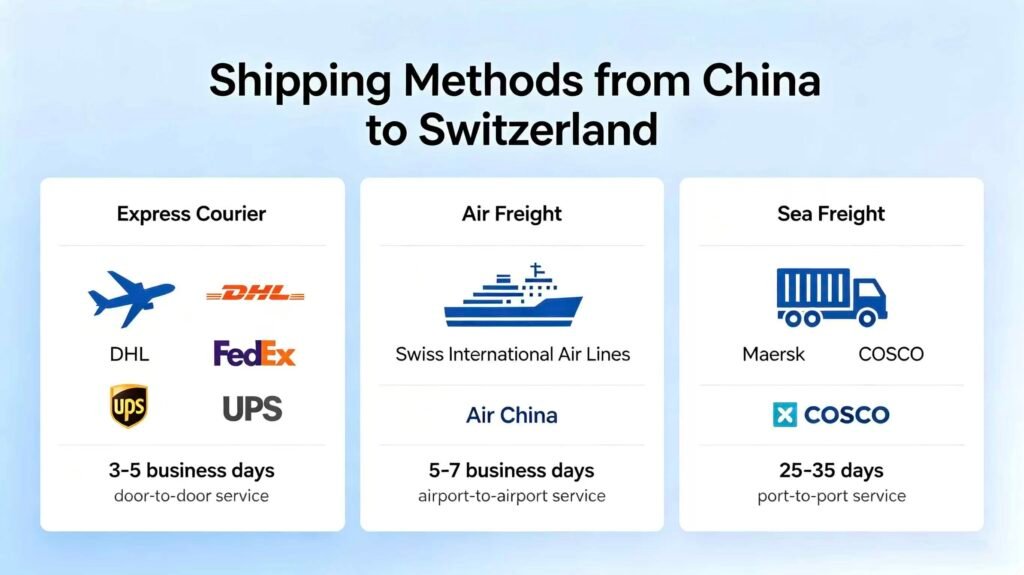
Shipping Methods from China to Switzerland — Which Option Is Right for You?
Sea Freight from China to Switzerland
Sea freight is the dominant and most cost-effective mode for China–Switzerland trade. Because Switzerland has no seaport, all sea freight arrives at North Sea gateway ports — typically Rotterdam (Netherlands), Hamburg (Germany), or Antwerp (Belgium) — before transiting inland via barge or rail to Basel, Switzerland’s primary goods gateway.
FCL (Full Container Load) — Book an entire 20ft or 40ft container exclusively. Best for shipments above 15 CBM.
LCL (Less than Container Load) — Your cargo shares a container, charged per CBM. Best for smaller shipments of 1–15 CBM.
Key sea freight routes to Switzerland (via North Sea gateway ports):
Route | Inland Transit to Basel / Zurich | Total Door-to-Door (Est.) |
|---|---|---|
Shanghai → Rotterdam → Basel | 5–8 days barge/rail | 40–65 days |
Shenzhen / Guangzhou → Hamburg → Basel | 4–7 days rail | 35–50 days |
Ningbo → Antwerp → Basel | 5–8 days barge/rail | 40–65 days |
Shanghai → Antwerp → Zurich | 6–9 days truck | 40–65 days |
Major China ports: Shanghai, Shenzhen (Yantian, Shekou), Guangzhou, Ningbo, Qingdao, Xiamen, Tianjin
Major European gateway ports: Rotterdam, Hamburg, Antwerp
Swiss destination hubs: Basel (main gateway), Zurich, Geneva, Bern
2026 FCL rate benchmarks (Shanghai to Rotterdam gateway, including inland to Basel):
- 20ft container: $1,650–$2,900 (including inland to Basel)
- 40ft / 40HQ container: $3,100–$4,500 (including inland to Basel)
- LCL: $15–$80 per CBM (including inland to Basel)
Best for: Bulk goods, furniture, machinery, electronics, textiles, automotive parts.
Rail Freight from China to Switzerland
Rail freight via the China–Europe Railway Express is an increasingly popular middle-ground option, with Switzerland accessible via the European rail network through Germany.
Key facts:
- Route: China → Kazakhstan → Russia → Belarus → Poland → Germany (Duisburg / Hamburg) → Basel, Switzerland
- Typical transit time: 18–25 days (China to Basel)
- Container types: 20ft and 40ft containers, including 40HQ
- Switzerland’s rail network (SVRT — Swiss Federal Railways) provides efficient onward distribution
- Best for: Mid-sized shipments where sea is too slow but air is too expensive; bypasses Suez and Red Sea routing
Best for: Mid-value cargo, electronics, automotive parts, pharmaceuticals, shipments from China’s interior cities.
Air Freight from China to Switzerland
Air freight to Switzerland is significantly faster — typically 3–7 days door-to-door — but 6–10x more expensive than sea freight.
Typical air freight rates (China to Switzerland), 2025:
- General cargo: $6.00–$11.00 per kg
- Express courier (DHL / FedEx / UPS): $9.00–$14.00 per kg
Major Swiss airports: Zurich Airport (ZRH — major cargo hub), Geneva Airport (GVA), Basel EuroAirport (BSL)
Best for: High-value goods, urgent shipments, pharmaceuticals (cold chain), samples, time-sensitive cargo.
Express Shipping from China to Switzerland (DHL / FedEx / UPS)
Express courier delivers from China to Switzerland in 3–5 business days door-to-door — the fastest option for small parcels and urgent shipments.
Best for: Small parcels, samples, urgent documents, B2C e-commerce shipments.
Door-to-Door Shipping from China to Switzerland
Door-to-door shipping bundles the entire journey: pickup in China, freight to the North Sea gateway port, inland transit to Switzerland, Passar customs declaration, VAT settlement, and final delivery to your Swiss address.
DDP (Delivered Duty Paid) is the most convenient option: BAT Logistics handles everything — freight, inland transit, FCA customs clearance, Form E FTA documentation, Swiss VAT, and last-mile delivery — invoicing you a single all-inclusive rate.
BAT Logistics offers DDP door-to-door service for all China–Switzerland shipments, including Passar digital declaration submission, Form E certificate of origin preparation, and coordinated delivery across all Swiss cantons.
Shipping Cost from China to Switzerland — 2026 Rate Guide
Import Duty Calculator
Calculate total landed cost for Switzerland destination.
CHF
CHF
Customs Value (CIF)
CHF 0.00
Customs Duty Rate
0%
Customs Duty Amount
CHF 0.00
Swiss VAT Amount
CHF 0.00
Total Landed Cost
CHF 0.00
📊
Calculation Summary
Click “Calculate Total” to see the breakdown of duties and VAT.
Understanding shipping cost from China to Switzerland means accounting for freight, inland transit, Swiss customs duties (including the FTA advantage), and Switzerland’s 8.1% VAT.
What Determines Your Total Landed Cost?
- Shipping method
- Cargo volume and weight (Swiss customs uses weight-based calculation)
- FTA eligibility — Does your product qualify for preferential tariff rates under the China–Switzerland FTA?
- Swiss customs duty rate — 0% to 8%+ depending on HS code and FTA status
- 8.1% Swiss VAT — Applied to customs value + duties
- Passar declaration fees
- Swiss customs clearance fees
- Inland transit costs — Barge, rail, or truck from gateway port to Swiss destination
Switzerland Import Duty Rates by Category (Representative rates)
Category | Standard Duty Rate | FTA Preferential Rate (with Form E) |
|---|---|---|
Electronics | 0–5% | 0–3% |
Machinery | 0–3% | 0–2% |
Textiles and clothing | 5–12% | 3–8% |
Footwear | 6–17% | 4–12% |
Furniture | 0–4% | 0–2% |
Toys | 0–4.5% | 0–2% |
Automotive parts | 0–4.5% | 0–3% |
The China–Switzerland FTA (2014) significantly reduces or eliminates duties on thousands of product categories. Always confirm your specific HS code’s FTA rate.
How to Calculate Switzerland Import Costs — Including 8.1% VAT
Step 1: Customs Value = CIFStep 2: Duty = Customs Value × Applicable Rate (check FTA eligibility)Step 3: VAT = 8.1% × (Customs Value + Duty)
Example (without FTA):
- Product value: CHF 25,000
- Freight and insurance: CHF 1,200
- Customs value: CHF 26,200
- Customs duty (4%): CHF 1,048
- Swiss VAT (8.1% × CHF 27,248): CHF 2,207
The FTA Advantage Example (Form E):
- Same shipment, FTA-eligible electronics (0% duty): CHF 0 duty → Swiss VAT (8.1% × CHF 26,200) = CHF 2,122 — saving CHF 1,048 in duties
2026 Shipping Cost Summary
Shipping Method | Cost Range (Incl. Inland to Basel) | Transit Time | Best For |
|---|---|---|---|
Sea Freight FCL (20ft) | $1,650–$2,900 / container | 33–43 days | Bulk, heavy |
Sea Freight FCL (40ft) | $3,100–$4,500 / container | 33–43 days | Very large shipments |
Sea Freight LCL | $15–$80 / CBM | 35–45 days | 1–15 CBM |
Rail Freight | $3.00–$5.50 / kg | 18–25 days | Mid-value cargo |
Air Freight | $6.00–$11.00 / kg | 3–7 days | Time-sensitive |
Express Courier | $9.00–$14.00 / kg | 3–5 days | Small parcels, samples |
BAT Logistics provides transparent, all-inclusive pricing. We quote your full landed cost — freight, inland transit, FCA duties, Swiss VAT, and all charges upfront.
Shipping Time from China to Switzerland — How Long Does It Take?
Method | Transit Time |
|---|---|
Express Courier | 3–5 business days |
Air Freight (via Zurich / Geneva) | 3–7 business days |
Rail Freight | 18–25 days |
Sea Freight (via Rotterdam / Hamburg → Basel) | 33–45 days |
Sea Freight (via Cape of Good Hope detour) | 43–58 days |
Swiss Customs and Regulations — Importing from China to Switzerland
Swiss Federal Customs Administration (FCA) — Passar Digital Declaration
Switzerland’s customs authority is the Swiss Federal Customs Administration (FCA). All commercial imports from China must be declared through the Passar digital customs platform — Switzerland’s mandatory electronic customs declaration system. Paper-based submissions are no longer accepted for commercial imports.
China–Switzerland Free Trade Agreement (2014) — Form E
The China–Switzerland Free Trade Agreement, in force since 2014, provides preferential tariff rates on thousands of product categories. To claim FTA benefits:
- Obtain a Form E certificate of origin from a certified issuing body in China
- Ensure the HS code and product description on the Form E match your shipment
- Submit the Form E through Passar during customs declaration
Swiss Customs Valuation — Weight-Based System
A distinctive feature of Swiss customs: Switzerland considers both the value and weight of goods when assessing customs duties. For certain product categories — particularly textiles, footwear, and leather goods — the weight-based tariff component can be the primary determinant of duty liability.
Swiss EORI Number
Switzerland has its own EORI system (CH EORI). Businesses importing into Switzerland must have a valid Swiss EORI number for customs declarations. This is separate from the EU EORI system.
Swiss VAT on Imports — 8.1% Standard Rate
Switzerland applies a 7.7% standard VAT rate (Mehrwertsteuer / TVA) — substantially lower than EU nations. Reduced rates:
Category | Swiss VAT Rate |
|---|---|
Standard (most goods and services) | 8.1% |
Food, books, newspapers | 2.5% |
Hotel accommodation | 3.7% |
CE Marking and Swiss Regulations
Although not an EU member, Switzerland largely recognizes CE marking for regulated product categories. Swissmedic regulates pharmaceuticals, medical devices, and health-related products.
Documents Required for Shipping from China to Switzerland
Document | Purpose |
|---|---|
Commercial Invoice | Customs valuation, HS code, transaction value in CHF or EUR |
Packing List | Contents, weight, dimensions |
Bill of Lading (B/L) / Air Waybill (AWB) | Contract of carriage |
Form E — Certificate of Origin | Required to claim China–Switzerland FTA preferential tariffs |
Swiss EORI Number (CH EORI) | Mandatory for all Swiss customs declarations |
Passar Customs Declaration | Lodged electronically by your customs broker |
CE Marking Documentation | Required for regulated product categories |
Swissmedic Approvals | Required for pharmaceuticals and medical devices |
Import Licenses | Required for restricted goods |
RoHS Declaration | Required for electronics imports |
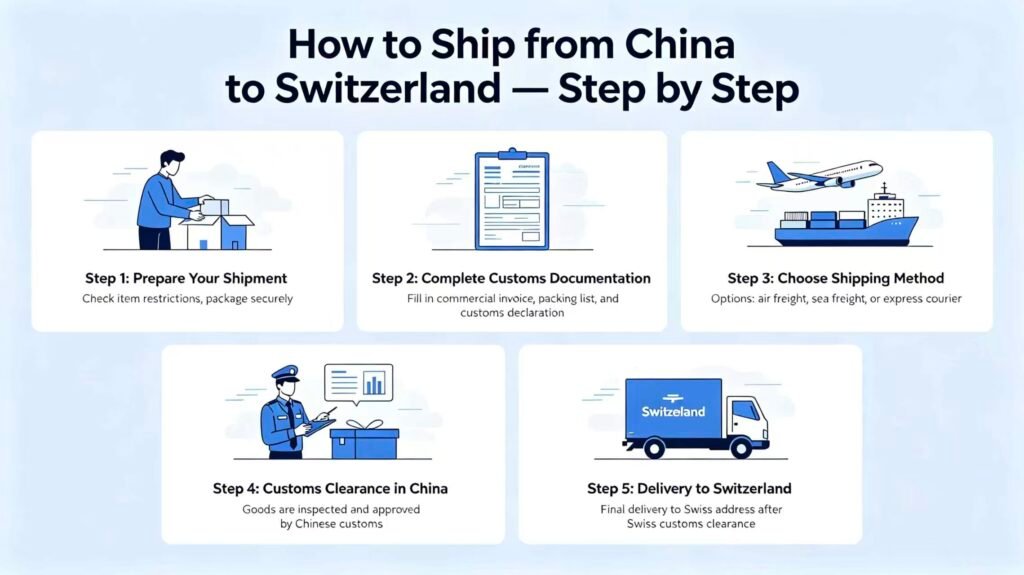
How to Ship from China to Switzerland — Step by Step
Step 1 — Verify FTA Eligibility (Form E): Check whether your product qualifies for preferential tariff rates. Arrange a Form E certificate of origin from a certified Chinese issuing body before shipment.
Step 2 — Classify Your Goods (HS Code): Determine your HS code and understand Swiss customs valuation rules — particularly for textiles, footwear, and leather goods where weight-based tariffs apply.
Step 3 — Calculate Full Landed Cost: Calculate: freight + inland transit + Swiss customs duty + 7.7% Swiss VAT + Passar fees + FCA clearance fees + last-mile delivery.
Step 4 — Choose Your Shipping Method:
- Large volume / non-urgent → Sea freight FCL (via Rotterdam or Hamburg to Basel)
- Mid-sized / cost-sensitive → Rail freight or Sea freight LCL
- Time-sensitive / high-value → Air freight (via Zurich or Geneva)
- Small parcels / samples → Express courier
Step 5 — Register Swiss EORI and Arrange Customs Broker: Apply for a Swiss EORI number (CH EORI). Engage a Swiss customs broker experienced with the Passar platform and FCA procedures.
Step 6 — Track, Clear, and Receive: Monitor via tracking. FCA may examine cargo (1–5 days). Passar declaration processing typically takes 1–3 business days.
Shipping from China to Amazon FBA Switzerland — Key Points
Key requirements: FNSKU labels, CE marking, Swiss EORI number, Passar declaration, 7.7% Swiss VAT obligations, and coordinated Amazon FC delivery. Note: Amazon Switzerland has a smaller FBA network compared to Germany or France; many sellers use German FBA and fulfill to Switzerland cross-border. BAT Logistics advises on the most efficient approach.
BAT Logistics — Your Trusted China to Switzerland Freight Partner
Who We Are
BAT Logistics is a China-based freight forwarding company with 20 years of specialised dangerous goods transport experience and broad capabilities on the China–Switzerland trade lane. As a recognized industry leader in China’s logistics sector, we serve importers across e-mobility, electronics, pharmaceuticals, machinery, and consumer goods sectors — including significant volumes on the China–Switzerland route via Rotterdam, Hamburg, and Antwerp gateway ports.
Our Core Credentials:
- ✅ 20 years of dangerous goods transport expertise — Certified handling for lithium battery, chemical, pharmaceutical, and DG-classified cargo on sea, rail, and air
- ✅ Strategic carrier partnerships — Guaranteed space with major shipping lines, airlines, and rail operators on China–Europe and China–Switzerland routes
- ✅ Switzerland gateway expertise — Deep experience with Basel as Switzerland’s primary goods gateway; established relationships with Swiss barge, rail, and truck operators
- ✅ Form E certificate of origin service — Assisting clients with FTA documentation to claim China–Switzerland FTA preferential tariff rates
- ✅ Passar platform expertise — Coordinating with Swiss broker partners for FCA digital customs declarations
- ✅ Swiss EORI and VAT guidance — Advising on Swiss import requirements including CH EORI registration
- ✅ End-to-end DDP service — Factory pickup in China through to door delivery across all Swiss cantons
- ✅ Full landed cost transparency — Quoting FCA duties, Swiss VAT, and all charges upfront
Why Importers Choose BAT Logistics:
Our Strength | Your Benefit |
|---|---|
20 years DG expertise | Correct handling of complex, regulated cargo |
Basel gateway expertise | Efficient transit through Europe’s most important inland port |
China–Switzerland FTA knowledge | Lower duties through Form E documentation |
Passar platform experience | Smooth FCA digital customs clearance |
7.7% VAT optimization | Lower VAT cost than any EU destination |
Transparent pricing | Know your full landed cost before your cargo ships |
Shipping from China to Switzerland — Case Study
Client: A Zurich-based specialty watch retailer importing watch accessories and precision tools from suppliers in Shenzhen and Guangzhou. Monthly import volume: 2–3 × 40ft containers via Rotterdam → Basel.
Challenges:
- Unaware of China–Switzerland FTA benefits — Previously paid full standard customs duty rates on all shipments; never claimed FTA preferential tariffs despite qualifying product categories
- Swiss customs valuation confusion — Accessories and packaging materials were misclassified, triggering higher duty assessments under Swiss weight-based tariff rules
- Amazon.ch expansion — Planning to launch on Amazon Switzerland with FBA; needed guidance on Swiss EORI, Passar declaration, and 7.7% VAT registration
- Pharmaceutical ancillary products — Shipping some components subject to Swissmedic oversight; needed regulatory guidance on import classification
- Inland transit coordination — Complex multi-leg journey: sea freight to Rotterdam, barge transit to Basel, customs clearance, last-mile delivery to Zurich; required single-point coordination
The BAT Logistics Solution:
- China–Switzerland FTA optimization — Conducted a comprehensive product classification review; confirmed three product categories qualified for FTA preferential rates. Arranged Form E certificate of origin issuance for all qualifying shipments. Client saved approximately CHF 18,000 in customs duties in the first six months
- Swiss customs valuation correction — Reclassified accessory SKUs under correct HS codes with proper weight-based tariff analysis; eliminated erroneous duty assessments and recovered approximately CHF 4,200 in overpaid duties
- Amazon Switzerland launch support — Guided client through Swiss EORI (CH EORI) registration, Passar setup, and 7.7% VAT registration with the Swiss Federal Tax Administration (ESTV)
- Swissmedic classification guidance — Identified which ancillary products required Swissmedic approval; arranged pre-clearance consultation with Swiss broker partner to prevent shipment holds
- Single-point coordination — Managed the entire multi-leg journey: Rotterdam port handling, barge booking to Basel, Passar FCA declaration, FCA duty payment (or FTA deferral), and coordinated truck delivery to Zurich; provided real-time tracking throughout
Results:
Metric | Before BAT | After BAT |
|---|---|---|
Annual customs duty savings (FTA) | CHF 0 | ~CHF 36,000 |
Customs duty overpayment recovered | — | CHF 4,200 |
Swiss EORI / Passar setup | Not initiated | Operational in 3 weeks |
Amazon.ch launch readiness | 6+ months | 8 weeks |
Multi-leg transit coordination | Multiple providers, fragmented | Single point of contact |
Shipment tracking visibility | Limited | Real-time, full chain |
Monthly import volume | 2–3 containers | 3–5 containers |
“We had no idea we were eligible for FTA preferential rates — we’d been paying full duties for three years. BAT Logistics showed us exactly which of our products qualified, arranged the Form E certificates, and the savings were immediate. Their Basel-to-Zurich coordination is also seamless.” — Operations Director, Zurich Specialty Watch Retailer
Frequently Asked Questions — Shipping from China to Switzerland
1. Is Switzerland in the EU? How does that affect shipping from China?
No, Switzerland is not a member of the European Union. It has its own customs authority — the Swiss Federal Customs Administration (FCA) — and its own customs regulations. Switzerland's standards are closely aligned with EU regulations. This means: no EU customs union complexity, no CET (EU Common External Tariff), and no risk of Brexit-style regulatory changes. Switzerland has its own EORI system (CH EORI) separate from the EU EORI.
2. Does Switzerland have a free trade agreement with China?
Yes. The China–Switzerland Free Trade Agreement (FTA) has been in force since July 2014 — one of the first bilateral FTAs between China and a European country. Thousands of product categories enjoy reduced or zero tariffs under the FTA. To claim these benefits, you need a Form E certificate of origin issued by a certified body in China.
3. How much does shipping from China to Switzerland cost in 2026?
Sea freight FCL (40ft, including inland transit to Basel) ranges from $3,800–$5,200 per container. LCL (including inland to Basel) runs $85–$140 per CBM. Rail freight is $3.00–$5.50 per kg. Air freight is $5–$10 per kg. Express courier is $12–$22 per kg. All exclude Swiss customs duties and 7.7% Swiss VAT.
4. How long does shipping from China to Switzerland take?
Sea freight via Rotterdam or Hamburg to Basel takes 3555 days door-to-door. Rail freight takes 18–25 days. Air freight takes 3–7 days. Express courier takes 3–5 days.
5. Does Switzerland charge import duty on goods from China?
Yes. Switzerland applies customs duties based on HS code and product weight (a unique feature of Swiss customs valuation). Standard rates range from 0% to 8%+. Under the China–Switzerland FTA, qualifying goods enjoy significantly reduced or zero tariffs with a valid Form E certificate of origin.
6. What is the VAT rate in Switzerland?
Switzerland's standard VAT rate is 7.7% — substantially lower than EU nations (19–27%). Reduced rates: 2.5% for food and books; 3.7% for hotel accommodation.
7. What is the Passar digital customs system?
Passar is Switzerland's mandatory electronic customs declaration platform administered by the Swiss Federal Customs Administration (FCA). All commercial imports into Switzerland must be declared through Passar. Paper-based declarations are no longer accepted.
8. What documents do I need to ship goods from China to Switzerland?
Commercial Invoice, Packing List, Bill of Lading (B/L) or Air Waybill (AWB), Swiss EORI Number (CH EORI), and Passar customs declaration. For FTA preferential tariffs: Form E certificate of origin. Electronics require CE marking documentation and RoHS declaration. Pharmaceuticals require Swissmedic approvals.
9. Can I ship from China to Switzerland by DHL, FedEx, or UPS?
Yes. Express courier delivers in 3–5 business days door-to-door — the fastest option for small parcels and urgent shipments.
10. Can BAT Logistics handle dangerous goods shipping from China to Switzerland?
Absolutely. 20 years of dangerous goods transport is our core specialisation. BAT Logistics handles DG cargo — including lithium batteries, chemicals, and pressurised containers — on all transport modes to Switzerland (sea, rail, air) with full IATA DGR, IMDG Code, and Swiss regulatory compliance.
Ready to Ship? Get a Quote from BAT Logistics
Shipping from China to Switzerland requires navigating the unique challenges of a non-EU market: the China–Switzerland FTA with Form E certificates, weight-based Swiss customs valuation, the mandatory Passar digital customs platform, 7.7% Swiss VAT optimization, and the multi-leg transit chain from North Sea gateway ports through Basel.
BAT Logistics combines 20 years of dangerous goods transport leadership with deep China–Switzerland trade lane expertise. Our Form E FTA documentation service ensures you pay the lowest possible tariffs. Our Passar platform expertise guarantees smooth FCA customs clearance. Our Basel gateway experience coordinates your entire inland transit seamlessly.
Contact BAT Logistics today for a free shipping consultation and all-inclusive Switzerland landed cost quote.