Sea & Ocean Freight from China—2026

In recent years, Sea Freight from China has continued to demonstrate strong global competitiveness. In the first 11 months of 2024, China’s total foreign trade throughput across all ports reached 4.96 billion tons, marking a 7.3% year-on-year increase. Container throughput hit 304 million TEUs, also up by 7.3%. This steady growth throughout 2024 has laid a solid foundation for China’s sea freight exports in 2025.

From January to September 2025, China exported 5,226 vessels, an impressive 23.5% year-on-year increase, with an export value of USD 40.55629 billion, up by 22.4%. In September 2025 alone, China exported 543 vessels—up 24% year-on-year—with a value of USD 6.62498 billion, reflecting a remarkable 43.1% increase.

Sea freight plays a pivotal role in global trade, and battery shipping also contributes significantly within this ecosystem. In 2024, our company achieved an export cargo value of USD 1 billion through Sea Freight from China, handling over 500 containers and shipping to 35 countries and regions. From January to October 2025, we continued contributing USD 900 million in export value, moving over 400 containers to 30 countries and regions.

What is Sea Freight
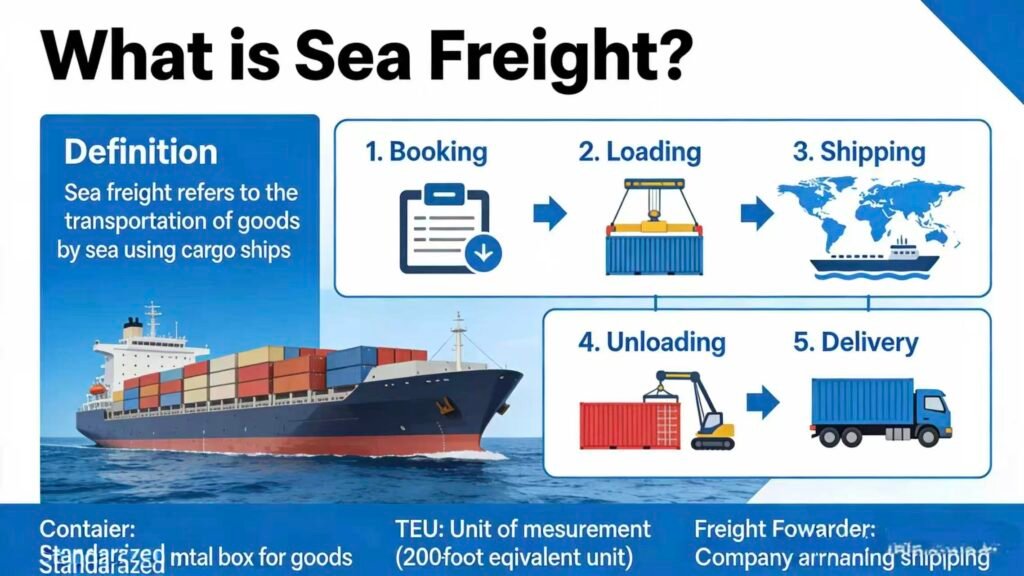
Sea/Ocean Freight refers to the transportation of goods by vessels operating along maritime shipping routes, moving cargo from ports in China to ports in various countries and regions around the world. It is currently the most widely used mode of transportation in international trade.

Importance of Sea Freight

Sea freight is the central transportation mode of the global supply chain. Currently, ocean exports account for 80–90% of the total global trade volume, while air freight represents only 3–5%. In 2024, the global sea freight cargo volume reached 12 billion tons, with China contributing approximately 8% of the world’s total maritime exports.
 
Global container capacity has reached about 25 million TEU, with China holding 20% of that capacity. From 2015 to 2024, China’s sea freight export volume increased from 500 million tons to 720 million tons, with an average annual growth rate of around 3.8%. Container exports grew from 21 million TEU in 2015 to 28 million TEU in 2024.
 
Looking ahead to 2025–2030, China’s ocean export volume is expected to maintain a compound annual growth rate above 6.5%, with total exports projected to surpass 1 billion tons by 2030. High value-added goods are expected to exceed 70% of the total export volume.

How does it work?

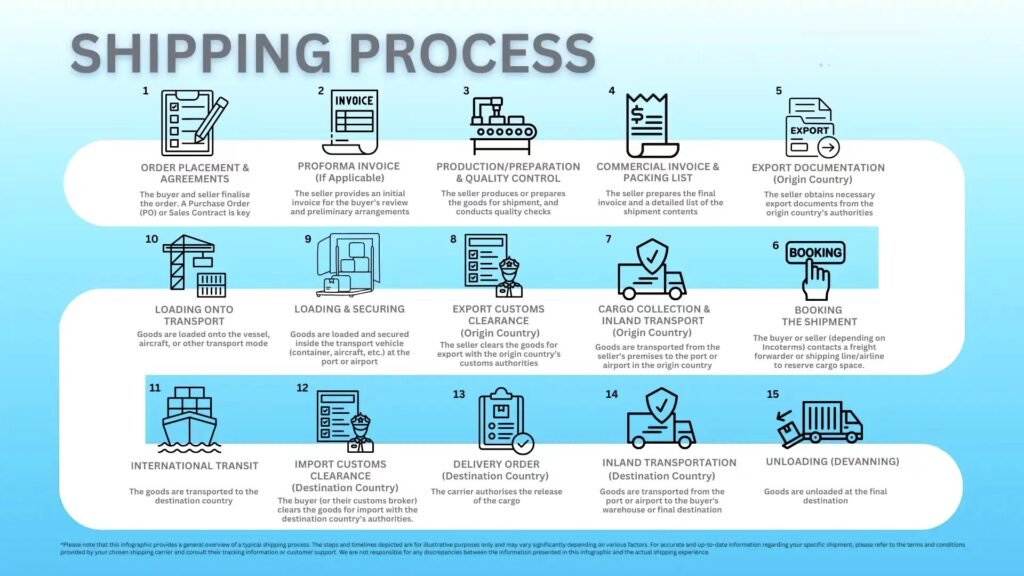
Ocean freight is a complex logistics chain involving multiple procedures, multiple stakeholders, and tightly connected operational stages. The entire process revolves around four core steps: compliant export of goods, cross-border sea transportation, compliant import – final delivery.
 
This workflow involves numerous parties, including exporters, importers, freight forwarders, carriers, customs brokers, ports, customs authorities, and inspection & quarantine agencies.
 
Below is the complete workflow for sea freight export, broken down in chronological order, designed to balance both general applicability and real-world operational practices.

l.Preparatory stage

1.Signing the Trade Contract:
 
The exporter and importer sign an international trade contract specifying the key terms, including: product name, quantity, specifications, unit price, payment method (such as L/C or T/T), delivery terms (e.g., EXW, FOB, FCA, CPT, CIP, CIF, DAP, DDU, DDP — which determine who bears the transportation and insurance costs), destination port, delivery deadline, and more.
 
Key point: Trade terms directly affect the responsibilities for booking space, insurance, and customs declaration. For example:
•Under FOB, the importer is responsible for booking the vessel.
•Under CIF, the exporter is responsible for freight booking + insurance
2.Preparing Cargo and Required Documentation
 
The exporter prepares the products through production or procurement according to the contract requirements, completes quality inspection, and organizes all shipment details, including cargo weight, volume, number of packages, and packaging method.
 
Documents to Prepare (for export customs clearance and destination import clearance):
 
  • Commercial Invoice Contains the shipper/consignee information, cargo description, quantity, and value. It serves as a key basis for customs export declaration.
  • Packing List Specifies the detailed packaging information of the shipment, including the quantity, weight, and volume of each package, which helps customers verify the cargo.
  • Sales Contract Acts as proof of the trade transaction and the invoice amount between the exporter and importer.
  • Certificate of Origin (CO) Required by certain countries for customs clearance or to obtain preferential tariff treatments.
  • Customs Declaration Form A consolidated declaration document that includes the shipper/consignee details, trading country, port of arrival, cargo name, quantity, and declared value.
3.Booking Space (Exporter/Importer → Freight Forwarder → Carrier/Shipping Agent)
 
The exporter or importer places a booking request with a freight forwarder. Most companies choose to book through freight forwarders because they consolidate shipping resources, are more familiar with various trade lanes, and can coordinate different operational steps more efficiently.
 
To book space, the following information must be provided: cargo details (volume, weight, number of packages, and description), destination port, delivery deadline, and trade terms.
 
After confirmation, the freight forwarder issues the booking confirmation, specifying the vessel name, voyage number, estimated loading date, and container type (20GP/40GP/40HQ).
 

II.Inspection and Customs Declaration

1. Commodity Inspection (if required, Forwarder → Inspection & Quarantine Authority)
 
For certain categories of goods—such as food products, cosmetics, machinery, and dangerous goods—the exporter must apply for inspection with the local Inspection and Quarantine Authority. Required documents typically include the commercial invoice, packing list, and inspection application form.
Once the goods pass inspection, the authority issues the “Outbound Cargo Clearance Certificate, which is a mandatory document for customs declaration. (For goods that do not require inspection, this step can be skipped.)
 
2. Customs Declaration (Exporter / Forwarder → Customs)
 
Submit all required declaration documents, including the electronic Customs Declaration Form, commercial invoice, packing list, sales contract, and inspection compliance documents (if applicable).
 
Customs Review: Customs will verify whether the declared information matches the actual cargo and may conduct random inspections if necessary.
Release: Once approved, Customs issues the “Electronic Customs Release Receipt,” allowing the cargo to proceed to the port loading stage.

III. From Warehouse to Vessel

1. Container Loading

For FCL (Full Container Load): The exporter instructs the freight forwarder to arrange trucking. The trucking company picks up an empty container from the carrier-designated container yard and transports it to the factory or the forwarder’s warehouse for loading. After loading, the container is sealed (the seal number must be recorded for later verification) and transported back to the port terminal.
For LCL (Less than Container Load): The exporter delivers the cargo to the freight forwarder’s designated warehouse. The forwarder consolidates cargo from multiple shippers into a single container.
 

2. Port Handover & Container Inspection

Once the container arrives at the port, terminal staff verify the seal number and container number to ensure they match the booking information, then input the data into the port system and arrange temporary storage.
If customs inspection is required, the terminal coordinates to move the container to the inspection area. Customs officers may unseal and examine the cargo. After verification, the container is resealed.
 

3. Loading Onto the Vessel

When the vessel arrives, the terminal loads containers onto the ship using quay cranes according to the carrier’s loading plan.
After confirming the onboard cargo details, the carrier issues the Bill of Lading (B/L) to the freight forwarder or exporter. The B/L serves as the document of title, recording vessel name, voyage number, container number, cargo details, and consignee information. It is the key document used for import customs clearance and cargo release at the destination

IV. Maritime navigation and tracking

1. Vessel Departure & Shipment Tracking

Shipping lines operate according to scheduled routes. During the voyage, vessels are monitored via satellite tracking systems. Freight forwarders or exporters can check the shipment status on the carrier’s official website, including the container’s ETD (Estimated Time of Departure) and ETA (Estimated Time of Arrival).
 
If the cargo requires transshipment (for example, most China–Europe routes transship via Singapore), the freight forwarder must coordinate the cargo connection during the transshipment process to ensure smooth movement.
 

2. Cargo Insurance & Claims (If Required: Exporter → Insurance Company)

Under CIF terms, the exporter is responsible for purchasing cargo insurance before the goods are loaded on board. Common insurers include Ping An and Pacific Insurance. The exporter must submit the bill of lading and commercial invoice when purchasing insurance.
If the cargo is damaged or lost during transportation, the exporter may file a claim with the insurer using the insurance policy and supporting documents.

V. Cargo Arrival at Destination: Customs Clearance & Pickup

1. Arrival Notice (Carrier ➝ Forwarder ➝ Consignee)

Typically, 3–7 days before the vessel arrives, the carrier sends an arrival notice to its destination agent.
The freight forwarder then informs the consignee to prepare for import customs clearance.
At the destination port, the carrier completes the vessel arrival procedures and submits the commercial invoice, packing list, and Bill of Lading to local customs.
 

2. Import Customs Clearance (Consignee / Forwarder ➝ Destination Customs)

The consignee appoints a local freight forwarder or customs broker to handle the import declaration.
The following documents must be submitted:
  • Original or telex release Bill of Lading
  • Commercial invoice
  • Packing list
  • Certificate of origin
  • Import license (if applicable)
Customs reviews the documents, verifies cargo information, and may conduct inspections. Duties, VAT, or other taxes are calculated and paid by the consignee. Once completed, customs issues a customs release notice.
 

3. Discharging & Cargo Pickup (Terminal ➝ Consignee)

Container Discharging: With the customs release notice, the terminal unloads the container from the vessel to the container yard (CY). After verifying the seal and container number, the consignee is allowed to pick up the cargo.
For FCL: The consignee arranges trucking to pick up the full container from the CY and transport it to the designated warehouse, where it is unstuffed.
For LCL: The consignee picks up their cargo from the LCL warehouse operated by the destination consolidator, using the Bill of Lading as proof.
 

4. Cargo Delivery & Closing

The consignee inspects the cargo for quantity, packaging, and quality. Once confirmed, they sign for receipt and the sea freight process is completed.
If there is any damage or shortage, the consignee must immediately file a claim with the carrier and/or insurance company, providing evidence such as:
  • Bill of Lading
  • Packing list
  • Photos of the damage
  • Detailed description of the issue

VI. Core Process Summary

Trade Contract → Cargo Preparation & Booking → Inspection & Export Customs Declaration → Container Loading & Delivery to Port → Vessel Loading & Departure → Ocean Transportation → Destination Customs Clearance → Discharging & Cargo Pickup → Final Delivery

Sea Freight Rate&Cost Trends in 2025 and Market Outlook

In 2025, Sea Freight Rate levels for full container load (FCL) exports from China showed significant volatility with clear route differentiation. At the beginning of the year, weak market demand led to depressed freight rates. By mid-year, the impact of tariff policy adjustments partially pushed rates upward, resulting in periodic increases. Toward the end of the year, shipping lines implemented concentrated tariff and surcharge increases, triggering an unusual phenomenon of freight rate hikes during the traditional low season.

I.Sea Freight Rate Trends from Early to Mid-2025: Initial Weakness Followed by Sharp Increases, with Notable Gains on Trans-Pacific Routes

Weak rates at the beginning of the year: In early 2025, influenced by the Chinese New Year, export demand remained subdued, leading to a generally weak ocean freight market. At the same time, uncertainties in the global trade environment limited upward momentum in Sea Freight Rate levels, placing the market in an overall adjustment phase.
 
Mid-year surge in freight rates: In April, although U.S. tariff measures had some impact. Most exporters had already built up inventory in advance, resulting in limited short-term rate fluctuations. However, in May, the U.S. decision to suspend tariffs and enter bilateral negotiations triggered a strong cargo rush, sharply driving up freight rates from China to the United States.
 
Between April and May, average Sea Freight Rate levels from Shanghai to the U.S. West Coast increased by 57.3%, while rates to the U.S. East Coast rose by 37.3%. In addition, escalating tensions between Iran and Israel in June pushed average freight rates from Shanghai to Jebel Ali up by 55% between May and June.

II. November: Asia–Europe Routes Rise Against the Trend While Multiple Routes See Declines in Sea Freight Rates

Routes with rising rates:
 
In November, Sea Freight Rate indices for China’s export routes to Europe and the Mediterranean increased by an average of 9.3% and 9.5% month on month. Correspondingly, the average market freight rates from Shanghai Port to the main base ports in these two regions rose by 14.8% and 20.6%, respectively. This upward movement was mainly driven by peak-season cargo demand related to European holiday consumption, including Christmas. In addition, growing overseas demand for Chinese solar photovoltaic products and electric vehicles provided further support to these routes.
 
Routes with declining rates: On November 21, Sea Freight Rate levels from Shanghai to major U.S. West Coast and East Coast ports declined by 9.8% and 8.3%, respectively, compared with the previous period. Freight rates on Australia–New Zealand routes dropped sharply by 11.8%, while South American routes continued their downward trend. Rates on the Red Sea–related routes also recorded a modest decrease of 2.9%. These declines were primarily due to sluggish economic recovery in the corresponding regions, restrained consumer demand, and insufficient momentum for growth in transportation demand.

III.December: Major Carriers Implement Intensive Rate Increases, Showing a “Peak-Season Pricing in the Off-Season” Pattern

Short-term decline earlier in the month:
 
In early December, Sea Freight Rate levels remained weak. As of December 5, freight rates from Shanghai to the U.S. West Coast declined by 5.0% compared with the previous period, while rates from Shanghai to major European base ports edged down slightly by 0.3%. Earlier, on November 21, the Shanghai Containerized Freight Index (SCFI) had fallen for consecutive periods to 1,393.56 points, with the U.S. West Coast route recording a cumulative drop of 37.85% over the previous three weeks.
 
Collective rate hikes later in the month:
 
Subsequently, several leading shipping lines, including MSC and CMA CGM, announced concentrated Sea Freight Rate increases. In December, MSC not only implemented an initial round of freight hikes on multiple routes from the Far East to Northern Europe and the Mediterranean, but also launched a second round of increases. For example, freight rates for 40-foot containers on the Northern Europe route were raised by an additional USD 400. Meanwhile, CMA CGM announced that effective December 15, freight rates on routes from Asia to Northern Europe would be increased, with rates on certain Asia–Mediterranean and Asia–North Africa routes reaching up to USD 7,500 per 40-foot container. As a result, Mediterranean routes were the first to respond, with freight rates from Shanghai to major Mediterranean ports already rising by 3.0% as of December 5.