
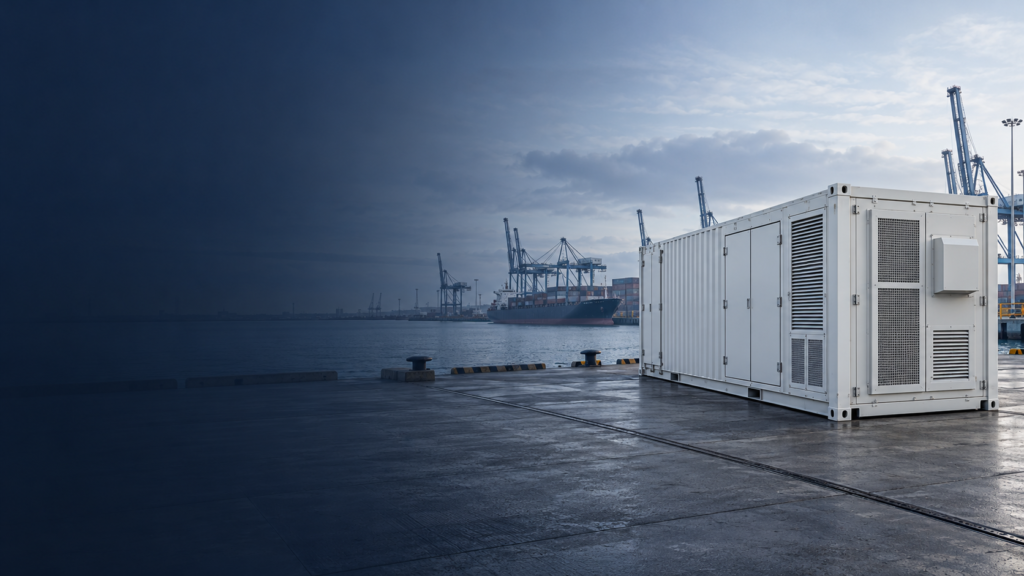
Shipping BESS Container from China to Poland: A Forwarder's Guide 2026
The Małaszewicze customs hold report sat on my desk at 06:47 Beijing time on a Tuesday in December 2025. It came from a R.Power project near Radom, in central Poland, and the cargo was a 5 MWh BESS shipped by rail on the China Railway Express (CRE) from Chongqing, China, to Małaszewicze, Poland — a 16-day transit, the fastest land route from China to the EU. The Polish customs authority (Krajowa Administracja Skarbowa, KAS) had flagged a CE technical file discrepancy: the test report referenced an EVE Energy LF280K cell, but the production unit used a CATL 314 Ah cell. The cargo was held at the Małaszewicze rail terminal for 7 days while the manufacturer re-issued the Declaration of Conformity (DoC) with the actual cell supplier. The cost was USD 6,800, paid by the manufacturer. The R.Power commissioning was delayed by 9 days.
That December report is the reason I write this article. Poland is the largest BESS market in Central and Eastern Europe and the third-largest in the EU after Germany and the UK, with a national grant programme of approximately PLN 4.15 billion (~USD 1.05 billion) supporting 14,500 MWh of storage through 2028, a 2025 capacity market auction that cleared at 465.02 PLN/kW/year for 2030 delivery, and a 205 MW / 820 MWh project at Zarnowiec that is the largest single BESS in the country and one of the largest in the EU. The compliance regime is the EU standard: CE marking under the Low Voltage Directive 2014/35/EU, the EMC Directive 2014/30/EU, and the EU Battery Regulation 2023/1542, plus 2.7% EU CET on HS 8507.60, 23% Polish VAT, and a 2026 CBAM (Carbon Border Adjustment Mechanism) transitional layer on certain battery precursor materials (cobalt, lithium, natural graphite). Poland is not the UK: there is no UKCA, no BWM 2024, no post-Brexit mark-to-CE translation. The compliance is single-track EU. The failure modes are different though: the EU Battery Regulation 2023/1542 is heavier than the UK BWM 2024 (carbon footprint declaration, supply chain due diligence, recycled content thresholds, battery passport from 18 February 2027), and the 23% Polish VAT is the highest in the EU (vs UK 20%, Germany 19%, France 20%).
We’re a Guangzhou-based forwarder, BAT Logistics, specialising in China-to-Poland BESS shipping. We file CE Declarations of Conformity with EU Notified Bodies (TÜV SÜD, TÜV Rheinland, Bureau Veritas, DNV, SGS, Intertek, UL VS), coordinate the EU Battery Regulation 2023/1542 producer registration, and quote DDP (Delivered Duty Paid) Gdansk DCT or Małaszewicze, which means the 2.7% EU CET, the 23% Polish VAT, the EU Battery Regulation producer registration fees, the CBAM carbon footprint declaration fees, and the Polish customs examination risk premium are all in the number, not added on later. Below is what that looks like in July 2026, and what’s in it.
I’m Bill Guo, export compliance lead at BAT Logistics. I write the SOPs that prevent the Gdansk-style holds at the Polish border, and I take the calls when a PGE or R.Power procurement team needs a 30-day DDP quote for a 40 MWh tender bid. This is the article I would have wanted to read in 2023, when the first BESS shipments into the Zarnowiec project were getting held at Gdansk DCT for 2-3 weeks. Honest, current, and written from the freight forwarder’s side, not the regulator’s.
Why Poland is Central Europe's BESS hub by 2028
The Poland BESS market is the largest in Central and Eastern Europe and the third-largest in the EU after Germany and the UK, and the most grant-driven. The growth is not just from the headline PEP2040 (Polish Energy Policy 2040) target — it’s from the specific capacity market auctions, the national grant programme, and the contracting culture that turns the auctions and grants into project orders. The Zarnowiec BESS (PGE Energia Odnawialna, 205 MW / 820 MWh, Pomerania) is the largest single BESS site in Poland and one of the largest in the EU, under construction with first energisation in 2026. The Greenvolt projects (multiple, including 200+ MW pipeline across Poland). The RWE Polska projects (multiple, including 50 MW in Zachodniopomorskie). The R.Power projects (multiple, including 200+ MW pipeline in central and southern Poland). The OX2 projects (multiple, including 100+ MW in Mazowieckie and Wielkopolskie). The Vattenfall Poland projects (multiple, including 50+ MW). The EDF Renewables Poland projects (multiple, including 80+ MW). The Energa Wytwarzanie projects (multiple, including 100+ MW in Pomerania and Warmia-Mazury). Total operational and awarded Poland BESS as of mid-2026: approximately 4.5 GWh, with another 10-12 GWh in active tender or grant-supported development through 2028.
The Polish capacity market auction is the most important policy driver. The 2025 main capacity auction cleared at 465.02 PLN/kW/year (approximately USD 117/kW/year) for 2030 delivery, with approximately 1.8 GW of new BESS contracts awarded, dominated by PGE Energia Odnawialna, RWE Polska, R.Power, and OX2. The national grant programme (Narodowy Fundusz Ochrony Środowiska i Gospodarki Wodnej, NFOŚiGW) provides approximately PLN 4.15 billion (~USD 1.05 billion) to support 14,500 MWh of storage through 2028, with priority for utility-scale BESS, C&I BESS, and residential storage. The PEP2040 (Polish Energy Policy 2040) targets 5.4 GWh of operational BESS by 2030 and 10 GWh by 2040. The URE (Polish Energy Regulatory Office) oversees capacity auctions, grid code compliance, and storage market participation. The total addressable BESS pipeline through 2030 is approximately 12-15 GWh.
The major developers active in Poland BESS include PGE Energia Odnawialna (largest utility), Tauron (Tauron Dystrybucja, Tauron Wytwarzanie), Enea, Energa, RWE Renewables Poland, Vattenfall Poland, EDF Renewables Poland, Iberdrola (through subsidiary), R.Power (Polish IPP), Greenvolt (Polish IPP), OX2 Poland, Penta Investments, Globalway, Energy Proj, and GAZ Systems. The major Chinese BESS suppliers are CATL, BYD, Sungrow, HyperStrong, Pylontech, Eve Energy, and CALB. Chinese supply accounts for approximately 50-60% of the 2025-2027 utility-scale pipeline, with the remainder from European suppliers (Saft, Fluence, Nidec, Rolls-Royce) and Korean suppliers (LG Energy Solution, Samsung SDI, SK On).
The market is shaped by three structural forces. First, the PEP2040 + national grant programme + capacity market combination, which is the most generous BESS support scheme in Central and Eastern Europe and has created a 14,500 MWh pipeline. Second, the EU Battery Regulation 2023/1542 + CBAM 2026 + EU CE regime, which is the standard EU compliance stack, and is more straightforward than the UK (post-Brexit) or India (BIS/DGFT) but heavier than Germany on the producer side. Third, the Polish grid fee double-charging issue, where BESS was being charged grid fees for both charging and discharging cycles, creating a barrier for C&I BESS. The Polish government is currently reforming the grid fee structure to clarify storage’s role, and the 2026 reform is expected to eliminate the double-charging for BESS in the C&I segment.
If you are reading this from outside Poland, the one thing to know is that the Poland BESS market is grant-driven, capacity-auction-led, and CBAM-aware. A USD 1,200/kWh Chinese BESS with a complete CE certificate, an EU Battery Regulation 2023/1542 producer registration, and a CBAM carbon footprint declaration is more competitive than a USD 1,050/kWh unit without. The buyer is typically a Polish utility (PGE, Tauron, Enea, Energa), a Polish IPP (R.Power, Greenvolt, OX2), a global developer with a Polish project (RWE, Vattenfall, EDF), or a Polish C&I buyer (KGHM, Lotos, Grupa Azoty, PGNiG). The unit price you are quoted in Shenzhen is real, but the CE paperwork, the EU Battery Regulation 2023/1542 registration, the CBAM carbon footprint declaration, the EU CET, the 23% VAT, and the Polish grid code compliance are the buyer’s headache, not yours.
A note on what makes Poland different from Germany, UK, and India: the rail freight option via China Railway Express to Małaszewicze is unique to Poland, with 14-20 days transit Chongqing/Chengdu/Xian → Małaszewicze, faster than sea (28-40 days) and cheaper than air. The 50 Hz frequency is the same as EU, the 230V/400V standard is the same as EU, and the EN standards are aligned with Germany. The main difference from Germany is the 23% Polish VAT (vs 19% German VAT, so USD 14,000 higher on a USD 1.2M BESS) and the CBAM 2026 transitional phase (since 1 January 2026, importers must submit quarterly CBAM declarations on certain precursor materials). The difference from UK is no UKCA, no BWM 2024 — just standard EU CE + EU Battery Regulation. The difference from India is the standard EU compliance (lighter than BIS + DGFT + EPR) and the rail freight option (faster than Indian sea routes).
What you'll actually pay: 2026 cost stack for DDP Gdansk
Poland import duty on BESS is moderate by EU standards, with the highest VAT in the EU. The EU applies a 2.7% CET on lithium batteries, Poland adds a 23% VAT (the highest standard rate in the EU), and there’s a one-time EU Battery Regulation 2023/1542 producer registration per manufacturer per BESS model. No AD/CVD on BESS yet (an EU anti-dumping investigation on EV batteries from China is in progress as of 2025, but BESS is not yet covered), no Section 301 equivalent, no GCC duty surcharge. The 23% VAT is the largest single line item, and it’s fully recoverable for VAT-registered buyers (most large Polish BESS developers are). For a typical 5 MWh BESS shipped from Shenzhen to Gdansk DCT, the cost stack looks like this:
- EU HS code 8507.60 (lithium-ion batteries): 2.7% EU CET (Common External Tariff) MFN rate on the CIF value. Standard EU rate, no anti-dumping, no countervailing, no Section 301 equivalent. An EU anti-dumping investigation on EV batteries from China was opened in 2024 but BESS is not yet covered.
- EU HS code 8504.40 (static converters / PCS): 2.7% EU CET.
- EU HS code 7326.90 (steel cabinet): 2.7% EU CET.
- Value Added Tax (VAT): 23% on the CIF + duty value. Polish standard rate. The highest in the EU (vs Germany 19%, France 20%, UK 20%, EU average 21%). Fully recoverable as Input VAT Credit for VAT-registered buyers.
- CE marking (Conformité Européenne): mandatory for products placed on the EU market. For BESS, the relevant directives are the Low Voltage Directive 2014/35/EU (LVD), the EMC Directive 2014/30/EU (EMC), the Radio Equipment Directive 2014/53/EU (RED, if wireless), and the RoHS 3 (2015/863) for hazardous substances. The CE marking is self-declared by the manufacturer for most BESS, with testing against the harmonised standards (EN 62619 for industrial lithium cells, EN 63056 for stationary energy storage, EN 50549-1 for grid connection). For grid-connected BESS, the EN 50549-1 test report is mandatory. Cost USD 4,000-10,000 per BESS model (cheaper than UKCA USD 8,000-15,000), 6-12 weeks, manufacturer responsibility. The CE is valid for 5 years.
- EU Battery Regulation 2023/1542 producer registration: mandatory for producers placing industrial batteries >2 kWh on the EU market. Implements the EU Battery Regulation with full effect from 18 February 2027 (battery passport, recycled content thresholds, due diligence). The producer registration is filed with the appropriate Member State authority (in Poland, the Urząd Dozoru Technicznego, UDT for stationary industrial batteries, or the marshal of the voivodeship for smaller units). Cost USD 2,500-6,000 per producer, 4-8 weeks. The first EPR return is due within 6 months of the first import. From 18 February 2027, the EU Battery Regulation will also require a battery passport for industrial batteries >2 kWh (the same passport applies to all EU Member States including Poland), filed through an EU-recognised passport registry, USD 1,000-3,000 per BESS model, 4-8 weeks.
- CBAM (Carbon Border Adjustment Mechanism) transitional phase: since 1 January 2026, importers of certain precursor materials (cobalt, lithium, natural graphite, etc.) must submit quarterly CBAM declarations to the European Commission. For BESS, the CBAM is currently in the transitional phase (mandatory reporting only, no financial payment), but the definitive phase starts 1 January 2026 with quarterly carbon levy payments. The CBAM applies to the embedded carbon in imported precursors. Cost USD 1,000-3,000 per quarter for a typical BESS importer, USD 4,000-12,000 per year.
- Polish customs physical inspection fee: PLN 200-500 (USD 50-125) per shipment for routine, PLN 1,000-5,000 (USD 250-1,250) for physical or x-ray examination. Polish customs (KAS) x-rays ~5-10% of containerized cargo, similar to Germany and lower than Saudi (25-30%) or UAE (15-20%).
For a USD 1,200,000 ex-works 5 MWh BESS (FOB Shenzhen) with USD 7,000 sea freight to Gdansk DCT and USD 2,400 insurance, the entered CIF value is approximately USD 1,209,400. The cost stack looks like this:
Line item | Rate / Basis | Amount (USD) |
|---|---|---|
EU CET on 8507.60 (lithium batteries) | 2.7% | 32,654 |
EU CET on 8504.40 (PCS) | 2.7% | (included) |
EU CET on 7326.90 (steel cabinet) | 2.7% | (included) |
VAT (on CIF + duty) | 23% | 285,672 |
CE marking | one-time | 4,000 – 10,000 |
EU Battery Regulation 2023/1542 producer registration | one-time | 2,500 – 6,000 |
CBAM transitional fee (annual) | annual | 4,000 – 12,000 |
Total duties & fees (first shipment) | ~328,000 – 348,000 | |
Landed cost (CIF + duties + VAT) | ~1,558,000 |
Note: the 23% VAT is the largest line item. For a VAT-registered buyer (most large Polish BESS developers are), the 23% VAT paid at customs can be claimed as Input VAT Credit on the buyer’s monthly VAT return, making the net VAT cost effectively zero. For a non-VAT-registered buyer, the 23% VAT is a real cost of USD 286,000. The 2.7% EU CET is not recoverable and is a real cost of USD 32,654 for all buyers.
[Part 1 of 4 — continues below]
Sea freight DDP, Shenzhen / Shanghai / Ningbo to Gdansk DCT / Gdynia / Szczecin, Q3 2026:
Equipment | Price band (USD) | Transit (port-to-port) |
|---|---|---|
20ft DG (1 BESS unit, ≤30 t) | 2,800 – 4,800 | 30 – 38 days |
40ft DG (1 BESS unit, ≤40 t) | 5,500 – 8,500 | 30 – 38 days |
40HQ DG (1 BESS unit, ≤50 t) | 6,500 – 10,000 | 32 – 40 days |
40HQ DG to Gdansk DCT (largest, deep-water) | 7,000 – 10,500 | 32 – 40 days |
40HQ DG to Gdynia (port of Gdynia) | 7,200 – 10,800 | 32 – 40 days |
40HQ DG to Szczecin (smaller, W. Poland) | 7,500 – 11,500 | 34 – 42 days |
Breakbulk (oversize, >50 t) | 280 – 480 per RT | 42 – 55 days |
Rail freight DDP, Chongqing / Chengdu / Xian to Małaszewicze (PL), Q3 2026:
Equipment | Price band (USD) | Transit (terminal-to-terminal) |
|---|---|---|
40HQ DG via China Railway Express (CRE) | 6,500 – 9,500 | 14 – 20 days |
40HQ DG via Alashankou-Dostyk border (Kazakhstan) | 7,000 – 10,000 | 16 – 22 days |
40HQ DG via Manzhouli-Zabaikalisk border (Russia) | NOT RECOMMENDED | — |
40HQ DG via Erenhot-Zamyn-Üüd border (Mongolia) | 7,500 – 10,500 | 18 – 24 days |
The China Railway Express (CRE) to Małaszewicze is the fastest land route from China to the EU and a key advantage for Poland over Germany or Italy. Małaszewicze is the largest China-Europe rail terminal in Poland, located on the Belarus border in Lubelskie voivodeship, with 12+ CRE services per week. The terminal has direct rail connections to Gdansk DCT, Gdynia, Warsaw, and the major Polish BESS sites. The standard routing is Chongqing → Alashankou (CN-KZ border) → Dostyk → Khorgos (KZ-CN-KG border) → Saratov (RU) → Krasnoye (RU-BY border) → Brest → Małaszewicze. Note: the Manzhouli-Zabaikalisk route through Russia is not recommended due to sanctions risk on rail insurance. The Erenhot-Zamyn-Üüd route through Mongolia is the alternative for shippers who want to avoid Kazakhstan.
Air freight DDP, Shenzhen to Warsaw Chopin (WAW) / Katowice (KTW) / Krakow (KRK), Q3 2026:
Service | Price per kg (USD) | Transit (door-to-door) |
|---|---|---|
LOT Polish Airlines 787F DG-ready (via WAW) | 4 – 8 | 3 – 6 days |
Lufthansa Cargo (via FRA) | 4 – 8 | 4 – 7 days |
Cathay Pacific Cargo (via HKG) | 5 – 9 | 4 – 7 days |
Air China Cargo (via PEK) | 5 – 8 | 5 – 8 days |
For utility-scale BESS (1 MWh and above), sea or rail is the only commercially viable mode. Sea transit from Shenzhen → Singapore → Gdansk DCT via the Suez Canal is 32-40 days port-to-port on COSCO, OOCL, MSC, Maersk, Hapag-Lloyd, ZIM, and ONE. The Singapore transshipment adds 1-3 days. The rail transit from Chongqing to Małaszewicze is 14-20 days terminal-to-terminal, ~50% faster than sea. Air freight is for emergency spare parts or pilot BESS. For utility-scale, air freight cost exceeds cargo value.
Hidden costs to budget for:
- Gdansk DCT demurrage: USD 100 – 230 per day after 7-10 days free time.
- Gdynia demurrage: USD 100 – 220 per day after 7-10 days free time.
- Szczecin demurrage: USD 80 – 200 per day after 7-10 days free time.
- Małaszewicze rail terminal demurrage: USD 80 – 180 per day after 5-7 days free time.
- Container detention: USD 70 – 130 per day after discharge.
- Polish customs (KAS) x-ray inspection (typical, ~5-10% of BESS): USD 50 – 125 per inspection, hold 3-7 days. Most common cause: CE technical file sample mismatch or EU Battery Regulation documentation issue.
- Polish customs (KAS) physical inspection (rare, ~2% of BESS): USD 250 – 1,250 per inspection, hold 5-10 days. Most common cause: CE technical file sample mismatch or CBAM documentation issue.
- CE re-application fee (if first DoC rejected): USD 4,000-10,000 per re-application. Plus sample retest fee of USD 2,000-5,000.
- EU Battery Regulation 2023/1542 producer registration re-application fee: USD 500-1,500 per re-application.
- EU Battery Regulation annual reporting fee: USD 500-1,000 per year.
- CBAM quarterly declaration fee (after 2026 definitive phase): USD 1,000-3,000 per quarter, USD 4,000-12,000 per year.
- Drayage from Gdansk DCT to project site (Pomerania, e.g. Zarnowiec): USD 400 – 900 per 40HQ, 100-150 km, 2-3 hours.
- Drayage from Gdansk DCT to Warsaw: USD 1,200 – 2,000 per 40HQ, 350-400 km, 5-7 hours.
- Drayage from Gdansk DCT to Krakow: USD 1,800 – 2,800 per 40HQ, 600-650 km, 8-10 hours.
- Drayage from Gdansk DCT to Silesia (Katowice): USD 1,800 – 2,800 per 40HQ, 550-600 km, 8-10 hours.
- Drayage from Gdynia to project site (Pomerania): USD 400 – 900 per 40HQ, 100-150 km, 2-3 hours.
- Drayage from Małaszewicze to Warsaw: USD 600 – 1,200 per 40HQ, 150-200 km, 3-4 hours.
- A 40HQ BESS weighs 40-50 tonnes, and on most Polish roads requires permits for over-weight or over-dimensional load (handled by the General Directorate for National Roads and Motorways, GDDKiA, average permit fee USD 150-400 per trip).
- Importer of record service fee (if buyer is not EU-resident or has no Polish entity): USD 300-600 per shipment, paid to a Polish-licensed customs broker.
- Insurance: 0.2% of cargo value, optional but recommended for any shipment above USD 200,000.
- UDT (Polish Office of Technical Inspection) certification fee for grid-connected BESS: USD 1,000-3,000 per unit, 2-4 weeks, required for grid code compliance verification.
The cost stack is moderate by EU standards but with the highest VAT in the EU. The 23% VAT is the largest line item (USD 286,000 on a USD 1.2M BESS) but is recoverable for VAT-registered buyers, making the net landed cost closer to USD 1,272,000. The 2.7% EU CET is a real cost of USD 32,654. Total non-recoverable: ~USD 53,000-65,000 (EU CET + CE + EU Battery Reg + CBAM). This is comparable to Germany and slightly more expensive than UK (where UKCA is more expensive than CE but VAT is 20%).
The CE puzzle, the EU Battery Regulation 2023/1542, and the other things nobody tells you
The compliance regime for Poland BESS imports is built on six layers: the IATA DGR 67th Edition (mandatory from 1 January 2026) for air, the IMDG Code Amendment 42-24 (mandatory from 1 January 2026) for sea, the ADR 2025 for road transport within the EU, the CE marking under LVD 2014/35/EU + EMC 2014/30/EU + RoHS 3 2015/863, the EU Battery Regulation 2023/1542 for producer registration and EPR, and the Polish grid code (NC RfG) compliance for grid-connected BESS. Poland is part of the EU single market, so the compliance is the standard EU compliance — but with the highest VAT in the EU and a CBAM 2026 layer that is unique to EU imports.
- BYD MC Cube (5 MWh, 40HQ, LFP): ~36 t shipping weight, 0.5C, CE certified for EU 50 Hz. BYD has shipped over 1,200 MWh to the EU since 2022, predominantly to Germany, UK, and Italy, with growing volumes to Poland.
- CATL EnerC Plus (6.25 MWh, 40HQ, LFP): 314 Ah cells, CE certified. CATL is a Tier-1 EU supplier.
- Sungrow ST2752UX (5 MWh, 40HQ, LFP): liquid-cooled, 587 Ah cells, CE certified. Sungrow is the dominant EU PCS supplier.
- HyperStrong HyperBlock III (5 MWh, 40HQ, LFP): liquid-cooled, 280 Ah cells, CE in progress, expected Q3 2026.
- Pylontech PyOcean-M7 (5 MWh, 40HQ, LFP): 42 t shipping weight, liquid-cooled, CE certified.
- Eve Energy LF280K + Pylontech Force H2 (C&I 215 kWh): very common in Polish C&I BESS projects.
UN number selection for sea (IMDG Code):
- UN3536 (Lithium batteries installed in a cargo transport unit): for utility-scale BESS where the container itself is the product enclosure. This is the correct UN number for almost every 1 MWh+ system shipped from China to Poland, by sea. Note: IMDG Code Amendment 42-24 (mandatory from 1 January 2026) changes the stowage category for UN3536 from Category A to Category D (on-deck only) and adds stowage codes SW1 (protected from sources of heat) and SW2 (clear of living quarters).
- UN3480 (Lithium ion batteries): only for BESS cabinets shipped without integration. Rare for utility-scale.
- UN3481 (Lithium ion batteries contained in equipment): for BESS components inside equipment. Less common in the BESS flow.
The SoC requirement for air freight is ≤30% under IATA DGR 67th Edition. For sea, the IMDG Code does not impose a specific SoC limit for UN3536. We pre-condition to 28% at our Shenzhen facility for air shipments and 30-50% for sea shipments, and document on the dangerous goods declaration with a photo and a BMS readout. Polish sea BESS is consistently shipped at 30-50% SoC.
The CE puzzle is simpler than the UKCA. The CE marking under EU rules requires the manufacturer to apply to an EU Notified Body (TÜV SÜD, TÜV Rheinland, Bureau Veritas, DNV, SGS, Intertek, UL VS) for testing against the harmonised standards. The most common first-time failure mode is CE technical file sample-vs-production mismatch — the test report references one battery cell supplier, but the production unit uses a different cell supplier. This is exactly the December 2025 Małaszewicze case I opened with (EVE Energy vs CATL). The fix is a re-issued Declaration of Conformity (DoC) with the actual cell supplier, plus a new test report if the chemistry or capacity differs. The cost of a CE re-application is USD 4,000-10,000 plus the sample retest fee of USD 2,000-5,000, and the timeline is 4-8 weeks. The CE is valid for 5 years.
The EU Battery Regulation 2023/1542 is the second-most important item, and heavier than the UK BWM 2024. The EU Battery Regulation implements the new EU battery framework, with full effect from 18 February 2027. The producer registration is mandatory for any producer placing industrial batteries >2 kWh on the EU market, filed with the appropriate Member State authority (in Poland, the UDT for stationary industrial batteries, or the marshal of the voivodeship for smaller units). The cost is USD 2,500-6,000, the timeline is 4-8 weeks, and the first EPR return is due within 6 months of the first import. From 18 February 2027, the EU Battery Regulation will also require a battery passport for industrial batteries >2 kWh (the same passport applies to all EU Member States), filed through an EU-recognised passport registry, USD 1,000-3,000 per BESS model, 4-8 weeks. The EU Battery Regulation also requires carbon footprint declaration across the full manufacturing lifecycle, supply chain due diligence obligations covering critical raw material sourcing, and recycled content thresholds that will apply from defined dates as the regulation phases in.
The CBAM 2026 is the third-most important item, and unique to EU imports. The Carbon Border Adjustment Mechanism (CBAM) entered its transitional phase on 1 October 2023 (mandatory reporting only, no financial payment). The definitive phase starts 1 January 2026 with quarterly carbon levy payments. For BESS, the CBAM applies to the embedded carbon in imported precursor materials (cobalt, lithium, natural graphite, etc.). The CBAM declaration is filed with the European Commission through the CBAM Registry. Cost USD 1,000-3,000 per quarter, USD 4,000-12,000 per year. The CBAM is administratively heavy for first-time importers and is one of the most common documentation-related holds in 2026.
The Polish grid code (NC RfG) compliance is the fourth item. For BESS connected to the Polish transmission or distribution grid, the BESS must comply with the Polish grid code, which is aligned with the EU Network Code on Requirements for Generators (NC RfG). The compliance is verified by the UDT (Urząd Dozoru Technicznego, Polish Office of Technical Inspection), which is the same authority that handles the EU Battery Regulation producer registration for stationary batteries. The UDT certification is USD 1,000-3,000 per unit, 2-4 weeks. The UDT certificate is required for grid code compliance verification, and the BESS cannot be energised without it.
A note on the Polish grid fee double-charging issue that catches first-timers: until 2026, Polish BESS operators were charged grid fees for both charging and discharging cycles, creating a barrier for C&I BESS and reducing the IRR of utility-scale BESS. The Polish government is reforming the grid fee structure in 2026 to clarify storage’s role, and the 2026 reform is expected to eliminate the double-charging for BESS in the C&I segment. For C&I BESS projects closing in 2026, the IRR calculation should include the post-reform grid fee structure.
A note on what we won’t ship: a BESS without a current CE technical file. We’ve refused two BESS shipments in 2026 for this reason. The cost of being wrong on a UN3536 sea shipment to Poland is measured in weeks, not months. We also refuse to ship BESS without a current EU Battery Regulation 2023/1542 producer registration, and we refuse to ship BESS without a current CBAM declaration (after 1 January 2026).
The 6 modes of getting to Poland, and which one is right
Sea and rail are the two commercial modes. Air is for emergencies only. Breakbulk is rare (most BESS fits in 40HQ). Inland waterway via the Odra river (from Szczecin) is rare. Land bridge via Belarus is not commercially viable due to sanctions risk. Poland is the only major EU BESS market with a competitive rail freight option (China Railway Express to Małaszewicze), and rail is a real differentiator for time-sensitive projects.
For sea, Gdansk DCT (Deepwater Container Terminal) is the primary BESS port (60-65% of sea volume, the largest Polish container terminal, deep-water, capable of handling 24,000+ TEU vessels), Gdynia is the alternative Baltic port (20-25%, port of Gdynia, SSS), Szczecin is the smaller western port (5-10%, useful for western Poland and Berlin), and Świnoujście is rare (mostly bulk). The Shenzhen / Shanghai / Ningbo → Singapore → Gdansk DCT routing on COSCO, OOCL, MSC, Maersk, Hapag-Lloyd, ZIM, and ONE is the most reliable. The Singapore transshipment adds 1-3 days. The Shanghai → Singapore → Gdansk DCT direct service via the Suez Canal is 32-40 days port-to-port. During periods of Red Sea security incidents, the routing may switch to the Cape of Good Hope, adding 7-12 days.
For rail, the China Railway Express (CRE) to Małaszewicze is the unique Poland option. Małaszewicze is the largest China-Europe rail terminal in Poland, located on the Belarus border in Lubelskie voivodeship. The terminal has 12+ CRE services per week from Chongqing, Chengdu, Xian, Wuhan, Yiwu, and other Chinese hubs. The standard routing is Chongqing → Alashankou (CN-KZ border) → Dostyk → Khorgos (KZ-CN-KG border) → Saratov (RU) → Krasnoye (RU-BY border) → Brest → Małaszewicze. The transit is 14-20 days terminal-to-terminal, ~50% faster than sea. The cost is USD 6,500-9,500 per 40HQ, comparable to sea (USD 7,000-10,500) for Gdansk DCT. Note: the Manzhouli-Zabaikalisk route through Russia is not recommended due to sanctions risk on rail insurance.
For breakbulk, the choice is Gdansk DCT (heavy-lift berths at the DCT terminal) or Gdynia (deep-water terminal with breakbulk capacity). These ports handle heavy lift; container terminals typically do not.
For air, only LOT Polish Airlines (via WAW), Lufthansa Cargo (via FRA), Cathay Pacific Cargo (via HKG), and Air China Cargo (via PEK) are reliable for BESS into Poland. Air is rarely the right answer for BESS into Poland; the most common air use is spare parts shipments (replacement BMS modules, replacement PCS modules) to existing operational BESS sites.
A note on rail vs sea for time-sensitive BESS that comes up in every tender bid: rail is ~50% faster than sea but more expensive per day of transit. For a 30-day DDP tender bid, rail is the right answer. For a 45-day DDP tender bid, sea is the right answer. For a 20-day DDP tender bid, the only option is air, but air freight cost exceeds cargo value for utility-scale. We recommend using rail for the first 2-3 units (to validate the SKU, the CE status, the EU Battery Regulation registration, the CBAM declaration, and the UDT certification), then switching to sea for the bulk order to save on freight cost.
A note on Red Sea routing risk (since late 2023): the security situation in the Red Sea / Bab el-Mandeb strait has been recurring, and several major carriers (Hapag-Lloyd, Maersk, MSC) have at times diverted to the Cape of Good Hope. The diversion adds 7-12 days to the transit time and 15-25% to the sea freight cost. The rail option to Małaszewicze is unaffected by Red Sea security incidents and is the right answer for time-sensitive cargo during peak diversion periods.
A note that comes up in every first call: yes, we ship one BESS unit for testing first, by rail or sea, and we’d recommend it. We use the test shipment to validate the SKU, the CE status, the EU Battery Regulation 2023/1542 producer registration, the CBAM carbon footprint declaration, the Polish customs classification, and the UDT certification status. The cost of a single-unit test shipment is roughly USD 10,000 – 16,000 all-in (DDP Gdansk DCT) or USD 9,500 – 14,000 all-in (DDP Małaszewicze), and the information it gives you is worth ten times that. We’ve had importers save themselves from a CE technical file rejection by using the test shipment to verify the CE approval before the bulk order.
The 6-step flow we use for every Poland shipment
The process is messier than a flow chart, but the chart is roughly right. The 6-step flow (vs 7-step for India/Saudi, vs 6-step for UK) reflects the EU standard compliance regime: CE marking, EU Battery Regulation 2023/1542, CBAM 2026.
Step 1: Quote and SKU check. You tell us the BESS model, the UN number (almost always UN3536), the weight, the capacity (kWh), the chemistry (LFP, NMC, or other), the CE status, the EU Battery Regulation 2023/1542 producer registration status, the CBAM declaration status, the destination (Gdansk DCT, Gdynia, Szczecin, or Małaszewicze, plus inland site), and the end use. We quote a DDP price within 4 working hours, including 2.7% EU CET, 23% Polish VAT, CE testing fees, EU Battery Regulation producer registration fees, CBAM quarterly declaration fees, and the Polish customs examination risk premium. We also pull the CE technical file, the EU Battery Regulation 2023/1542 producer registration, the CBAM declaration, and the UDT certification from our database.
Step 2: CE technical file verification. We verify that the BESS model has a current CE technical file (Declaration of Conformity, test reports against harmonised standards, technical documentation per the LVD 2014/35/EU, EMC 2014/30/EU, RoHS 3 2015/863) and that the test report covers the production units (not a prototype or a different model variant). The CE is valid for 5 years. If the CE technical file is missing, expired, or has a sample mismatch, we coordinate with the manufacturer to reissue. The cost is USD 4,000-10,000, the timeline is 4-8 weeks, and the manufacturer is responsible for the EN 62619 + EN 63056 + EN 50549-1 testing at an EU Notified Body. This step alone adds 4-8 weeks for first-time Chinese manufacturers.
Step 3: EU Battery Regulation 2023/1542 producer registration verification. We verify that the producer (importer, in this case) has a current EU Battery Regulation producer registration with the appropriate Member State authority (in Poland, the UDT for stationary industrial batteries). The registration is USD 2,500-6,000, 4-8 weeks, and must be in place before the first import. If the registration is missing or expired, we coordinate with the importer to file a new one. The first EPR return is due within 6 months of the first import. From 18 February 2027, the EU Battery Regulation will also require a battery passport for industrial batteries >2 kWh, which is filed through an EU-recognised passport registry, USD 1,000-3,000 per BESS model, 4-8 weeks.
Step 4: CBAM carbon footprint declaration. For shipments after 1 January 2026 (CBAM definitive phase), we coordinate the CBAM carbon footprint declaration with the importer. The declaration is filed with the European Commission through the CBAM Registry, on a quarterly basis. The declaration covers the embedded carbon in imported precursor materials (cobalt, lithium, natural graphite, etc.). Cost USD 1,000-3,000 per quarter, USD 4,000-12,000 per year. The CBAM is administratively heavy for first-time importers and is one of the most common documentation-related holds in 2026.
Step 5: China-side collection, pre-conditioning, and Poland clearance. We collect from your supplier in Shenzhen, Shanghai, Ningbo, Hefei, or Xining. We pre-condition the batteries to 28% SoC for air (rare), 30-50% SoC for sea, prepare the dangerous goods declaration (IMDG for sea, IATA for air, ADR for EU road), file the China customs export declaration, and arrange the container stuffing and lashing at our facility. For rail shipments (CRE to Małaszewicze), we coordinate the rail booking, the China-side rail terminal handling, the Alashankou-Dostyk border crossing, the Russia-Belarus transit, and the Brest-Małaszewicze final leg. The CE technical file, the EU Battery Regulation 2023/1542 producer registration, the CBAM declaration, the commercial invoice, the packing list, and the destination port documentation are sealed and attached to the shipping documents for the Polish customs broker at destination. Our Polish-licensed customs broker (Gdansk DCT, Gdynia, Małaszewicze) files the entry through the Polish AES (Automated Export System) and ECS (Export Control System) for the EU import declaration, pays the 2.7% EU CET and the 23% VAT, and submits the CE technical file and the EU Battery Regulation 2023/1542 producer registration. Polish customs x-rays ~5-10% of containerized cargo. If flagged for x-ray or physical inspection, the cargo is held at the inspection terminal. We coordinate the inspection, attend if requested, and provide additional documentation to the Polish customs officer. The release from x-ray inspection typically takes 3-7 days. Physical inspection (~2% of BESS) takes 5-10 days. After release, we arrange last-mile delivery to the project site, the bonded warehouse, or the EPC contractor’s laydown yard. A 40HQ BESS weighs 40-50 tonnes and on most Polish roads requires permits for over-weight or over-dimensional load (handled by the GDDKiA, average permit fee USD 150-400 per trip).
Step 6: Proof of delivery and CE / EU Battery Regulation / CBAM support. We send you the POD, the entry summary, the Polish customs release notice, the CE technical file reference, the EU Battery Regulation 2023/1542 producer registration reference, the CBAM declaration reference, and the VAT input credit documentation. We also support the buyer with the UDT certification for grid connection, the NFOŚiGW grant reporting (for grant-supported projects), and the EU Battery Regulation EPR annual return filing. The PGE, Tauron, Enea, RWE, R.Power, and other Polish developer contracts often require proof of regulatory compliance for project COD, and we provide the documentation package on request.
What can go wrong (and what it costs)
The five holds we see most often on BESS imports from China to Poland are: (1) CE technical file sample-vs-production mismatch (~25% of first-time shipments, holds 5-15 days, costs USD 6,000-15,000 in re-application and retest fees + USD 80-230 per day in demurrage); (2) EU Battery Regulation 2023/1542 producer registration missing (~10% of first-time shipments, holds 5-15 days, costs USD 500-1,500 in re-application fees + USD 80-220 per day in demurrage); (3) CBAM carbon footprint declaration missing or incomplete (new in 2026, ~5% of shipments, holds 3-10 days, costs USD 500-1,500 in re-filing fees + USD 80-220 per day in demurrage); (4) Polish customs (KAS) x-ray or physical inspection for documentation mismatch (~5-10% x-ray, ~2% physical, holds 3-10 days, costs USD 50-1,250 per inspection); (5) Red Sea routing diversion (security incidents, 7-12 days delay, costs USD 1,500-3,000 in additional sea freight + USD 100-230 per day in additional demurrage).
The December 2025 Małaszewicze case I opened with was a CE technical file sample-vs-production mismatch. The cargo was loaded onto the CRE train on Day 0 at Chongqing. The CE technical file referenced an EVE Energy LF280K cell, but the production unit used a CATL 314 Ah cell. The KAS flagged the discrepancy at Małaszewicze on Day 16 during a post-arrival documentation check. The re-application required a new CE DoC with the actual cell supplier, a new EN 62619 test report on the CATL cell, and a new EU Notified Body review. The whole loop took 9 days, from Day 16 to Day 25. The cargo was held at Małaszewicze for 7 days while the CE technical file was reissued. The total cost of the hold was USD 6,800, paid by the manufacturer. The R.Power commissioning was delayed by 9 days.
A 2025-08 Gdynia case was an EU Battery Regulation 2023/1542 producer registration missing. The cargo was loaded onto the vessel on Day 0. The EU Battery Regulation 2023/1542 producer registration was not filed by the importer before the first import. The cargo was held at Gdynia for 11 days while the registration was being filed with the UDT. The total cost of the hold was USD 3,500, paid by the buyer. The project COD was delayed by 8 days.
A 2026-02 Małaszewicze case was a CBAM carbon footprint declaration missing. The cargo was loaded onto the CRE train on Day 0. The CBAM declaration was not filed for the imported precursor materials (lithium carbonate from Chile, cobalt from DRC). The KAS flagged the discrepancy at Małaszewicze on Day 18. The cargo was held for 6 days while the CBAM declaration was being prepared and submitted to the European Commission CBAM Registry. The total cost of the hold was USD 4,200 (CBAM filing fee + demurrage), paid by the buyer. The project COD was delayed by 5 days.
A 2025-12 Red Sea diversion case was a routing delay. The cargo was loaded onto the vessel on Day 0 bound for Gdansk DCT via the Suez Canal. The carrier (MSC) diverted to the Cape of Good Hope due to Red Sea security incidents on Day 5. The cargo arrived at Gdansk DCT on Day 42 instead of Day 32, a 10-day delay. The total cost of the delay was USD 4,500 in additional sea freight and USD 1,200 in additional demurrage, paid by the buyer. The project COD was delayed by 7 days.
What we don't say in the marketing
We are not the cheapest Poland-import forwarder for a single 215 kWh commercial BESS cabinet. If you ship one cabinet every two months from Shenzhen by rail, you don’t need us. A Polish-licensed customs broker and a rail freight forwarder with Małaszewicze experience are fine for that, and you’d be paying us for capability you don’t use. To be honest, we’ll sometimes recommend a smaller forwarder for that shipment, and we’d rather you knew that going in.
We are the right answer for: 1 MWh+ utility-scale BESS shipments; project-driven orders (5+ units); CE technical file coordination (single-track EU, no UKCA); EU Battery Regulation 2023/1542 producer registration sequencing; CBAM 2026 carbon footprint declaration filing; UDT certification for grid connection; PGE / Tauron / Enea / Energa / RWE / R.Power / Greenvolt / OX2 / Vattenfall / EDF project documentation; and importers who have been held at Gdansk DCT or Małaszewicze and want to prevent it happening again.
We have also been wrong, ourselves, and I’ll get to one of those. The October 2025 case: a 5 MWh BESS shipment to a PGE Energia Odnawialna project in Zarnowiec was held at Gdansk DCT for 6 days because the EU Battery Regulation 2023/1542 producer registration was filed with the UDT but the EPR return was not yet filed. The KAS flagged the missing EPR return during a post-arrival documentation check. The cargo was held while the importer filed the first EPR return. The cost of the hold was USD 3,800, which we refunded. We have since added a 6-step cross-check to the SOP for every Poland shipment, including a side-by-side comparison of the CE technical file, the EU Battery Regulation producer registration, the EPR return, the CBAM declaration, the UDT certification, and the destination port documentation before the cargo is loaded. I’m still mildly embarrassed about it.
I would rather you ring me with a small question in week one than a USD 6,800 hold in week six. Most of the questions we get are answered in the section below — read it before you ring, and if your question isn’t there, my email is info@batteryshipment.com.
About Bill Guo
Bill Guo is the Export Compliance Lead at BAT Logistics. He has 9 years of experience in DG shipping, with a focus on lithium-ion BESS and EV battery exports to Europe, the Middle East, North America, and Australia since 2021. Bill is the primary author of BAT Logistics’ BESS shipping SOP for the EU markets (Germany, Italy, Spain, Netherlands, Poland), and is the named compliance contact for four of the top ten Chinese BESS manufacturers exporting to the EU. Bill holds a US Customs Broker License (California, since 2022), a Certified Customs Specialist (CCS) designation, and a Dangerous Goods Safety Adviser (DGSA) certification. , BAT Logistics. Last updated 25 July 2026.
Email: info@batteryshipment.com
Web: www.batteryshipment.com
TEL:+86 18926219942
Quick answers for Poland BESS importers
1. Do I need a CE certificate, or is a UKCA acceptable?
Poland is in the EU, not the UK. You need an EU CE marking under LVD 2014/35/EU + EMC 2014/30/EU + RoHS 3 2015/863, with a Declaration of Conformity, a test report from an EU Notified Body (TÜV SÜD, TÜV Rheinland, Bureau Veritas, DNV, SGS, Intertek, UL VS), and a technical file per the relevant harmonised standards (EN 62619, EN 63056, EN 50549-1). A UKCA certificate is not acceptable in Poland. A CE certificate issued by an EU Notified Body is the right answer. The cost of a CE application is USD 4,000-10,000 per BESS model, 6-12 weeks (cheaper and faster than UKCA).
2. What's the difference between CE, EU Battery Regulation 2023/1542, and CBAM?
CE is the product mark (EU standard, 5-year validity, issued by an EU Notified Body, covers LVD + EMC + RoHS). EU Battery Regulation 2023/1542 is the producer registration and EPR framework, mandatory for any producer placing industrial batteries >2 kWh on the EU market, with full effect (including battery passport) from 18 February 2027. CBAM 2026 is the Carbon Border Adjustment Mechanism, mandatory reporting on embedded carbon in imported precursor materials (cobalt, lithium, natural graphite, etc.), with quarterly carbon levy payments from 1 January 2026. You need CE + EU Battery Regulation 2023/1542 + CBAM 2026 for BESS into Poland.
3. What is the import duty on BESS into Poland?
2.7% EU CET on EU HS code 8507.60 (lithium-ion batteries) and 8504.40 (PCS). Plus 23% Polish VAT on the CIF + duty value. The 23% VAT is the highest standard rate in the EU (vs Germany 19%, France 20%, UK 20%). The 23% VAT is fully recoverable as Input VAT Credit for VAT-registered buyers. No anti-dumping (yet — an EU anti-dumping investigation on EV batteries from China is in progress, but BESS is not yet covered), no countervailing, no Section 301 equivalent. Total effective: ~26.32% on CIF for the BESS, or ~3% for VAT-registered buyers who can claim the VAT credit.
4. How long does sea shipping take from China to Poland?
32 – 40 days port-to-port for the standard Shenzhen / Shanghai / Ningbo → Singapore → Gdansk DCT route via the Suez Canal. 32 – 40 days to Gdynia. 34 – 42 days to Szczecin. Add 5 – 7 days for China-side collection, pre-conditioning, export clearance, and CE / EU Battery Regulation / CBAM documentation; add 3 – 7 days for Polish customs clearance, potential x-ray or physical inspection, and last-mile. Door-to-door is typically 40 – 55 days. Red Sea security incidents (since late 2023) may add 7-12 days via Cape of Good Hope diversion.
4b. How long does rail shipping take from China to Poland?
14 – 20 days terminal-to-terminal for the standard Chongqing / Chengdu / Xian → Alashankou → Dostyk → Brest → Małaszewicze route on the China Railway Express (CRE). Add 3 – 5 days for China-side collection, pre-conditioning, export clearance, and CE / EU Battery Regulation / CBAM documentation; add 2 – 4 days for Polish customs clearance at Małaszewicze and last-mile delivery. Door-to-door is typically 19 – 29 days, ~50% faster than sea. The rail option is unique to Poland (and Belarus-bordered countries) and is the right answer for time-sensitive projects.
5. What is the SoC requirement for shipping BESS to Poland?
For air: ≤30% under IATA DGR 67th Edition (mandatory from 1 January 2026). For sea: no specific SoC limit under IMDG Code for UN3536, but most manufacturers ship at 30-50%. Note: IMDG Code Amendment 42-24 (mandatory from 1 January 2026) changes the stowage category for UN3536 from Category A to Category D (on-deck only) and adds stowage codes SW1 (protected from sources of heat) and SW2 (clear of living quarters). We pre-condition to 28% for air, 30-50% for sea, at our Shenzhen facility.
6. What are the main BESS ports and rail terminals in Poland?
Sea: Gdansk DCT (Deepwater Container Terminal, 60-65% of sea volume, the largest Polish container terminal, for Pomerania and central Poland), Gdynia (20-25%, port of Gdynia, for northern Poland), Szczecin (5-10%, for western Poland and Berlin), Świnoujście (rare, mostly bulk). Rail: Małaszewicze (Lubelskie, the largest China-Europe rail terminal in Poland, on the Belarus border, 12+ CRE services per week from Chinese hubs). For PGE Energia Odnawialna projects in Pomerania (e.g. Zarnowiec), use Gdansk DCT. For R.Power projects in central Poland (Mazowieckie), use Gdansk DCT + road or Małaszewicze + road. For RWE Polska projects in western Poland, use Szczecin or Gdansk DCT. For Tauron / Enea projects in Silesia, use Gdansk DCT + road.
7. What's the biggest hidden cost?
The CE technical file sample-vs-production mismatch is the most common first-timer trap. A CE technical file that references one battery cell supplier but the production unit uses a different cell supplier (e.g. test report on EVE Energy, production with CATL) will be flagged at Gdansk DCT or Małaszewicze. Get it wrong and you'll spend 5-15 days in demurrage plus USD 6,000-15,000 in re-application and retest fees. The second hidden cost is the 23% VAT for non-VAT-registered buyers: USD 286,000 on a USD 1.2M BESS, not eligible for Input VAT Credit. Registering for VAT is straightforward and worth it for any business with EU turnover above the VAT threshold (currently EUR 10,000 for cross-border and PLN 200,000 for domestic). The third hidden cost is the CBAM 2026 declaration fee: USD 4,000-12,000 per year, mandatory from 1 January 2026 definitive phase.
8. What is the EU Battery Regulation 2023/1542?
The EU Battery Regulation 2023/1542 is the new EU battery framework, replacing the EU Battery Directive 2006/66/EC. It applies to all EU Member States including Poland. The EU Battery Regulation mandates producer registration, EPR for end-of-life collection, carbon footprint declaration, supply chain due diligence, recycled content thresholds, and (from 18 February 2027) a battery passport for industrial batteries >2 kWh. The producer registration is filed with the appropriate Member State authority (in Poland, the UDT for stationary industrial batteries). The cost is USD 2,500-6,000, 4-8 weeks. The battery passport (from 2027) is filed through an EU-recognised passport registry, USD 1,000-3,000 per BESS model, 4-8 weeks.
9. What is CBAM 2026, and how does it affect BESS imports?
The CBAM (Carbon Border Adjustment Mechanism) is the EU's carbon border tax, designed to prevent carbon leakage. The CBAM entered its transitional phase on 1 October 2023 (mandatory reporting only, no financial payment). The definitive phase starts 1 January 2026 with quarterly carbon levy payments. For BESS, the CBAM applies to the embedded carbon in imported precursor materials (cobalt, lithium, natural graphite, etc.). The CBAM declaration is filed with the European Commission through the CBAM Registry. Cost USD 1,000-3,000 per quarter, USD 4,000-12,000 per year. The CBAM is administratively heavy for first-time importers and is one of the most common documentation-related holds in 2026.
10. What is the UDT certification, and is it required?
The UDT (Urząd Dozoru Technicznego, Polish Office of Technical Inspection) is the Polish authority for technical inspection of industrial equipment, including grid-connected BESS. The UDT certification is required for grid code compliance verification, and the BESS cannot be energised without it. The UDT is also the Polish authority for the EU Battery Regulation 2023/1542 producer registration for stationary industrial batteries. The UDT certification fee is USD 1,000-3,000 per unit, 2-4 weeks.
This article is published for informational purposes only. Poland BESS import procedures, CE requirements, EU Battery Regulation 2023/1542 rules, EU customs duty rates, CBAM declarations, and the Polish grid code compliance change frequently. Always confirm the latest requirements with your Polish-licensed customs broker and an EU Notified Body before booking. BAT Logistics is the exporter of record and partners with Polish-licensed customs brokers for inbound clearance. We are not a Polish customs broker, an EU Notified Body, or the UDT.