
China origin / automotive battery shipping
How to Ship a Car Battery from China: A Complete Guide 2026
To ship a car battery from China, first identify its chemistry, function, condition and shipping configuration. Then confirm the applicable transport requirements, prepare matching documents and packaging, and arrange a freight option that accepts the actual shipment. A description such as “car battery,” “sealed battery” or “replacement part” is not enough to establish how it can travel.
This guide covers commercial shipments for automotive battery buyers, distributors and parts importers. It explains what to collect from the factory, what to check before booking, and how to separate transport planning from destination import responsibilities.
Identify the Car Battery You Are Shipping
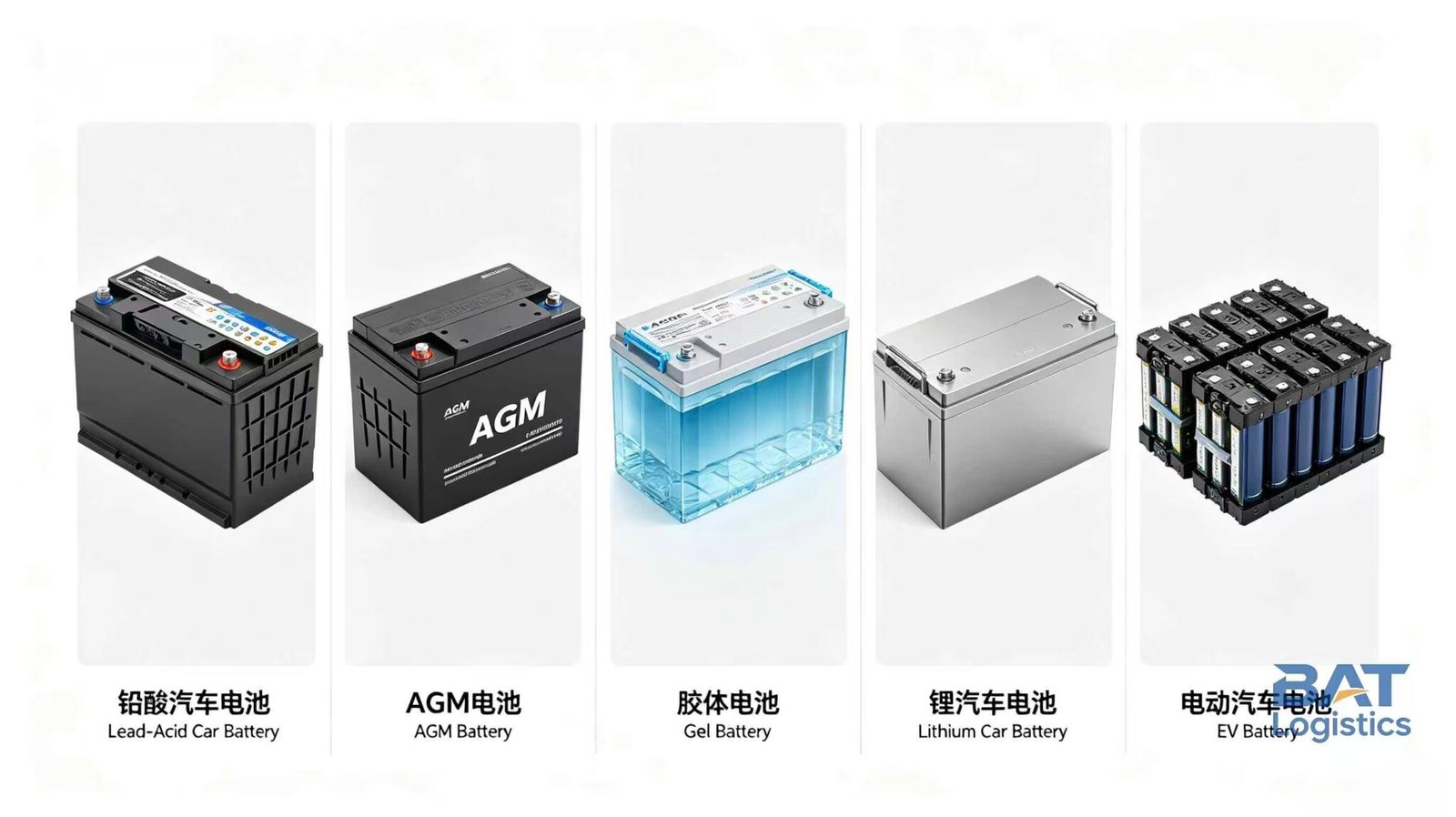
Starter and replacement batteries
Start with what the battery does. A vehicle starter battery, a traction battery pack and a portable jump starter may all appear in an automotive catalogue, but they are different shipment descriptions.
For a starter or replacement battery, request the manufacturer, model, chemistry, rated voltage, capacity and unit weight. Record whether it is new stock, a used serviceable unit or a return. Include clear photographs of the product label, terminals and proposed packaging.
AGM, gel and other lead-acid batteries
Ask the manufacturer to identify the construction and electrolyte arrangement. Do not replace that technical description with a sales term such as “maintenance-free.”
For AGM or gel products, request the evidence supporting any claimed non-spillable transport treatment. The next section explains why a product name alone does not establish an exception.
Lithium starter batteries, EV packs and jump starters
For a lithium starter battery, also request the rated energy in watt-hours and model-matched technical documentation. State whether it travels on its own, with equipment or installed in equipment; do not infer the configuration from the intended end use.
Large traction packs need the more specific handling review described in our guide to shipping EV battery packs from China. Portable booster products belong in the separate guide to shipping car jump starters from China.
Confirm the Transport Entry and Any Claimed Exception
The transport entry identifies the dangerous goods being offered for carriage. It is separate from the customs tariff classification used for import declarations.
For example, the US hazardous materials table lists wet batteries filled with acid under UN 2794 and wet, non-spillable batteries under UN 2800. These are starting points for classification, not permission to use a particular service. The applicable entry, conditions and exceptions must be checked for the actual movement. Source: US hazardous materials table, 49 CFR 172.101.
Under US rules, non-spillable treatment involves technical criteria, including vibration and pressure-differential testing. The related exceptions also depend on conditions covering packing, protection, marking and electrolyte behaviour. An AGM, gel or sealed label does not establish that those conditions have been met. For international shipments, confirm the requirements for each air, sea and road leg separately; a US exception alone does not establish eligibility for the entire route. Sources: 49 CFR 173.159 and 49 CFR 173.159a.
For lithium-ion air cargo, IATA's 2026 guidance assigns standalone UN 3480 batteries to Packing Instruction 965; UN 3481 uses PI 966 when packed with equipment and PI 967 when contained in equipment. Lower energy ratings do not automatically remove dangerous-goods requirements. Source: IATA 2026 battery guidance.
Before requesting space, ask which transport entry is proposed, what evidence supports it, and which rules and carrier conditions have been checked. Resolve disagreements between the product label, technical records and shipping description before booking.
Compare Sea Freight, Air Freight and Courier Options
Compare services using the same cargo record and delivery scope. A port-to-port quotation and a final-address quotation are not equivalent offers.
For sea freight, ask whether the proposed consignment can use an accepted less-than-container-load service or requires a full-container arrangement. Neither a small carton count nor a full container removes the need for cargo review. Our battery sea freight guide explains the broader planning process.
For air freight, request confirmation for the actual battery and package configuration. Do not plan the shipment around an airline name before its acceptance conditions have been checked.
For standalone lithium-ion batteries under PI 965, the standard air-cargo approach requires cargo aircraft and a state of charge (SoC) no higher than 30%. Higher SoC requires State of Origin and State of the Operator approval under A331; passenger-aircraft carriage requires relevant authority approval under A201. Do not assume either exception is available. Source: IATA 2026 guidance, page 4.
For courier delivery, disclose the battery before arranging collection. Obtain confirmation for the origin, destination address, product and package; a general account or parcel quotation is not evidence that the battery is accepted.
Use the following questions to compare offers. This is a quotation checklist, not a statement that a service accepts your battery.
| Option | Cost questions | Delivery-scope questions | Acceptance questions |
|---|---|---|---|
| Sea freight | What are the total origin, ocean and destination charges for the proposed LCL or FCL arrangement? | Does the offer end at the port, a destination warehouse or the buyer's address? | Has the proposed service reviewed the battery, packing and any consolidation restrictions? |
| Air freight | What chargeable weight, handling charges and onward-delivery costs are included? | Who arranges pickup, airport handling, clearance and delivery after arrival? | Are the battery configuration, aircraft restrictions and applicable SoC conditions covered? |
| Courier | What weight basis, surcharges and excluded destination charges apply? | Does the confirmed service cover the exact delivery address and requested clearance scope? | Has the actual origin-to-destination channel accepted the declared battery and package? |
Approval for a sample shipment should not be treated as approval for a later production order. Quantity, packing, condition, service availability and destination arrangements may differ.
Build a Model-Matched Document Record
A useful document set explains the product and the shipment consistently. Collect it before the cargo is ready, so discrepancies do not first appear during collection or booking.
| Record | What it supports | Responsible source | When to request it |
|---|---|---|---|
| Commercial invoice and packing list | Description, quantity, value and package totals | Seller or exporter | For the proposed commercial shipment |
| Model specification and product-label photographs | Chemistry, ratings, identity and physical features | Manufacturer or supplier | At the initial review |
| Applicable transport test evidence | Technical basis for classification or a claimed exception | Manufacturer, with relevant testing records | When required for that battery and transport treatment |
| SDS, when requested | Product hazard information | Manufacturer or responsible supplier | When relevant to the review or requested by an operating party |
| Packing details and photographs | Unit protection, package construction and handling | Packing party or factory | Before final acceptance and collection |
| Applicable dangerous-goods declaration | Shipment-specific declaration for the relevant mode | Responsible shipper or appropriately qualified, authorized party | Where required for the shipment |
| Destination import records | Importer and product-market requirements | Importer and its customs or compliance advisers | Before dispatch |
Do not apply a lithium document checklist to a lead-acid car battery. For applicable lithium batteries, match the UN 38.3 test summary to the model and distinguish it from the test report. IATA permits electronic availability rather than a paper summary accompanying every shipment. Source: IATA battery guidance, test-summary section.
If the invoice uses a distributor's product code, ask for a clear link to the manufacturer's model. A similarly named report should not be substituted without evidence that it covers the battery.
BAT Logistics reviews supplied information for shipment planning and coordinates relevant parties. It does not issue laboratory reports or convert incomplete supplier records into technical approval.
Plan Terminal Protection, Packing and Pallet Handling
Confirm the packing method against the applicable requirements and the planned handling conditions. Do not assume that retail packaging is transport-ready.
For the packing review, provide:
- How terminals are protected and batteries are restrained against movement.
- Outer package type, units per package and gross weight.
- Completed package and pallet dimensions, not only battery dimensions.
- Pallet layout, load restraint, stacking limitations and handling access.
- Manufacturer instructions relevant to orientation and handling.
- Photographs showing internal protection and the completed load.
US wet-battery rules specifically address short-circuit protection and secure preparation. Requirements for another jurisdiction or mode must be checked separately. Source: 49 CFR 173.159.
Ask the responsible packing party to confirm which packaging standard, marks and labels apply to your battery and transport mode, including where each required mark or label belongs. Keep final measurements available for freight planning, and report any repacking that changes the accepted arrangement.
Separate New Stock, Returns and Batteries with Safety Concerns
“Returned” describes a commercial transaction, not a battery's physical condition. State why it is being returned and whether there has been damage, leakage, overheating, swelling, a recall or another safety concern. A used, serviceable unit should not simply be grouped with damaged stock—or described as new.
IATA's guidance states that lithium batteries with specified safety defects or damage posing a risk of dangerous heat, fire or short circuit are forbidden in air transport. Source: IATA battery guidance, damaged and defective batteries.
A routine return booking is not a substitute for condition assessment.
Flag recycling or disposal movements separately for specialist review. Do not drain, open, discharge or otherwise alter a battery simply to fit a requested shipping description. Obtain appropriate technical advice and confirm the permitted transport approach before arranging collection.
Define Customs, Importer and Destination Responsibilities
Transport acceptance and permission to import or sell the product are separate questions. A carrier's acceptance does not establish that the destination importer has completed its responsibilities.
Before dispatch, agree who will handle export declarations, destination clearance, duties and taxes, product requirements and final delivery. Record the Incoterm and named place, then check what the freight quotation actually includes. Identify the party responsible for unloading at the delivery address.
The customs adviser needs the battery's function, chemistry, value, origin and destination—not only a UN number. For lithium-specific documentation issues, see our lithium battery customs clearance guide; it is not a substitute for lead-acid import advice.
Product-market rules also have category-specific dates. For example, the European Commission states that the EU battery passport requirement begins on 18 February 2027 for EV batteries, light-means-of-transport batteries and industrial batteries above 2 kWh. This is not a blanket passport requirement for every automotive starter battery. Importers should check the obligations for their actual category. Source: European Commission battery passport announcement, 21 August 2026.
Understand What Changes Cost and Total Lead Time
Request a quotation after the battery and package record is sufficiently clear. Useful pricing inputs include the accepted transport treatment, shipment size, packing work, pickup location, destination scope and required handling.
Check the quotation for origin collection, terminal or warehouse handling, main carriage, destination charges and delivery. Ask which charges are excluded or conditional. Do not assume duties, inspection costs, storage or unloading are included because a quotation mentions door delivery.
For timing, distinguish four stages: document and packing preparation, acceptance and booking, main carriage, and destination clearance and delivery. A factory-ready date is not a confirmed departure date. A departure estimate is not a guaranteed arrival at the buyer's address.
Give both the ready date and the date the goods are needed. If there is a fixed receiving appointment, disclose it before booking so the proposed plan can be assessed against that constraint.
Send One Complete Car Battery Shipment Brief
Put the following details in one request:
- Battery function, chemistry, manufacturer and model.
- Voltage, capacity, applicable energy rating and unit weight.
- New or used condition, and the reason for any return.
- Quantity, package count, total gross weight and packed dimensions.
- Proposed packing, pallet arrangement and photographs.
- Available technical and commercial documents, with missing items identified.
- China pickup location, destination and requested delivery scope.
- Ready date, required delivery date and importer arrangements.
Separate different models in the same enquiry rather than averaging their ratings or weights. If details are provisional, label them clearly and say when the factory expects to confirm them.
BAT Logistics can review the information you supply and coordinate the proposed shipping arrangement. Final acceptance, routing, space, customs treatment and delivery remain shipment-specific. For wider product and mode planning, see battery shipping from China.
Car Battery Shipping Questions
Are AGM and gel batteries automatically exempt from dangerous-goods rules?
No. Those descriptions do not prove that the battery meets the relevant technical criteria or exception conditions. Request manufacturer evidence and check its applicability to the planned transport mode and jurisdiction. See the non-spillable discussion above.
Does every car battery need UN 38.3 documentation?
No. Do not apply a lithium battery document checklist to every lead-acid starter battery. Identify the chemistry and ask for the evidence relevant to the actual transport treatment.
Can a car battery travel by air freight or courier?
Some shipments may be eligible, but the answer depends on the battery, condition, packing, route and service. Ask for shipment-specific acceptance before arranging collection; an automotive product name is insufficient.
Can used or returned batteries use the same service as new stock?
Do not assume so. Disclose the condition and return reason, and obtain a fresh review where they differ from the original shipment. Safety concerns require assessment before a transport option is proposed.
Can car batteries be consolidated with other automotive parts?
Ask before packing them together. Supply a complete list of the other goods and their packing details so compatibility, segregation and service conditions can be reviewed. Shared ownership or destination does not establish compatibility.
Does approval for one sample cover a later production order?
No. Submit the production shipment's quantities, packages and current details. Keep the earlier reference available, but do not use it as standing acceptance for a changed consignment.
What information makes a quotation useful?
Provide the battery model and chemistry, condition, quantity, packed weight and dimensions, available documents, pickup and destination details, and ready date. State the delivery scope you want so quotations can be compared on the same basis.
Request a Car Battery Shipping Review
Send your battery, package and route details in one enquiry. If a factory document or measurement is still missing, identify it so the next review step is clear.