
Shipping from China to Canada — Complete Guide 2026: Rates, Transit Times & Best Methods
Table of Contents
In 2026, China’s exports to Canada remain robust, with electronics, new energy batteries, machinery, and e-commerce products all being manufactured in China and exported to Canada in large volumes. Whether you’re a B2B buyer sourcing from Chinese manufacturers, an Amazon FBA seller, or an individual importing bulk goods, understanding how shipping from China to Canada works is essential for controlling costs and avoiding logistics surprises.
Canada presents a distinct import environment compared to the US or Australia. Unlike Australia, Canada has no free trade agreement with China — meaning all goods are assessed at full MFN (Most Favoured Nation) tariff rates. Unlike the US, Canada’s de minimis threshold is just CAD $20, meaning virtually every commercial shipment triggers GST and duties. And the CARM (CBSA Assessment and Revenue Management) system, now fully implemented, has changed how Canadian importers interact with customs — requiring more proactive compliance than ever before.
This guide covers everything you need to know about shipping from China to Canada in 2026: shipping methods, real cost benchmarks, Canadian customs requirements, CBSA regulations, transit times, and how BAT Logistics — with 20 years of dangerous goods transport expertise — helps you navigate the China–Canada trade lane with confidence.
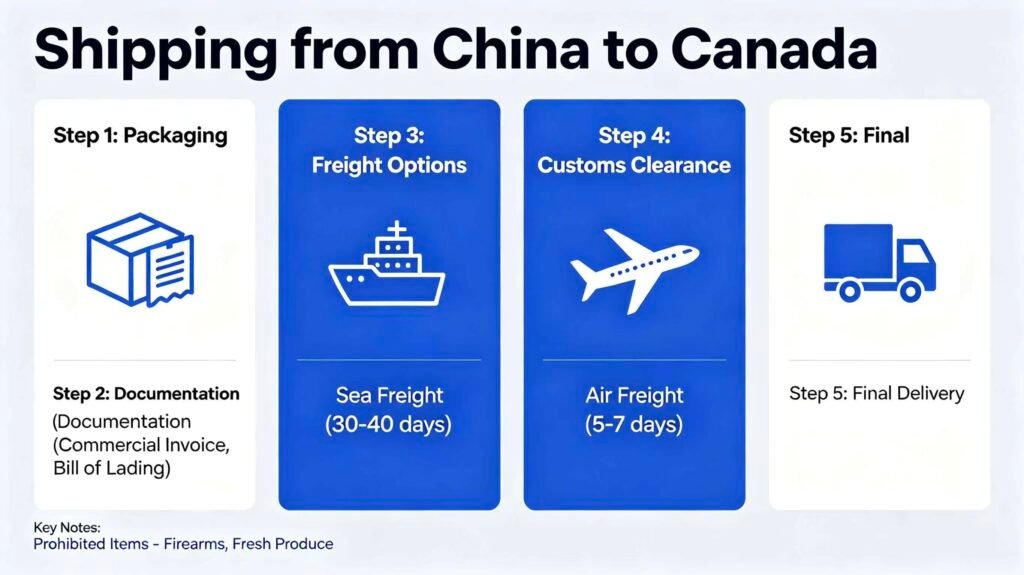
Why Shipping from China to Canada Demands an Experienced Freight Partner
Shipping from China to Canada is more complex than it looks. The Canada–China trade lane is over 7,000 nautical miles from Shanghai to Vancouver, crossing the Pacific with multiple regulatory checkpoints on both ends. For businesses importing at scale, the complexity compounds quickly.
Three things make Canada unique for China imports:
- No FTA with China. Unlike Australia’s ChAFTA or the US–China trade framework, Canada has no preferential trade agreement with China. Every import is assessed at full MFN tariff rates — there are no preferential duty rates to claim, no certificates of origin that unlock savings. This makes accurate HS code classification and duty calculation even more critical.
- CAD $20 de minimis. Canada’s de minimis threshold is among the lowest in the world. Any commercial shipment from China — no matter how small — will owe 5% GST and potentially duties at the border. Budgeting for these costs from the start is non-negotiable.
- CARM compliance. The CBSA Assessment and Revenue Management (CARM) system is now fully operational. Importers must either register with CARM directly or use a licensed customs broker who does. Late or inaccurate releases under CARM can result in penalties and delayed cargo.
These factors mean that choosing the right freight forwarder China to Canada is not a commodity decision — it’s a compliance decision.
BAT Logistics is a recognized industry leader in China’s logistics sector with 20 years of dangerous goods transport experience and deep expertise on the China–Canada trade lane. Our established partnerships with major airlines and shipping lines guarantee space. Our licensed customs broker network ensures CARM-compliant entries every time. And our transparent pricing model means you know your full landed cost before your cargo ships.
Shipping Methods from China to Canada — Which Option Is Right for You?
Sea Freight from China to Canada
Sea freight is the backbone of China–Canada trade, particularly for commercial importers shipping full or partial containers.
FCL (Full Container Load) — You book an entire 20ft or 40ft container exclusively. Lower per-unit cost, less handling risk. Best for shipments above 15 CBM.
LCL (Less than Container Load) — Your cargo shares a container with other shippers, charged per cubic meter (CBM). Best for smaller shipments of 1–15 CBM.
Key sea freight routes from China to Canada:
Route | Transit Time (Port to Port) |
|---|---|
Shanghai → Vancouver | 11–18 days |
Shenzhen / Guangzhou → Vancouver | 16–22 days |
Ningbo → Vancouver | 12–19 days |
Shanghai → Montreal (via Panama Canal) | 32–36 days |
Shenzhen → Toronto (inland point) | 36–45 days |
Major China ports: Shanghai, Shenzhen (Yantian, Shekou), Guangzhou, Ningbo, Qingdao, Xiamen
Major Canadian ports: Vancouver (Port of Vancouver), Montreal, Halifax, Toronto (inland via rail)
2026 FCL rate benchmarks (Shanghai → Vancouver):
- 20ft container: $1,800–$2,800
- 40ft / 40HQ container: $2,300–$4,300
- LCL: $50–$220 per CBM
Best for: Bulk goods, furniture, machinery, electronics, textiles, Amazon FBA inventory, non-urgent commercial cargo.
Air Freight from China to Canada
Air freight is faster but significantly more expensive — typically 5–10x the per-unit cost of sea freight.
Typical air freight rates (China to Canada), 2025:
- General cargo: $6.00–$12.00 per kg
- Express courier (DHL / FedEx / UPS): $8.00–$10.00 per kg
Major Canadian airports: Toronto Pearson (YYZ), Vancouver (YVR), Montreal (YUL), Calgary (YYC)
Air freight to Canada is subject to IATA dangerous goods regulations for batteries, chemicals, and pressurised goods. BAT Logistics’ 20 years of dangerous goods expertise covers all cargo types on the Canada route.
Best for: High-value goods, urgent shipments, samples, electronics, time-sensitive e-commerce replenishment.
Express Shipping from China to Canada (DHL / FedEx / UPS)
Express courier delivers from China to Canada in 3–7 business days door-to-door. Given Canada’s CAD $20 de minimis, virtually all express shipments trigger 5% GST at the door.
Best for: Small parcels, samples, urgent documents.
Door-to-Door Shipping from China to Canada
Door-to-door shipping bundles the entire journey: pickup in China, freight across the Pacific, CBSA customs clearance, and final delivery to your Canadian address.
Two Incoterms options:
- DDP (Delivered Duty Paid) — The forwarder pays all duties, taxes, and GST on your behalf; nothing owed at the border.
- DDU / DAP (Delivered at Place) — You pay duties and taxes upon arrival; requires a CARM-registered customs broker.
BAT Logistics offers DDP door-to-door service for China–Canada shipments, including CBSA clearance, GST remittance, and last-mile delivery across Canada.
Shipping Cost from China to Canada — 2026 Rate Guide
Understanding shipping cost from China to Canada means accounting for more than just freight — Canadian import costs include duties, GST, and various border fees.
What Determines Your Total Landed Cost?
- Shipping method — Sea freight is cheapest per unit; air and express are significantly more expensive
- Cargo volume and weight — Sea freight priced per container or CBM; air freight per kg
- MFN tariff rate — Determined by your 10-digit HS code; no FTA discounts available
- 5% GST — Applied to (value for duty + freight + insurance + duties)
- Provincial sales tax — PST/HST applied on top of GST depending on destination province
- CARM-related fees — Customs brokerage and compliance fees
- Port and inland handling charges
Canada Import Costs — What You’ll Pay
Tariff rates by category (MFN, representative ranges):
- Electronics: 0–8%
- Furniture: 0–9.5%
- Machinery: 0–5%
- Textiles and clothing: 8–18%
- Footwear: 10–20%
- General merchandise: 3–8%
GST: 5% on the total of (customs value + freight + insurance + duties)
Provincial taxes:
- Ontario: +13% HST
- British Columbia: +12% PST
- Quebec: +9.975% QST
- Alberta: No provincial sales tax (GST only)
2026 Shipping Cost Summary
Shipping Method | Cost Range | Transit Time | Best For |
|---|---|---|---|
Sea Freight FCL (20ft) | $1,800–$2,800 / container | 11–45 days | Bulk, heavy cargo |
Sea Freight FCL (40ft) | $2,300–$4,300 / container | 11–45 days | Very large shipments |
Sea Freight LCL | $50–$220 / CBM | 18–45 days | 1–15 CBM |
Air Freight | $6.00–$12.00 / kg | 5–10 days | Time-sensitive cargo |
Express Courier | $8.00–$10.00 / kg | 3–7 days | Small parcels, samples |
All methods exclude Canadian import duties, GST, and provincial taxes.
BAT Logistics provides transparent, all-inclusive pricing for China–Canada shipments. We quote your full landed cost — freight, duties, GST, brokerage, and last-mile delivery — so you can set accurate landed costs for your products.
Shipping Time from China to Canada — How Long Does It Take?
Transit times by method (2025 averages, door-to-door):
Method | Transit Time |
|---|---|
Express Courier | 3–7 business days |
Air Freight | 5–10 business days |
Sea Freight FCL (Vancouver) | 11–45 days |
Sea Freight LCL (Vancouver) | 18–45 days |
Sea Freight to Montreal | 28–40 days |
Key variables: Destination port vs. inland point, port congestion, typhoon season (July–October), CBSA customs clearance (1–3 days), peak season demand.
BAT Logistics tracks all China–Canada shipments in real time.
Canadian Customs and Regulations — Importing from China to Canada
Canada’s De Minimis Threshold — CAD $20
Canada’s de minimis threshold is remarkably low. Any commercial shipment from China valued at more than CAD $20 triggers 5% GST on the full value including freight and duties, plus potential MFN tariff based on HS code.
MFN Tariff Rates — No FTA Discounts
Canada applies standard MFN (Most Favoured Nation) tariff rates to all imports from China. There is no preferential trade agreement that reduces duties. Accurate HS code classification is critical — misclassification means overpayment.
CARM — CBSA Assessment and Revenue Management
CARM is the CBSA’s digital platform for managing import revenue. As of 2026, CARM is fully operational and requires:
- All importers to register with CARM or use a licensed CARM-registered customs broker
- Electronic release submissions through the CARM portal
- Duties and GST to be paid through CARM’s self-account or broker account
Post-clearance audits are now more frequent — retain all import documentation for 6 years.
BAT Logistics’ Canadian broker partners are fully CARM-compliant, handling all electronic releases, GST remittance, and post-clearance compliance.
Documents Required for Shipping from China to Canada
Document | Purpose |
|---|---|
Commercial Invoice | Customs valuation, HS code, transaction value |
Packing List | Contents, weight, dimensions per package |
Bill of Lading (B/L) / Air Waybill (AWB) | Contract of carriage |
Certificate of Origin | Required for MFN treatment |
CBSA customs broker release | Lodged through CARM |
BN (Business Number) | Canadian importer number from CRA |
Import permits | Required for restricted goods (food, cosmetics, health products) |
Product certifications | Canadian standards (e.g., CSA, IC for electronics) |
How to Ship from China to Canada — Step by Step
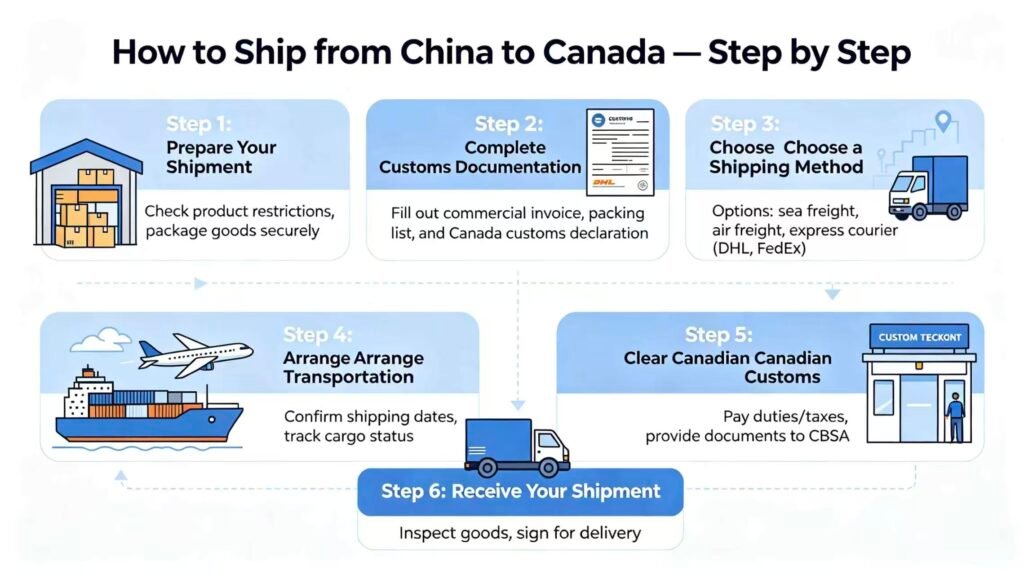
Step 1 — Classify Your Cargo (HS Code)
Determine your 10-digit Canadian tariff code using the Canada Customs Tariff Schedule. This determines your duty rate, reporting obligations, and import permit requirements.
Step 2 — Calculate Landed Cost
Calculate your full landed cost before committing:
- Freight cost
- Customs duties (value × MFN rate)
- 5% GST on (value + freight + duties)
- Provincial sales tax
- Customs brokerage fees
- Last-mile delivery
Step 3 — Choose Your Shipping Method
- Large volume / non-urgent → Sea freight FCL
- Smaller shipments → Sea freight LCL
- Time-sensitive / high-value → Air freight
- Small parcels / samples → Express courier
Step 4 — Select a Freight Forwarder
An experienced freight forwarder China to Canada handles: carrier booking, export customs clearance in China, documentation preparation, freight management, CBSA customs brokerage and CARM release, GST remittance, and last-mile delivery.
BAT Logistics brings 20 years of dangerous goods expertise to the Canada route, handling battery, chemical, and restricted cargo with full regulatory compliance.
Step 5 — Track, Clear, and Receive
Monitor via your forwarder’s tracking system. CBSA may select cargo for examination (1–3 day delay). Customs clearance takes 1–2 business days with complete documentation. Arrange final delivery once CBSA releases the cargo.
Shipping from China to Amazon FBA Canada — Key Points
Key requirements:
- FNSKU labels must be applied to all units
- Carton compliance — Amazon.ca enforces weight and dimension limits
- CARM requirements — FBA warehouses are commercial importers; CARM-compliant entries are required
- Provincial tax registration — PST/HST obligations may apply depending on provinces of sale
BAT Logistics handles Amazon FBA Canada shipments from China, including customs clearance, CARM releases, label preparation, and delivery to Amazon FCs (YYZ4, YVR2, YOW1, etc.).
BAT Logistics — Your Trusted China to Canada Freight Partner
Who We Are
BAT Logistics is a China-based freight forwarding company with 20 years of specialised dangerous goods transport experience and broad general freight capabilities on the China–Canada trade lane. As a recognized industry leader in China’s logistics sector, we partner with major airlines and shipping lines to ensure reliable cargo space and competitive rates on one of the world’s longest trade lanes.
Our Core Credentials:
- ✅ 20 years of dangerous goods transport expertise — Certified handling for lithium battery, chemical, and DG-classified cargo on air and sea
- ✅ Strategic carrier partnerships on China–Canada routes — Guaranteed space with major shipping lines and airlines
- ✅ CARM-compliant customs brokerage network — Fully licensed CBSA brokers handling all CARM releases, GST remittance, and compliance
- ✅ End-to-end service capability — From factory pickup in China to door delivery across Canada (Vancouver, Toronto, Montreal, Calgary, and beyond)
- ✅ Full landed cost transparency — Quoting duties, GST, and all charges upfront before you ship
- ✅ Licensed and bonded — Licensed Chinese freight forwarder with licensed Canadian customs broker partners
Why Importers Choose BAT Logistics:
Our Strength | Your Benefit |
|---|---|
20 years DG expertise | Correct handling of complex, regulated cargo |
Carrier partnerships | Guaranteed space — no last-minute cancellations |
CARM compliance expertise | Stress-free CBSA clearance with zero penalties |
Transparent landed cost | Know your total cost before your cargo ships |
Full-service offering | One contact from factory to door in Canada |
Shipping from China to Canada — Case Study
Client: A Vancouver-based outdoor equipment retailer importing camping gear, e-bike accessories, and portable power stations from suppliers in Shenzhen and Ningbo. Monthly import volume: 2–3 × 40ft containers.
Challenges:
- MFN duty burden — No FTA preferential rates; wanted expert HS code review to confirm accuracy
- CARM compliance confusion — Had been using a non-CARM-registered broker; concerned about compliance gaps
- Inland delivery costs — Most customers in Alberta and Saskatchewan; needed efficient Vancouver-to-inland routing
- Battery-containing products — Several SKUs contained lithium batteries; required proper DG documentation
- GST calculation errors — Had been incorrectly calculating provincial GST/HST; owed back-payments
The BAT Logistics Solution:
- HS code audit and duty review — BAT’s tariff specialists identified 3 misclassified items and recovered approximately $12,000 in duty overpayments
- CARM-compliant broker transition — Introduced a fully CARM-registered broker partner; all releases now submitted electronically
- Vancouver-to-inland routing optimization — CN Rail partnerships reduced last-mile costs by 18%
- Dangerous goods documentation — IATA-compliant documentation for all lithium battery SKUs; zero CBSA holds in 18 months
- GST and PST calculation review — Broker recalculated GST obligations and introduced PST deferment accounts for Alberta and Saskatchewan customers
Results:
Metric | Before BAT | After BAT |
|---|---|---|
Customs hold rate | 1 in 4 shipments | 0 |
Inland delivery cost | Baseline | -18% |
Duty overpayment recovered | — | ~$12,000 |
CARM compliance status | Non-compliant broker | Fully CARM-compliant |
CBSA DG holds | 2 per year | 0 |
Monthly import volume | 2–3 containers | 4–5 containers |
“We’d been importing from China for three years and had no idea our CARM setup was a problem until BAT pointed it out. Their Canadian broker network and landed cost transparency completely changed how we manage our supply chain.” — Operations Manager, Vancouver Outdoor Equipment Retailer
Frequently Asked Questions — Shipping from China to Canada
1. What is the cheapest way to ship from China to Canada?
Sea freight FCL (Full Container Load) is the most cost-effective option for most commercial shipments. LCL is suitable for smaller volumes. For shipments under 100 kg that are genuinely urgent, air freight or express courier becomes the practical choice.
2. How much does shipping from China to Canada cost in 2026?
Sea freight FCL (20ft) ranges from $1,800–$2,800 per container from Shanghai to Vancouver. LCL runs $50–$220 per CBM. Air freight is $6–$12 per kg. Express courier is $8–$10 per kg. All methods exclude Canadian import duties and 5% GST.
3. How long does shipping from China to Canada take?
Sea freight to Vancouver takes 13–22 days port-to-port (18–30 days door-to-door). Montreal and Toronto add 10–15 days by rail. Air freight is 5–10 days door-to-door. Express courier is 3–7 business days.
4. Does Canada charge GST on imports from China?
Yes. Canada charges a flat 5% GST on virtually all commercial imports from China. GST is calculated on the total of (customs value + freight + duties). Provincial sales taxes (PST/HST) may apply on top depending on the destination province.
5. Does Canada charge import duties on goods from China?
Yes. All goods from China are assessed at MFN (Most Favoured Nation) tariff rates. There is no preferential trade agreement with China. Duty rates range from 0% to 20%+ depending on product category and HS code.
6. What is CARM and how does it affect my imports from China?
CARM (CBSA Assessment and Revenue Management) is Canada's digital customs platform. All commercial importers must be CARM-registered or use a licensed CARM-registered customs broker. BAT Logistics' Canadian broker partners handle full CARM compliance.
7. Can I ship from China to Canada by DHL, FedEx, or UPS?
Yes. Express courier delivers in 3–7 business days. However, virtually all commercial express shipments exceed Canada's CAD $20 de minimis, triggering 5% GST. Express is best for small parcels, samples, and urgent documents.
8. What documents do I need to ship goods from China to Canada?
Commercial Invoice, Packing List, Bill of Lading (B/L) or Air Waybill (AWB), Certificate of Origin, and CBSA customs broker release (lodged through CARM). Products may require import permits (food, cosmetics, health products) and Canadian product certifications (CSA, IC, etc.).
9. What are the main Canadian ports for China imports?
Vancouver (Port of Vancouver) is the primary gateway — shortest transit time. Montreal handles eastbound cargo. Toronto is reached via inland rail from Vancouver or Montreal.
10. Can BAT Logistics handle dangerous goods shipping from China to Canada?
Absolutely. 20 years of dangerous goods transport is our core specialisation. BAT Logistics handles DG cargo — including lithium batteries, chemicals, and pressurised containers — on all transport modes to Canada with full IATA DGR and IMDG Code compliance.
Ready to Ship? Get a Quote from BAT Logistics
Shipping from China to Canada requires navigating MFN tariffs, CARM compliance, 5% GST, provincial taxes, and one of the longest ocean routes in global trade.
BAT Logistics combines 20 years of dangerous goods transport leadership with deep China–Canada trade lane expertise. Our carrier partnerships guarantee space. Our CARM-compliant broker network ensures smooth CBSA clearance. Our transparent landed cost quotes mean no surprises.
Contact BAT Logistics today for a free shipping consultation and all-inclusive Canada landed cost quote.